Why CRISPR Screening Matters for Precision Drug Development
From identifying druggable targets to streamlining clinical pipelines, CRISPR screening is reshaping precision medicine with unprecedented functional clarity.
Introduction: Are You Targeting the Right Genes?
Have you spent months validating drug targets, only to discover they don’t actually drive disease progression or drug resistance? You’re not alone—many drug discovery projects hit similar frustrating dead ends. Expression profiling (RNA-seq) often reveals potential targets but falls short in confirming functional causation. This disconnect is costly in both time and resources.
That’s why the drug discovery landscape is rapidly embracing CRISPR screening analysis—a data-driven approach that uncovers gene function at scale. Unlike methods reliant on correlation, CRISPR screens reveal causal roles directly, empowering teams to make confident decisions earlier in the development pipeline. Click here to learn how CRISPR screen analysis works in real-world drug development.
Why Functional Validation Outperforms Correlation
Here’s the reality many teams face: high expression doesn’t necessarily equate to high impact. A recent oncology project heavily invested in transcriptomics, chasing highly-expressed targets for months. However, these targets repeatedly failed in functional assays, ultimately derailing timelines. A subsequent CRISPR screen uncovered a gene with low expression but high functional relevance—completely transforming their therapeutic approach.
CRISPR screening offers this critical functional validation. Instead of relying on indirect markers, a CRISPR screen provides actionable data on gene necessity, dramatically increasing confidence before costly downstream validations.
Real Applications, Proven Impact
1. Fast-Tracking Resistance Mechanism Discovery
Challenge: Resistance to kinase inhibitors in lung cancer was poorly understood, causing major delays in clinical advancement.
CRISPR Approach: A genome-wide knockout screen conducted by Dana-Farber Cancer Institute swiftly identified novel resistance-mediating genes within weeks.
Impact: Immediate actionable targets emerged, refining drug development strategies and clinical trial designs.
2. Pinpointing Synthetic Lethal Interactions
Challenge: Identifying reliable gene pairs for combination therapies, crucial in precision oncology.
CRISPR Approach: Functional screens validated synthetic lethality between BRCA1 and PARP inhibition, now foundational in breast and ovarian cancer treatments.
Impact: Enabled rapid progression to clinical trials and combination therapy approvals.
3. Clarifying Immunotherapy Resistance Pathways
Challenge: Limited understanding of immunotherapy resistance severely restricted therapeutic innovation.
CRISPR Approach: A CRISPR-based pooled screen revealed critical genes suppressing T-cell infiltration, directly impacting CAR-T and immune checkpoint therapy strategies.
Impact: Accelerated development of combination treatments now entering clinical evaluation.
CRISPR Screening vs RNA-Seq: A User-Focused Comparison
| Application | CRISPR Screening | RNA-Seq |
|---|---|---|
| Gene causality | Direct | Indirect |
| Expression profiles | Limited | Excellent |
| Functional validation | Immediate | Requires follow-up |
Scalability | High | Medium |
| Predictive ROI | High | Moderate |
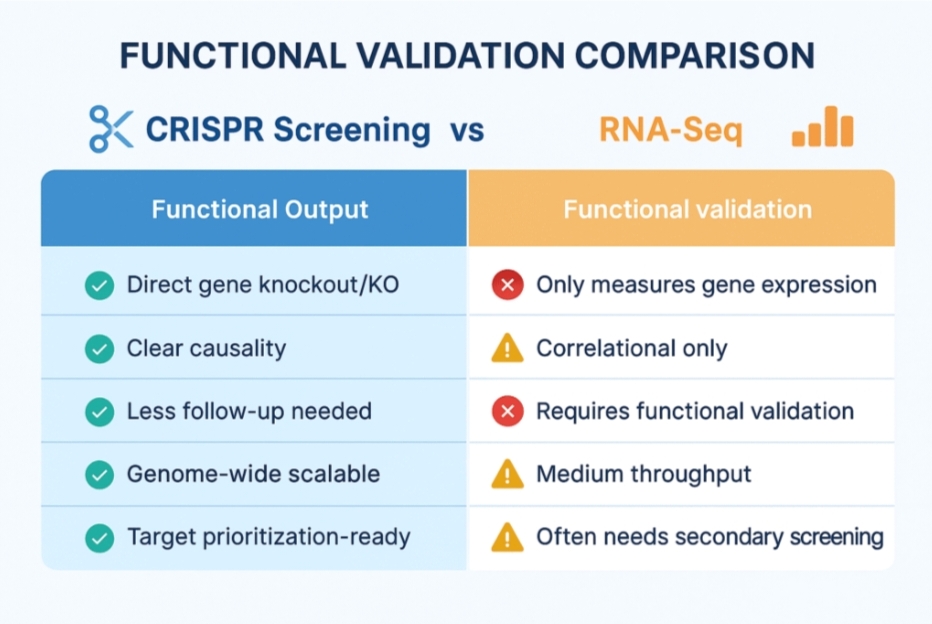
RNA-seq provides crucial correlative data. However, CRISPR screening bridges the gap from correlation to causation, significantly streamlining the discovery process.
From Hits to Mechanisms: Why Multi-Omics Integration Matters
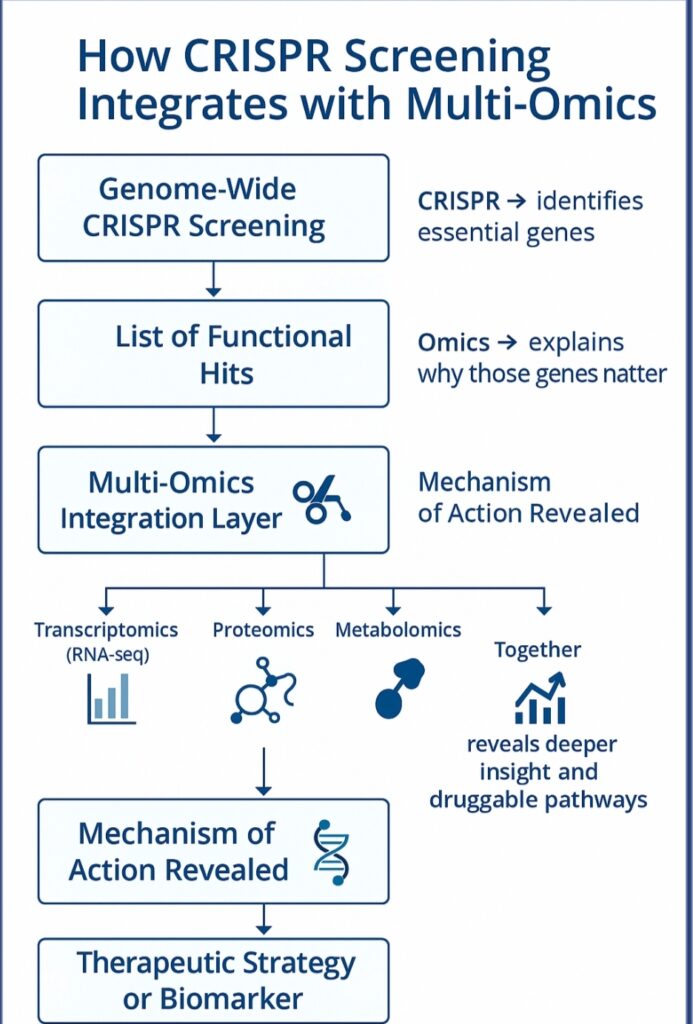
CRISPR screening gives you the “what.” But to fully understand the “why,” integrating additional omics layers—like transcriptomics, proteomics, or metabolomics—transforms functional hits into actionable insights.
For example, a screen might reveal Gene X is essential for resistance, but without transcriptomic or proteomic data, you won’t know whether its effects are mediated via signaling cascades, metabolic shifts, or transcriptional rewiring. This context is critical when designing targeted therapies or selecting biomarkers.
Best practices for integration include:
- Collecting RNA/protein data at multiple timepoints post-screen
- Including non-targeting gRNA controls for signal clarity
- Collaborating early with experienced bioinformatics teams
A 2023 Cell Reports study showed that combining genome-wide CRISPR screens with single-cell RNA-seq not only improved target discovery but also revealed immune evasion pathways, enabling biomarker and therapeutic strategy development in one go.
In short, CRISPR screening provides functional anchors—and multi-omics adds interpretive depth, bridging discovery to mechanism.
Avoiding Common Pitfalls (And Their Real Consequences)
| Mistake | Outcome | Consequence | Prevention |
|---|---|---|---|
| Poor viral packaging | Uneven transduction | Wasted months repeating experiments | Use high-titer lentivirus (≥10⁷ TU/ml) with QC |
| Too few replicates | Unreliable data | Difficulty validating hits | Minimum three replicates per condition |
| Undefined phenotype | Ambiguous results | Non-actionable data | Clearly measurable phenotypes (e.g., survival rate) |
| No validation plan | Unconfirmed hits | Reduced trust in results | Build in CRISPRi, rescue, or orthogonal follow-ups |
Economic Advantages of Functional Screening
The cost of a comprehensive CRISPR screen typically ranges around $20,000. However, studies published in Nature Reviews Drug Discovery (2022) indicate that functional validation via CRISPR screens can reduce subsequent failure rates by up to 50%, potentially saving millions in R&D expenditure.
The message is clear: the earlier you identify functional relevance, the greater your project’s success and ROI.
Choosing a CRISPR Screening Provider: Key Questions to Ask
Not all providers offer equal value. Before initiating a screen, ask:
- “Do you offer documented case studies?”
- “Is your viral packaging QC data transparent?”
- “What bioinformatics support and validation strategies do you include?”
If you’re looking for a trusted partner, click here to explore Ubigene’s gene editing service—from high-quality libraries to full validation workflows.
Recommended CRISPR Gene Editing Tools from Ubigene
Ubigene delivers validated CRISPR gene editing solutions that streamline your discovery:
- Human CRISPR KO Library v3.0
Covers over 19,000 human genes with industry-leading low off-target rates. - Custom Oncology-Focused CRISPRi Libraries
Target key oncogenic pathways for high-confidence validation. - Pre-validated Knockout Cell Lines (A549, HCT116, HeLa)
Save weeks of prep time and accelerate functional screening.
Quick FAQ: What Researchers Often Ask About CRISPR Screens
Q1: How long does a genome-wide CRISPR screen take?
Typically 4–8 weeks including culture, selection, sequencing, and initial analysis.
Q2: Can CRISPR screening be applied to primary or difficult cell types?
Yes, using optimized lentiviral systems or electroporation, even sensitive cell types can be screened effectively.
Final Thought: Act Sooner, Discover Faster
Don’t wait until your pipeline stalls due to inconclusive correlation data. Integrating a CRISPR-based functional screen early in the workflow can prevent costly missteps and accelerate your path to therapeutic impact.
When precision medicine demands certainty, functional validation isn’t optional—it’s essential. CRISPR screening isn’t just the future; it’s already transforming how modern drug discovery is done.