Checklist for Buying a Beverage Production Line
Checklist for Buying a Beverage Production Line
Purchasing a beverage production line is one of the most significant investments a company can make. From craft breweries to industrial-scale juice and soda producers, the right production line determines efficiency, quality, and profitability. But with so many options on the market, how do you ensure you are making the right choice?
A structured checklist helps businesses evaluate suppliers, avoid hidden costs, and align the investment with long-term goals. This article outlines a comprehensive checklist for buying a beverage production line, so you can invest with confidence.
Step 1: Define Your Beverage and Market Needs
The first step in the buying process is to clearly define what type of beverage you are producing and for which market.
- Beverage type: Beer, juice, soft drinks, kombucha, dairy alternatives, or functional drinks all require different equipment.
- Target market: Are you serving local craft enthusiasts, health-conscious niche consumers, or global mass markets?
- Volume expectations: Estimate daily, monthly, and annual production needs.
- Growth potential: Consider whether your production may double or triple in the next few years.
This clarity ensures you buy a line that suits both current requirements and future scalability.
Step 2: Choose the Right Scale of Production
The size of your production line depends on your business model.
- Small-scale lines: Ideal for startups and artisanal producers. Lower cost, flexible, but higher per-unit costs.
- Medium-scale lines: Good for regional distribution. Balanced automation and output.
- Large-scale lines: Designed for mass-market brands with nationwide or international distribution. Fully automated, highly efficient, but costly.
Scale determines not just the purchase price but also operational expenses and ROI.
Step 3: Evaluate Automation Levels
Automation improves efficiency, reduces labor costs, and enhances consistency. But the right level depends on your budget and workforce.
- Manual/Semi-automated: Lower upfront cost but labor-intensive. Suitable for small operations.
- Fully automated: High efficiency, reduced labor, consistent output. Higher initial cost but long-term savings.
- Smart systems: IoT-enabled equipment with real-time monitoring and predictive maintenance.
Consider where automation will bring the most value: filling, labeling, quality control, or packaging.
Step 4: Assess Equipment Quality and Materials
Beverage equipment must meet hygiene and durability standards.
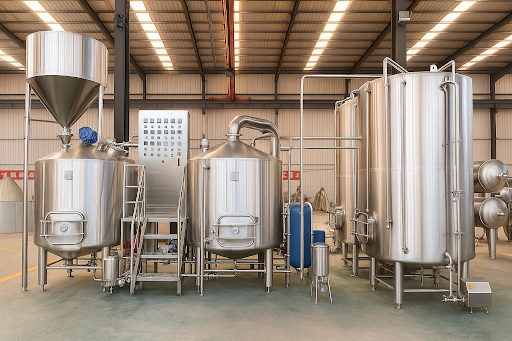
- Stainless steel: Industry standard for tanks and piping due to corrosion resistance and easy cleaning.
- Certifications: Ensure compliance with FDA, CE, or ISO standards.
- Build quality: Check welding, surface finishes, and ease of maintenance.
Buying cheap equipment may reduce upfront costs but could lead to expensive breakdowns or contamination risks later.
Step 5: Plan for Packaging and Labeling
Packaging is more than functionality—it communicates your brand identity.
- Containers: PET bottles, glass bottles, aluminum cans, cartons, or pouches.
- Labeling: High-speed applicators, shrink sleeves, or eco-friendly labels.
- Batch coding: Inkjet or laser coders for traceability.
- Secondary packaging: Boxes, shrink wraps, or crates for logistics.
Investing in the right packaging system ensures your products stand out on store shelves.
Step 6: Consider Sustainability and Efficiency
Consumers increasingly value sustainability, and energy costs are rising globally.
- Energy-efficient pasteurizers: Reduce water and electricity usage.
- Waste reduction systems: Prevent ingredient and packaging waste.
- Eco-friendly packaging: Recyclable or biodegradable options.
Sustainability investments not only save costs but also strengthen your brand reputation.
Step 7: Calculate Total Costs (Not Just Upfront Price)
A common mistake is focusing only on the purchase price. Instead, calculate the total cost of ownership:
- Purchase price: Machinery and installation.
- Facility adjustments: Plumbing, electrical, and space modifications.
- Maintenance and spare parts: Annual service contracts, parts replacement.
- Training: Staff education for operation and safety.
- Utility costs: Water, electricity, and CO₂ (for carbonated products).
- Downtime costs: Lost revenue during setup or breakdowns.
A realistic budget avoids surprises later.
Step 8: Evaluate Supplier Support and Reputation
Choosing a supplier is as important as choosing equipment.
- After-sales service: Availability of technicians, spare parts, and online support.
- Installation assistance: Does the supplier provide commissioning and training?
- References and case studies: Proof of experience in similar projects.
- Warranty terms: Coverage length and scope.
Suppliers with strong reputations ensure smoother operations and long-term reliability.
Step 9: Think About Scalability and Flexibility
Markets evolve quickly, and so should your production line.
- Modular systems: Allow you to expand capacity without replacing the entire line.
- Recipe flexibility: Equipment capable of producing multiple beverage types.
- Technology upgrades: Compatibility with future automation or software.
Flexibility is critical for businesses that anticipate growth or diversification.
Step 10: Plan Staff Training and Safety
Your production line is only as effective as the people operating it.
- Operational training: Ensure staff can run equipment efficiently.
- Maintenance skills: Basic troubleshooting reduces downtime.
- Safety compliance: Protects workers and meets regulatory requirements.
A well-trained team maximizes the value of your investment.
Step 11: Run ROI Calculations
Return on investment (ROI) is the ultimate metric to justify your purchase.
- Payback period: How long until you recover your investment?
- Labor savings: Automation reduces staff costs.
- Waste reduction: Precision systems minimize material loss.
- Increased capacity: Higher volumes mean more sales.
An ROI analysis ensures financial sustainability and helps secure funding if needed.
FAQs About Buying a Beverage Production Line
1. What’s the most important factor when buying a beverage production line?
There isn’t one single factor—it’s about balance. Product type, scale, budget, and supplier support all matter equally in making a successful investment.
2. How long does it take to install and start operating a production line?
Depending on complexity, installation and commissioning can take anywhere from a few weeks to several months. Large-scale, fully automated lines take longer.
3. Can one production line make different types of beverages?
Yes, modular systems can handle multiple products, but cleaning and sterilization are crucial to prevent cross-contamination. Large producers often prefer dedicated lines for efficiency.
Conclusion: Invest with Confidence
Buying a beverage production line is a complex decision that goes beyond upfront cost. A well-structured checklist ensures you account for every variable—from product type and scale to sustainability and supplier support. With careful planning, your investment will deliver consistent quality, operational efficiency, and strong ROI.
For businesses seeking reliable partners, Micet Group offers high-quality stainless steel beverage production equipment, from small-scale craft systems to fully automated industrial lines. With global expertise and tailored solutions, Micet Group helps brands succeed in the competitive beverage market.
👉 Learn more at https://www.micetgroup.com/ and discover how Micet Group can help you build the right production line for your business.
And for insights into optimizing performance with smart manufacturing solutions, resources like MicetCraft provide valuable guidance.