The Unlikely Protagonist in Blue Diamonds
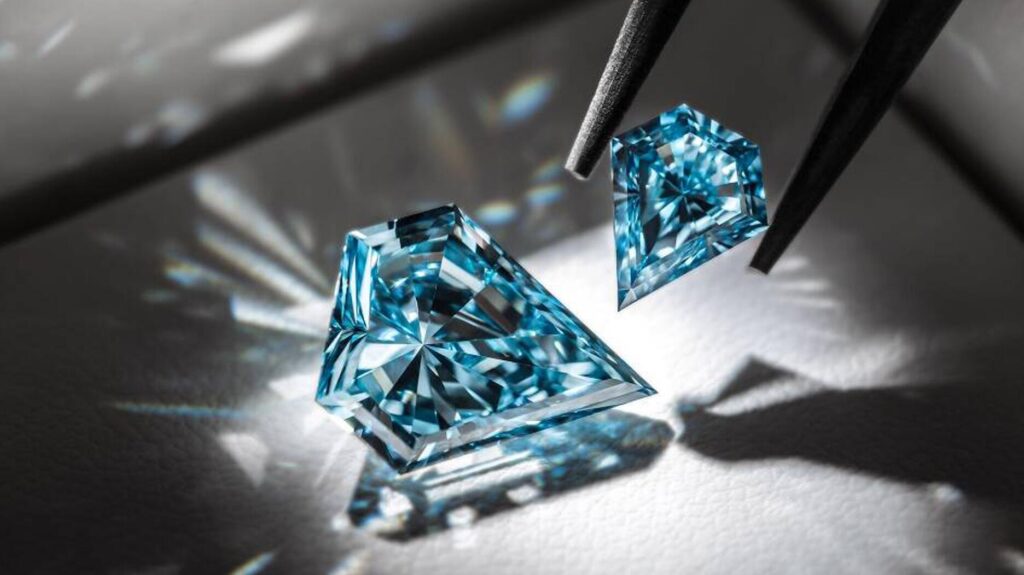
In the invisible realm of atomic structures, a microscopic miracle unfolds that transforms ordinary carbon into one of nature’s most coveted treasures. The story of blue diamonds begins not with mining or cutting, but with a single element’s elegant dance through crystal lattices—a performance so precise and beautiful that it literally changes the way light itself behaves. This is boron’s beautiful secret, and understanding it opens a window into the fundamental forces that create extraordinary beauty from the simplest building blocks of matter.
Boron, element number five on the periodic table, seems an unlikely protagonist in the blue diamond story. With just five protons and electrons, it’s a lightweight compared to carbon’s six, yet this slight difference creates profound effects. When boron atoms infiltrate the otherwise perfect carbon crystal structure of a diamond, they don’t simply occupy space—they revolutionize the entire optical character of the stone.
Birth in Earth’s Furnace
The process begins deep in the Earth’s mantle, where temperatures exceed 2,000 degrees Fahrenheit and pressures reach more than 725,000 pounds per square inch. Under these extreme conditions, carbon atoms arrange themselves in diamond’s characteristic tetrahedral structure, with each carbon atom bonded to four others in a three-dimensional network of incredible strength and regularity. This perfect arrangement normally allows diamonds to be colorless, as the uniform structure doesn’t interfere with white light passing through.
But when boron enters this crystalline ballroom, it performs a subversive dance. Boron has one fewer electron than carbon, creating what scientists call an “electron hole” in the crystal lattice. This deficiency might seem like a flaw, but it’s actually the source of the diamond’s extraordinary beauty.
The Poetry of Light Absorption
The optical physics behind this phenomenon reads like poetry written in wavelengths. When white light enters a boron-containing diamond, the electron holes preferentially absorb the red and orange portions of the spectrum. This selective absorption leaves the blue wavelengths free to travel through the crystal and reflect back to our eyes. The intensity of the blue depends on boron concentration—more boron atoms create deeper, more saturated blues, while trace amounts produce delicate, almost ethereal sky-blue tones.
What makes this process even more remarkable is its incredible sensitivity. Boron concentrations as low as one part per million can create detectable blue coloration. At higher concentrations—still measured in parts per million—diamonds can achieve the deep, royal blues that command millions of dollars at auction. This relationship between atomic-scale chemistry and macroscopic beauty demonstrates nature’s ability to create extraordinary effects through seemingly minor variations.
Nature’s Fingerprints
The distribution of boron within a diamond crystal adds another layer of complexity to the story. Boron doesn’t spread uniformly like ink in water. Instead, it often concentrates in specific growth zones, creating patterns that mirror the diamond’s formation history. Some blue diamonds display color zoning, where different areas of the stone show varying intensities of blue. These patterns serve as geological fingerprints, telling stories about changing conditions during the crystal’s billion-year formation process.
Modern gemological science has developed sophisticated methods to study boron’s role in diamond coloration. Spectroscopic analysis can detect and measure boron concentrations with extraordinary precision, while photoluminescence mapping reveals exactly where boron atoms reside within the crystal structure.
Geographic Signatures
The Cullinan Mine in South Africa, source of many famous blue diamonds, produces stones with specific boron characteristics that differ from those found in other locations. These differences reflect the unique geological conditions at each deposit, including the composition of source rocks and the particular chemical environment during diamond formation. Understanding these signatures helps both scientists and collectors appreciate the complex interplay between geology and gemology.
Laboratory-grown blue diamonds offer another perspective on boron’s role. By precisely controlling boron introduction during the synthetic diamond growth process, scientists can create blue diamonds with specific color intensities and distributions. This controlled environment has revealed new insights into how boron concentration affects not just color, but also other optical properties like fluorescence and conductivity.
The Semiconductor Secret
Interestingly, the same boron that creates beautiful blue coloration also makes blue diamonds semiconductors—the only diamonds with this electrical property. This dual nature as both gemstone and technological material highlights boron’s remarkable versatility. While jewelry applications focus on beauty, industrial researchers explore blue diamonds’ potential in electronics and quantum computing applications.
The cutting and polishing of blue diamonds requires special consideration of boron’s effects. The element doesn’t just influence color—it can also affect how the diamond responds to heat and pressure during processing. Experienced diamond cutters study each blue rough carefully, planning cuts that maximize both the stone’s color display and its overall light performance.
Environmental Sensitivity
Temperature changes can subtly affect how we perceive blue diamond color, as thermal energy influences the electron holes’ behavior. This means a blue diamond might appear slightly different in various environmental conditions, adding to their dynamic, living quality. Professional gem photographers must account for these variations when documenting blue diamonds, using controlled lighting and temperature conditions to ensure accurate color representation.
Future Discoveries
The future of blue diamond research continues to unlock new aspects of boron’s beautiful secret. Advanced imaging techniques now allow scientists to visualize individual boron atoms within diamond crystals, while quantum mechanical models predict new ways that boron might interact with other trace elements to create novel optical effects.
Understanding boron’s role transforms how we appreciate blue diamonds. Each stone represents not just geological rarity, but a masterpiece of atomic engineering where element five’s elegant dance with element six creates beauty that transcends simple chemical composition, reminding us that nature’s most spectacular achievements often emerge from the most fundamental interactions.