How Does Borescope Articulation Work?

Getting a borescope into an engine, turbine, pipe or cavity is one thing. Pointing the camera exactly where you need it is another. That’s where articulation comes in. On modern articulated borescopes, the tip can be steered from the handle so you can look around corners, behind components and back toward the entry point.
Understanding how that articulation works helps you use the tool more effectively, choose the right configuration and spot the difference between a light-duty gadget and a serious inspection instrument.
The basic idea behind articulated borescopes
At its core, borescope articulation is about converting your input at the handle into controlled bending at the distal end (the tip) of the probe. You move a knob, lever or joystick and, in response, the tip curves in a predictable direction and by a certain angle.
Three things are happening together:
- A control mechanism (knob, lever or joystick) is moved by the operator.
- Internal control elements (usually cables) transmit that movement down the insertion tube.
- A flexible tip section bends because those cables pull on it, changing its shape and the direction of view.
Do this smoothly and repeatably, and you have a powerful inspection tool that can “look” far beyond a simple straight-ahead view.
Inside the probe: cables, joints and the flexible section
Articulation cables
Most articulated borescopes use one or more high-strength control cables running along the length of the insertion tube. These cables are anchored at the distal end and connected to the control mechanism at the handle.
When you move the control:
- One cable is pulled (put under tension).
- The opposite cable is relaxed (tension is reduced).
That imbalance in tension makes the flexible tip bend toward the cable under tension.
The articulated segment
Near the tip, the probe has a dedicated flexible section made up of small interlocking segments, coils or links. This portion is engineered to:
- Bend in specific directions (2-way or 4-way)
- Maintain a smooth curve instead of kinking
- Protect the internal wiring and optics or camera
The rest of the insertion tube is often semi-rigid or flexible but not designed to bend sharply—only the articulated zone is meant to steer precisely.
2-way vs 4-way cable systems
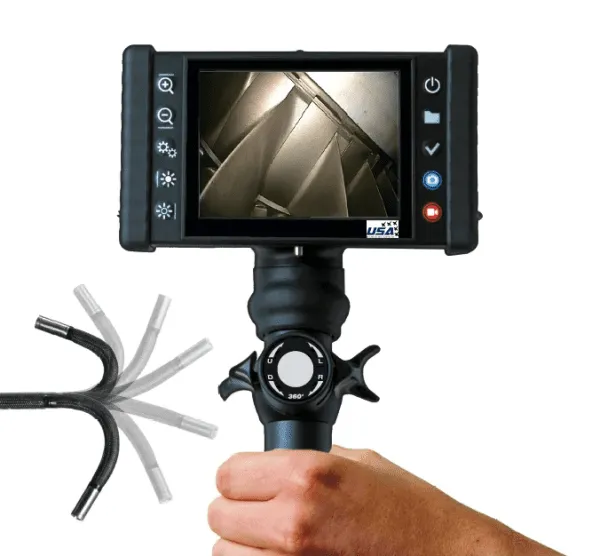
How 2-way articulation works
In a 2-way system, there are typically two main cables arranged opposite each other. When you move the control one way, one cable tightens and the tip bends “up”; move it the other way, the opposite cable tightens and the tip bends “down.”
This design is mechanically simpler and works well when you mainly need to look forwards and in one plane—up and down inside a cylinder, for example.
How 4-way articulation works
A 4-way system adds two more cables at 90° to the first pair. Now the tip can bend:
- Up and down (one cable pair)
- Left and right (the other cable pair)
Internally, the control mechanism coordinates cable tension so that when you move the joystick or control diagonally, multiple cables are adjusted at once, giving you smooth, combined movement in any direction. This lets you sweep around blades, welds, fittings and internal features without constantly repositioning the insertion point.
Joystick, knob and lever controls
Knob or wheel controls
Some borescopes use a rotating wheel or knob to control articulation. Turning the knob pulls one cable while paying out the opposite one. For 4-way articulation, there may be two knobs or a more complex linkage.
This style is precise but can require more hand movement and practice.
Joystick controls
On many video borescopes, articulation is controlled by a small joystick or thumbstick. Pushing the joystick forward, back, left or right changes the tension in the corresponding cables, so the tip follows the joystick movement.
This feels very natural:
- Push towards the area you want to see.
- Release to let the tip return towards neutral (on some models).
- Make fine adjustments with small joystick movements.
When inspectors talk about “joystick articulation,” they’re usually referring to this kind of control setup, where steering is handled by a thumb-operated stick rather than a knob or dial.
How articulation works in real inspections
Navigating complex geometries
Imagine you’re inspecting a turbine or engine:
- You insert the borescope through an existing access port.
- You advance the probe to a specific stage or component.
- You use articulation to:
- Turn the tip toward a blade root or trailing edge.
- Look behind a lip or around a corner.
- Sweep along surfaces to check for cracks, pitting or foreign object damage.
- Turn the tip toward a blade root or trailing edge.
Without articulation, you’d only ever see what was directly in front of the tip. With articulation, you can cover far more surface area from the same entry point, making inspections quicker and more complete—especially in industries like aviation, power generation and oil and gas, where internal visual access is limited but critical. These are the kinds of industries where articulated borescopes have become standard practice.
Holding and repeating positions
Better borescopes let you hold the tip at a chosen angle without constant pressure. This helps when:
- Capturing still images or video
- Comparing the same feature across multiple inspections
- Training new technicians to follow a repeatable inspection path
Some advanced systems also allow fine adjustment to “trim” the position so you can line up the exact angle you need for clear, repeatable documentation.
Why build quality and maintenance matter
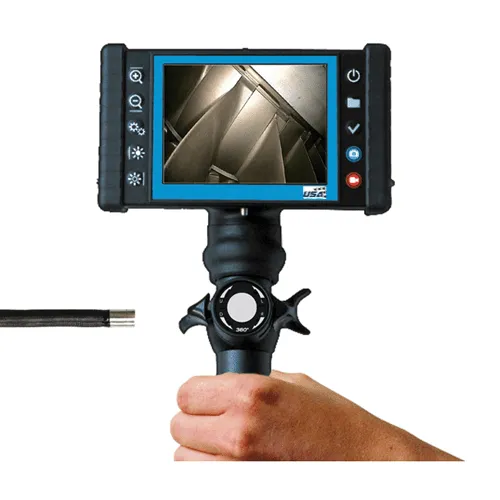
Because articulation relies on precise cable tension, flexible joints and smooth internal movement, build quality and ongoing care are crucial. Poorly designed or abused systems can develop:
- Slack or “play” in the tip
- Reduced bending range
- Jerky or unresponsive movement
Professional remote visual inspection providers back their equipment with inspection-focused support—evaluation, repair and maintenance—to keep articulation performing properly over time. For organisations that depend on frequent borescope work, leveraging specialist inspection services is often part of a sensible asset-care strategy.
Making articulation work for you
In practice, getting the most out of articulated borescopes is about combining:
- The right articulation type (2-way vs 4-way) for your assets
- A suitable control style (knob vs joystick) for your operators
- Proper training in how to navigate internal paths and angles consistently
- Good care, storage and maintenance habits
USA Borescopes focuses on remote visual inspection solutions and understands how articulation requirements differ between industries and applications. Their experience with engines, turbines, process equipment and structural inspections informs the way they guide customers on probe selection, articulation ranges and control options, as outlined on their About Us page.
If you’re evaluating articulated borescopes or looking to improve how your team uses them, it’s worth talking directly with a specialist who works with these systems every day. To get expert guidance on articulation, probe configurations and inspection best practices, contact USA Borescopes to discuss your needs.
About the Author
This guest post was written by a technical content writer specialising in inspection, maintenance and reliability-focused tools. They work with industrial equipment providers to turn complex engineering concepts into practical guidance that helps technicians, engineers and buyers choose and use inspection technology more confidently in demanding real-world environments.