Sociopath vs Psychopath: Distinctions in Behavior
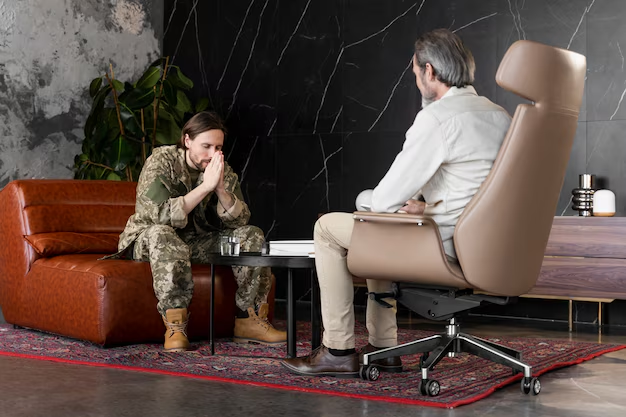
It’s common to hear the words “sociopath” and “psychopath” used interchangeably—especially in movies, crime shows, and social media. But in real mental health conversations, these labels can create confusion. Understanding the difference between sociopath and psychopath starts with knowing one key fact: neither term is a formal clinical diagnosis on its own. Most professionals diagnose Antisocial Personality Disorder (ASPD), while “psychopathy” is often discussed as a trait-based concept and “sociopathy” is usually a colloquial term.
That said, people still use these words to describe certain patterns—especially around empathy, emotional regulation, impulse control, and social behavior. This guide explains those patterns in a more accurate, responsible way.
First: What Do These Terms Usually Refer To?
In everyday language:
- “Sociopath” often refers to someone with antisocial traits shaped more by environment (unstable upbringing, chronic stress, trauma, neglect), where emotions may be present but poorly regulated.
- “Psychopath” often refers to a person with a stronger pattern of callousness, low empathy, shallow emotional responses, and more calculated behavior—sometimes linked to measurable personality traits.
Important: A person can show some traits without meeting criteria for ASPD, and you cannot diagnose someone based on behavior seen online or in a single situation.
Emotional Range and Empathy
One of the biggest differences people discuss is emotional responsiveness:
Psychopathy (as a trait pattern)
- Emotions may appear shallow or restricted
- Empathy can be low, especially emotional empathy (feeling what others feel)
- Some individuals can still understand emotions intellectually (often called cognitive empathy) and use that understanding in social interactions
Sociopathy (as commonly described)
- Emotions may be stronger, but less stable
- Reactions can be more reactive, hot-tempered, or unpredictable
- Relationships may be more chaotic due to emotional swings and trust issues
Reality check: It’s not accurate to say a “psychopath has no emotions at all.” Many people described this way may still experience emotions—just differently, and often with reduced guilt or emotional resonance.
Roots: Biology, Environment, and Development
People often frame the difference as “born vs made,” but real human behavior is rarely that simple.
- Traits associated with psychopathy are sometimes linked to biological and neurological factors, as well as temperament differences.
- Traits associated with sociopathy are often linked to environmental factors like trauma, inconsistent parenting, neglect, or exposure to violence.
Most experts agree it’s often a mix of genetics, brain development, and life experience—not one single cause.
Behavior Style: Impulsivity vs Planning
Both patterns can involve manipulation, rule-breaking, or harmful decisions, but how they show up can look different:
Sociopathy-style pattern
- More likely to be impulsive
- May act in the moment due to anger, fear, or frustration
- Struggles more with consistency (jobs, routines, stable relationships)
Psychopathy-style pattern
- More likely to be calculated
- Can appear calm under pressure
- May blend into social settings more easily because behavior is controlled and strategic
Social Functioning and “Blending In”
Another commonly discussed distinction is social stability:
- People described as sociopathic may have unstable relationships and frequent conflict due to reactivity and inconsistency.
- People described as psychopathic may appear charming, confident, and socially skilled—sometimes making harmful behavior harder to detect.
However, social success doesn’t automatically mean someone is dangerous, and social instability doesn’t automatically mean someone is violent. Labels are not risk assessments.
Manipulation and Deceit
Both patterns can involve manipulation, but the “style” may differ:
- Sociopathy-style manipulation may happen in emotional moments—reactive, defensive, or driven by insecurity.
- Psychopathy-style manipulation is often described as more strategic—planned responses aimed at control, advantage, or image management.
Still, manipulation can appear in many conditions and personality styles, not only antisocial traits.
Relationships and Attachment
- People described as “sociopaths” may form attachments, but relationships can be turbulent due to emotional instability and mistrust.
- People described as “psychopaths” may form relationships that are more transactional—based on benefit, status, or control—though this varies by individual.
Risk and Harm: A Careful Note
Not everyone with antisocial traits commits crimes or becomes violent. Many people with these traits live in society without obvious criminal behavior. Harm can be emotional, financial, relational, or psychological—not only physical.
If you feel unsafe around someone, focus on behavior and boundaries, not labels:
- document patterns (if needed)
- set firm limits
- seek professional support
- prioritize safety planning in high-risk situations
Treatment and Change Potential
Treatment can help, but it depends on the person’s motivation, insight, and the presence of co-occurring issues (substance use, trauma history, mood disorders).
- People described as “sociopathic” may sometimes respond better because emotions are present and change may feel more personally relevant.
- People described as “psychopathic” may show less emotional engagement in therapy, but behavioral interventions can still help reduce harm and improve functioning.
Therapy outcomes vary widely—so it’s best to avoid absolute claims like “they can’t change.”
Media Myths That Create Confusion
Entertainment often portrays “psychopaths” and “sociopaths” as violent masterminds. Real-world psychology is more nuanced. These portrayals can increase stigma and make people mislabel normal conflict or immaturity as something extreme.
Conclusion
The difference between sociopath and psychopath is usually discussed in terms of emotional regulation, empathy style, impulsivity, social stability, and possible developmental roots. But in real clinical care, professionals focus less on movie labels and more on patterns, functioning, safety, and diagnosis.
If you want clinically grounded guidance or support in navigating these concerns, resources may be available through Clear Mind Treatment,.