Small Business Bookkeeping Security and AI Implementation Roadmaps for SMEs
Small and medium-sized enterprises (SMEs) face increasing pressure to manage finances efficiently, protect sensitive business information, and adopt technology that improves productivity. As businesses grow, traditional bookkeeping processes can become time-consuming, difficult to scale, and vulnerable to human error. At the same time, artificial intelligence (AI) offers new opportunities to automate repetitive tasks, improve financial visibility, and support better decision-making.
However, successful digital transformation requires more than purchasing software or introducing automated tools. Business owners must evaluate security requirements, understand their operational needs, and develop a practical implementation roadmap. Combining secure bookkeeping practices with carefully planned AI adoption can help SMEs build more efficient, resilient, and scalable operations.
Why Bookkeeping Security Matters for Small Businesses
Bookkeeping systems contain some of the most sensitive information within a business. Financial statements, invoices, payroll records, supplier details, customer information, and bank transactions can all become targets for cybercriminals if appropriate safeguards are not in place.
Small businesses sometimes assume that their size makes them less attractive to attackers. In reality, limited IT resources and inconsistent security procedures can leave smaller organizations exposed to phishing attacks, unauthorized access, ransomware, and data theft.
Protecting financial information should therefore be a priority when selecting bookkeeping software. Business owners should assess how a platform handles authentication, data encryption, user permissions, backups, and security updates.
A structured bookkeeping software evaluation and security checklist can help organizations compare available solutions and identify important safeguards before committing to a new system.
Beyond technical controls, businesses should establish clear internal procedures. Employees need to understand how to handle financial documents, verify payment requests, recognize suspicious emails, and report unusual account activity. Regular reviews of user access can also prevent former employees or unnecessary accounts from retaining access to confidential records.
Choosing the Right Bookkeeping Software
Selecting bookkeeping software requires a careful assessment of business requirements rather than simply choosing the platform with the largest feature set.
A small business should begin by identifying its essential accounting activities, such as invoicing, expense tracking, bank reconciliation, payroll integration, tax reporting, and financial statement generation. The selected system should support these workflows without introducing unnecessary complexity.
Scalability is another important consideration. A platform that works well for a business with five employees may become less suitable when the organization expands into multiple locations, increases transaction volumes, or adds new revenue streams.
Integration capabilities also matter. Bookkeeping software should work effectively with existing banking services, payment processors, inventory platforms, customer relationship management systems, and other business applications where appropriate.
Before making a decision, companies should examine the total cost of ownership. Subscription fees, implementation expenses, staff training, additional integrations, and data migration can all affect the overall investment.
Finally, businesses should understand how they can export their records and recover their data if they change providers. Maintaining access to essential financial information reduces the risk of becoming overly dependent on a single software vendor.
The Role of Artificial Intelligence in SME Operations
Artificial intelligence is becoming increasingly useful for businesses that want to automate repetitive processes and extract insights from operational data. For SMEs, the most practical applications often involve improving existing workflows rather than replacing entire departments.
In bookkeeping, AI-powered tools can help categorize transactions, extract information from invoices, identify unusual expenses, and assist with bank reconciliation. Depending on the system, automation can also help generate financial summaries and highlight discrepancies that require further investigation.
These capabilities can reduce manual work and allow employees to focus on higher-value responsibilities. However, AI-generated results are not always accurate, and financial records should still be reviewed by qualified personnel.
Businesses must also consider confidentiality when using AI tools. Financial statements, payroll information, customer records, and other sensitive data should not be entered into unapproved systems. Organizations should understand how their chosen tools store information, process prompts, retain data, and manage access.
A responsible approach combines automation with human oversight, documented procedures, and clear accountability for financial decisions.
Developing an AI Implementation Roadmap
Successful AI adoption begins with identifying a specific business problem. Instead of introducing technology simply because it is popular, SMEs should determine where automation could deliver measurable improvements.
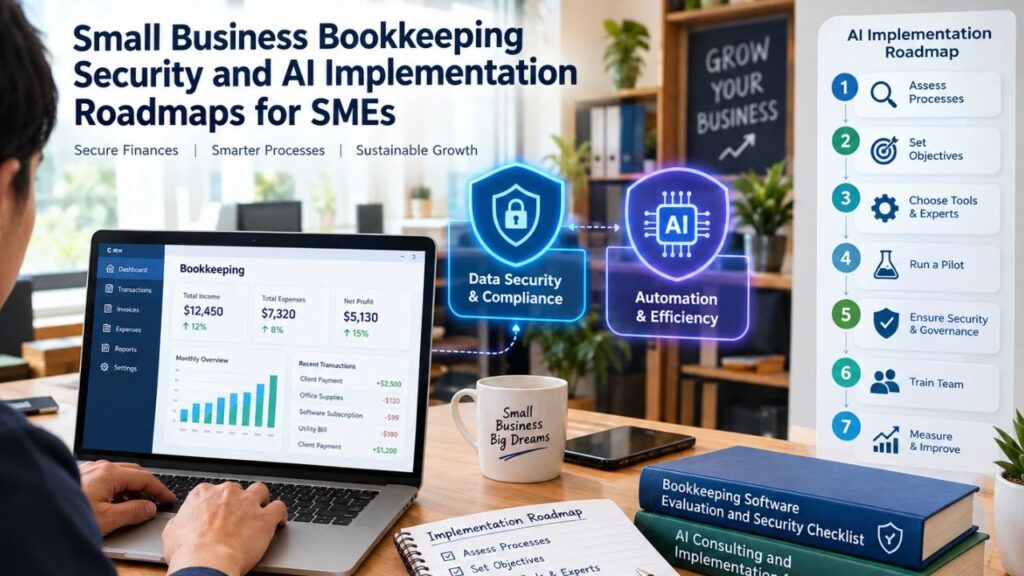
A structured implementation roadmap helps businesses manage costs, reduce disruption, and evaluate results before expanding their use of AI.
Step 1: Assess Existing Business Processes
Start by reviewing repetitive tasks, operational bottlenecks, and areas where employees spend excessive time handling information manually.
For example, a company might discover that its finance team spends several hours each week collecting receipts, matching transactions, and preparing routine reports. These activities may provide opportunities for automation.
Documenting existing workflows creates a baseline against which future improvements can be measured.
Step 2: Define Clear Objectives
Each AI initiative should have a specific purpose and measurable success criteria. Possible objectives include reducing invoice-processing time, improving data accuracy, shortening reporting cycles, or helping customer service teams respond more efficiently.
Businesses should also establish acceptable error rates, approval requirements, and conditions under which automated processes must be reviewed by a person.
Clear objectives prevent technology investments from becoming expensive experiments without practical outcomes.
Step 3: Select Appropriate Tools and Expertise
SMEs should compare AI solutions based on functionality, integration requirements, security, usability, and total cost. In some cases, existing software may already include automation features that can be activated without purchasing additional products.
Organizations with limited technical expertise may benefit from external guidance. Professional AI consulting and implementation for SMEs can help businesses identify suitable use cases, evaluate vendors, establish implementation priorities, and develop a realistic adoption strategy.
The right approach depends on the organization’s size, budget, existing technology, and regulatory obligations. Businesses should avoid adopting complex systems when a simpler solution can achieve the same objective.
Step 4: Run a Controlled Pilot
Before implementing AI across the organization, test the selected solution within a limited workflow.
For example, a business could use AI-assisted invoice extraction on a sample of documents while employees verify the extracted amounts, supplier details, and payment dates. The pilot should measure accuracy, processing time, exception rates, and employee feedback.
Testing under controlled conditions helps identify technical limitations and unexpected risks before the system affects important business operations.
Step 5: Establish Security and Governance Controls
AI implementation introduces questions about data access, accountability, and the reliability of automated outputs. Businesses should determine who can use each system, what information it can access, and which decisions require human approval.
Sensitive financial processes should have appropriate access restrictions, audit trails, backup procedures, and incident-response plans. Where AI systems connect to accounting platforms or other business applications, permissions should be limited to what the workflow actually requires.
Organizations should also establish rules for reviewing AI-generated information and correcting inaccurate results.
Step 6: Train Employees and Measure Results
Technology delivers value only when employees understand how to use it effectively. Training should explain the purpose of each tool, its limitations, approved data-handling practices, and the procedures for escalating problems.
After implementation, compare results with the original baseline. Useful indicators include time saved, error frequency, operating costs, processing speed, and employee adoption.
If the results do not justify the investment, businesses should adjust the workflow, improve training, or reconsider the tool before expanding its use.
Integrating AI With Secure Financial Systems
Bookkeeping and AI initiatives should not operate as completely separate technology projects. When carefully integrated, they can provide a more consistent view of business performance while reducing repetitive administrative work.
For example, an SME may use bookkeeping software as its primary financial record system and introduce AI-assisted tools to extract invoice details or summarize transaction trends. The accounting platform remains the authoritative source, while automation helps employees process information more efficiently.
This distinction is important because financial decisions often require accuracy, traceability, and reliable supporting evidence. AI should assist with appropriate tasks without silently changing accounting records or bypassing established approval procedures.
Integration should be tested carefully to prevent duplicate entries, incorrect classifications, and unauthorized data transfers. Businesses should also document how information moves between systems and how errors can be identified and corrected.
A phased approach is generally more manageable than attempting to automate every financial process at once.
Common Mistakes SMEs Should Avoid
Several common mistakes can undermine bookkeeping security and AI implementation efforts.
Choosing software based only on price: Low subscription costs may be attractive, but weak security, poor integration, or expensive upgrades can create greater long-term costs.
Automating inefficient processes: Introducing AI into a poorly designed workflow may simply make existing problems occur faster. Businesses should simplify and document processes before automating them.
Ignoring employee training: Without appropriate training, staff may misuse tools, overlook errors, or expose confidential information.
Relying on AI without verification: Automated classifications, summaries, and recommendations can contain mistakes. Important financial outputs require suitable checks and human accountability.
Failing to review security regularly: Business needs change over time. Permissions, integrations, backups, and vendor security practices should be reassessed periodically.
Avoiding these mistakes allows organizations to adopt technology more confidently while maintaining control over their financial operations.
Conclusion
Secure bookkeeping and responsible AI adoption can provide SMEs with a stronger foundation for sustainable growth. The right financial software improves visibility, protects important records, and supports consistent accounting processes. Meanwhile, a carefully planned AI roadmap can reduce repetitive work, improve operational efficiency, and help employees focus on more valuable activities.
The most effective strategy begins with clear business requirements, appropriate security controls, and measurable objectives. By evaluating software carefully, testing automation in controlled environments, training employees, and maintaining human oversight, small businesses can modernize their operations without taking unnecessary risks.
Ultimately, successful digital transformation is not about adopting every new technology. It is about selecting practical tools that solve real problems, protect business information, and deliver measurable value as the organization grows.