Why DevOps Success Depends on Recovery and Reliability, Not Just Faster Releases
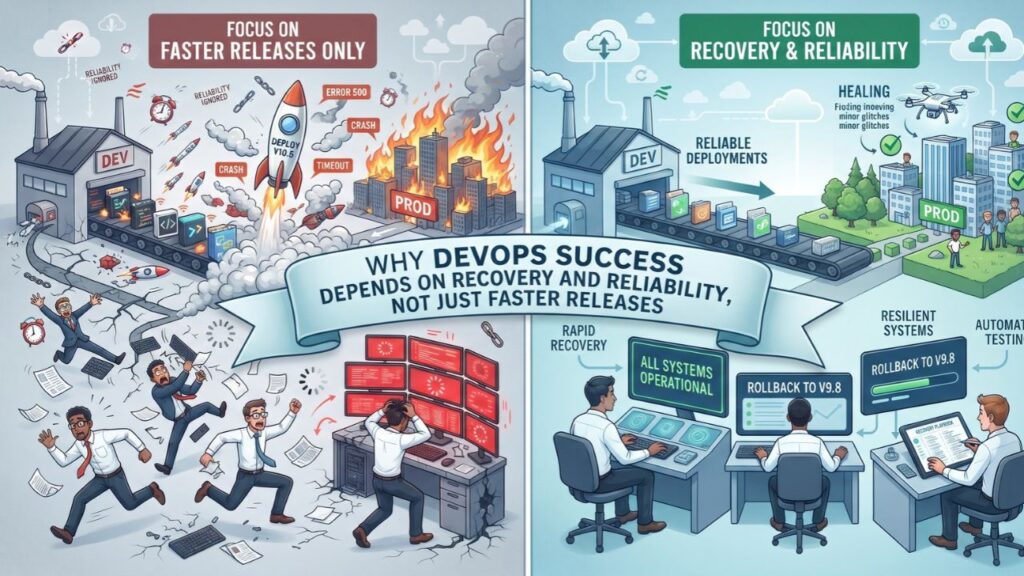
Release frequency has become one of the most visible indicators of DevOps maturity, and many engineering teams track it closely. A high deployment count suggests an efficient pipeline, so it often features prominently in management reports. However, the number reveals little about what happens when a release fails in production. A faulty change can interrupt checkout, corrupt inventory records, or take a customer portal offline, and the speed at which it shipped offers no protection against that impact. Delivery performance should therefore be judged by how safely changes reach users and how quickly service returns when something goes wrong.
Faster delivery does not have to come at the cost of reliability. McKinsey’s 2020 Developer Velocity research found that companies in the top quartile of its Developer Velocity Index recorded revenue growth four to five times faster than those in the bottom quartile during 2014–2018. The research examined broader factors, including developer tools, working practices and organisational support; it did not establish that release automation alone caused the difference. For engineering teams, the practical lesson is to improve delivery speed without overlooking testing, monitoring and recovery. Experienced DevOps service providers can help establish these practices, with progress measured through release reliability and service restoration.
Why Deployment Frequency Alone Is an Incomplete Measure
Deployment frequency records how often code reaches production, yet it does not indicate whether those deployments succeed. A team can release every day and still spend much of each week repairing the changes it shipped. For this reason, frequency is best read alongside three further measures, which together describe both speed and stability.
- Deployment frequency shows how often changes reach production.
- Lead time for changes shows how long a committed change takes to reach users.
- Change failure rate shows the share of releases that lead to an incident or require a fix.
- Time to restore service shows how long users are affected when a failure occurs.
The first two measures describe speed, while the last two describe stability. Reading them together prevents a team from improving one at the expense of the other. A team with moderate release frequency, a low failure rate, and fast recovery may therefore serve customers better than a team that ships constantly but disrupts production often. In addition, the last two measures translate directly into business terms, since failure rate affects support effort and customer trust, while recovery time determines how long transactions stay interrupted.
How DevOps Practices Reduce Deployment Risk and Limit Disruption
Reliable delivery rests on three layers of protection. Each layer addresses a different stage of a release, so the combined effect is stronger than that of any single tool.
Pipelines, Automated Testing and Release Validation
CI/CD pipelines replace manual handovers with a consistent and repeatable process. Every code change moves through the same sequence of automated stages, so the outcome no longer depends on who performs the release. DevOps development services typically cover the design of this process, including the following elements.
- Automated builds that compile and package the application on every commit.
- Automated unit and integration tests that run alongside each build.
- Release validation on a staging environment, such as smoke tests and configuration checks, to confirm that the build behaves as expected in conditions close to production.
- Controlled promotion of a build to production only after the earlier stages pass.
- Automated deployment scripts that remove manual file transfers and reduce the risk of missing or mismatched files.
Because each stage acts as a checkpoint, most defects surface before customers encounter them. Release validation adds a final check that the deployment itself, and not only the code, works in the target environment.
Observability and Incident Detection
Testing cannot reproduce every condition found in production, so teams also need visibility into live behavior. Monitoring tracks known signals such as error rates, response times, and server load. Observability goes further by combining logs, metrics, and traces, which lets engineers investigate why a service behaves unexpectedly. Alerts linked to user-facing symptoms then shorten the interval between a fault and the team’s response.
Rollback Strategies and Automated Recovery
Detecting a fault is useful only if the team can then restore normal service quickly. The most direct safeguard is a rollback, which means redeploying the last version that worked correctly so that users are affected for as short a time as possible. Two release techniques reduce the risk further.
- Blue-green deployment: The new version runs in a separate environment next to the live one, and traffic moves across only after the new version is confirmed to work. If a problem appears, traffic can switch back immediately.
- Canary release: The new version first reaches a small group of users, so any fault affects only that group before the rollout is paused or reversed.
Automated recovery adds a final layer. Health checks continuously test running services and can restart a failing service or stop a rollout without waiting for an engineer to step in.
Real-World Example: How CI/CD Automation Improved Release Control
An Ottawa-based recycling firm providing environmentally friendly scrap recycling and automobile salvage services faced operational hurdles in managing its growing business data. Relying on manual updates and static Google Sheets to track employee engagement and inventory activities slowed down operational tracking and restricted business visibility. The release process added to the problem. Releases were handled manually, took considerable time, and depended on specific individuals. Missing a file during a release was a constant worry, and when a build failed on staging or production, reverting it took too long.
The firm brought in a development partner offering DevOps development services to build a custom solution using Laravel 7 and Flutter on a cloud setup, with mobile applications for both Android and iOS. Alongside the build, the team set up CI/CD so that code went out in small batches, and each batch passed automated unit tests before release.
The change showed up in everyday releases.
- Builds could be uploaded to staging or production servers within a few minutes, without manual intervention.
- Automated deployments reduced the risk of missing files and allowed any team member to deploy the build.
- When a problem occurred in staging or production, reverting the build became easier and faster.
- Defect leakage into production decreased by 25% as build frequency increased.
- CI/CD improved business visibility, increased productivity, and simplified business procedures.
The new pipeline reduced reliance on manual deployment and made releases easier to manage, while faster rollbacks helped the team respond to problems with less disruption.
Practical Steps to Build a More Reliable Delivery Process
Improving reliability does not require rebuilding the entire pipeline. Most teams make progress by adopting a few practices.
- Measure recovery alongside frequency. Report change failure rate and time to restore service on the same dashboard as deployment frequency, so that rising release counts cannot mask rising failures.
- Release in small batches. Smaller changes are easier to test and to isolate, and they are simpler to reverse when a release must be withdrawn.
- Separate deployment from release with feature flags: Code can reach production with a new feature switched off, so a faulty feature can be disabled quickly without redeploying the application.
- Alert on customer impact: Base alerts on failed transactions, slow responses, and error spikes, because these signals reflect what users actually experience.
- Rehearse rollbacks: Run the rollback procedure on staging at regular intervals and document it, so that any engineer can perform it during an incident.
- Bring in specialist support where needed: Teams with limited in-house experience can use DevOps development services to set up the pipeline, test suites, and monitoring in a planned order.
Reliability Turns Faster Releases Into Business Value
Fast releases remain valuable because they help teams respond to user needs and market change. Their value, however, depends on how reliably each release performs and how quickly a failure is resolved. Tested pipelines, early detection, and dependable rollback keep applications available, and availability in turn protects business continuity. Engineering performance, customer experience, and operational resilience are therefore closely linked, since a weakness in recovery quickly becomes a poor experience for customers. Evaluating DevOps service providers on recovery capability, and not release speed alone, helps organizations build delivery processes that the business can depend on.