Shooting the Moon: Understanding High-Reward Tactics in the Hearts Card Game
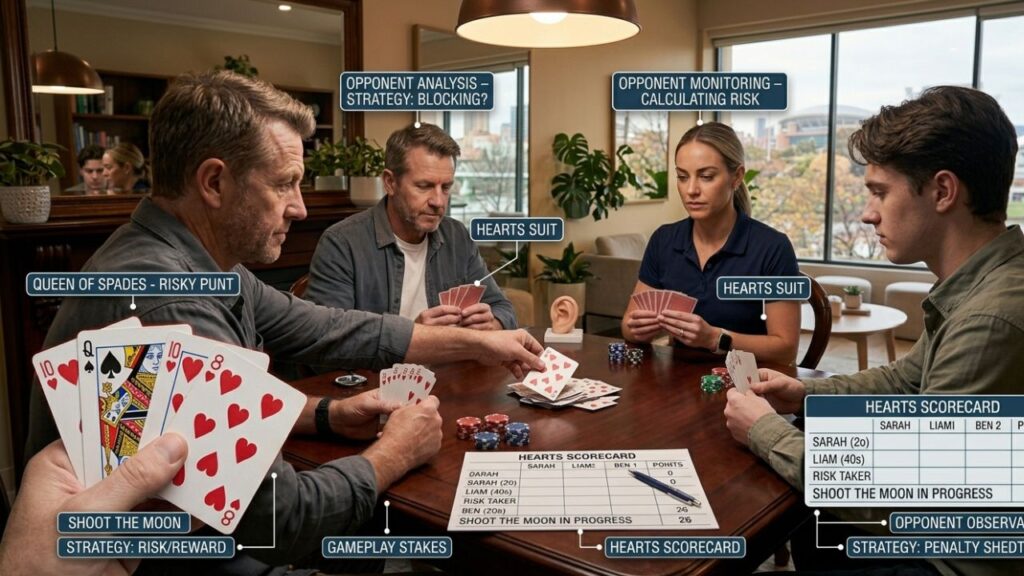
The hearts card game is usually taught as a game of avoidance, where players try to collect as few points as possible. But one of its most dramatic tactics asks for the exact opposite. Shooting the moon means deliberately taking every heart plus the queen of spades, turning a normally defensive game into a high-risk offensive play. That reversal is what makes the tactic so strategically fascinating.
Why is shooting the moon considered the boldest tactic in Hearts?
Shooting the moon is the boldest tactic in Hearts because it flips the game’s normal objective. Instead of avoiding penalty cards, the player tries to capture all of them. The reward can be substantial, but failure usually leaves the player with a punishing score, making the tactic a calculated gamble rather than a flashy shortcut.
In standard Hearts, caution is rewarded. Players spend most rounds trying to dodge hearts and avoid the queen of spades. Shooting the moon changes that logic completely. The player commits to taking all 26 penalty points in one round, usually causing those points to be added to every opponent instead of to themselves. That means the tactic is not just aggressive. It is structurally disruptive. One successful moon shot can alter the entire scoreboard and force every other player to change pace.
What makes it so difficult is that the tactic requires control from beginning to end. A player needs enough high cards to dominate key suits, enough timing to keep control when needed, and enough awareness to prevent opponents from “bleeding off” a single heart at the wrong moment. In other words, it is not only about having a strong hand. It is about having a hand that can stay strong under pressure.
This is part of why Hearts remain strategically rich. The game rewards players who can stay focused inside one evolving problem rather than jumping between goals. That kind of sustained concentration matters more broadly too. The American Psychological Association notes that mental switching can cost as much as 40% of productive time, which helps explain why games built on continuous awareness feel so mentally demanding.
How do players know when a moon shot is actually worth attempting?
A moon shot is worth attempting only when the hand offers unusual control, not just unusual strength. Players should look for dominant high cards, likely control of lead position, and a low chance that opponents can escape with a single penalty card. Timing and structure matter more than optimism.
The biggest mistake beginners make is confusing a strong hand with a moon-shot hand. A handful of face cards can look powerful, but that does not guarantee the control needed to capture every penalty card. The better question is whether the hand gives the player a way to manage tempo across multiple suits. Can they take the lead when they need it? Can they keep opponents from sloughing a heart onto a safe trick? Can they control spades well enough to secure the queen?
Good moon-shot opportunities usually contain depth, not just force. Multiple high cards in several suits are useful, but so is a distribution that prevents the player from losing control too early. If the hand is too uneven, one forced loss can destroy the attempt immediately.
Awareness matters as much as courage here. Hearts is a game where one wrong read can undo an entire plan. That links to the broader cognitive demands of structured play. A 2023 study involving 181 older adults found that puzzle gamers showed stronger working-memory capacity and distraction resistance, with some outcomes approaching those of younger adults. That was not a Hearts study, but it supports the larger point that games requiring sustained attention and flexible updating draw on meaningful mental skills.
Why does timing matter as much as card strength during a moon shot?
Timing matters as much as card strength because a moon shot depends on controlling not just what you win, but when you win it. Even a powerful hand can fail if the player takes tricks in the wrong order, loses the lead too early, or gives opponents a safe chance to discard danger.
A successful moon shot is rarely a straight march from high card to high card. It is more often a carefully managed sequence. The player must decide when to pull control cards, when to delay a certain suit, and when to force hearts into active play. A mistimed trick can leave an opponent just enough room to dump one penalty card and ruin the whole attempt.
This is why experienced players treat moon shots as sequencing problems. The order of events matters. Sometimes the player must hold back strength temporarily so the table develops in a more favorable way. At other times, they must act early before opponents recognize the threat and start defending against it.
That sequencing pressure is part of what makes Hearts so strategic online. Digital play removes setup friction, but it does not remove the need for judgment. If anything, it makes timing errors more visible because the player can study exactly where control slipped away.
How do opponents usually defend against a player trying to shoot the moon?
Opponents defend a moon shot by disrupting control. Their goal is not necessarily to win the round, but to force the shooter to miss just one penalty card. They do this by breaking suit patterns, protecting low exits, and recognizing the attempt early enough to stop feeding the player easy tricks.
Once opponents suspect a moon shot, the round changes immediately. Cooperation becomes more likely, even among otherwise competing players, because everyone benefits from stopping the attempt. They may hold back dangerous cards, refuse to dump hearts into obvious traps, or deliberately force awkward leads that break the shooter’s rhythm.
This is what makes moon shooting such a public tactic. It starts as a hidden plan, but once it becomes visible, the table turns against it. That means the shooter must not only manage cards but also manage suspicion. If the attempt becomes obvious too soon, defenders get more time to adjust.
The tactic therefore depends on a narrow window between opportunity and detection. Strong players understand that once the table starts resisting, the moon shot may no longer be the best option. In some rounds, the smartest move is abandoning the plan before the damage becomes permanent.
What does shooting the moon teach about risk and strategic judgment?
Shooting the moon teaches that high reward only makes sense when the structure justifies the risk. The tactic rewards players who can evaluate probability, stay disciplined under pressure, and abandon a failing plan before it becomes costly. It is a lesson in judgment, not bravado.
The deeper value of the tactic is that it teaches restraint inside ambition. A player may want the dramatic score swing, but wanting it is not enough. The hand must support it. The table must allow it. And the player must stay honest about when conditions have changed.
That kind of judgment is useful beyond cards. The CDC says adults should get at least 7 hours of sleep each day, and its Chronic Disease Indicators note that 35% of U.S. adults reported insufficient sleep duration in 2020. Insufficient sleep is associated with reduced functioning and increased errors, which is a reminder that good decision-making depends heavily on attention and self-control.
In Hearts, moon shooting is the clearest example of risk with a real downside. It can transform a game, but only when the player reads the situation correctly. That is why the tactic remains so compelling. It is not reckless when done well. It is a disciplined bet on control, timing, and probability.
Why does this tactic keep the Hearts card game strategically fresh?
Shooting the moon keeps Hearts strategically fresh because it prevents the game from becoming purely defensive. It introduces a credible offensive threat that forces every player to stay alert. Even when no one attempts it, the possibility changes how strong hands, risk, and tempo are interpreted throughout the round.
Without moon shooting, Hearts would still be strategic, but it would be narrower. The tactic expands the game’s range by making total control a live possibility. Players cannot think only about avoidance. They must also watch for moments when another player may pivot toward domination.
That threat keeps the table honest. It makes every strong hand more ambiguous and every early trick more revealing. A player who takes control may simply be managing danger, or they may be building toward a moon shot. That uncertainty is part of the game’s depth.
In the end, shooting the moon is memorable because it captures what makes Hearts last: a simple ruleset that still allows bold, intelligent, high-stakes decisions. It is not the tactic players should force often. But when the hand is right and the timing holds, it remains one of the sharpest strategic plays in the game.