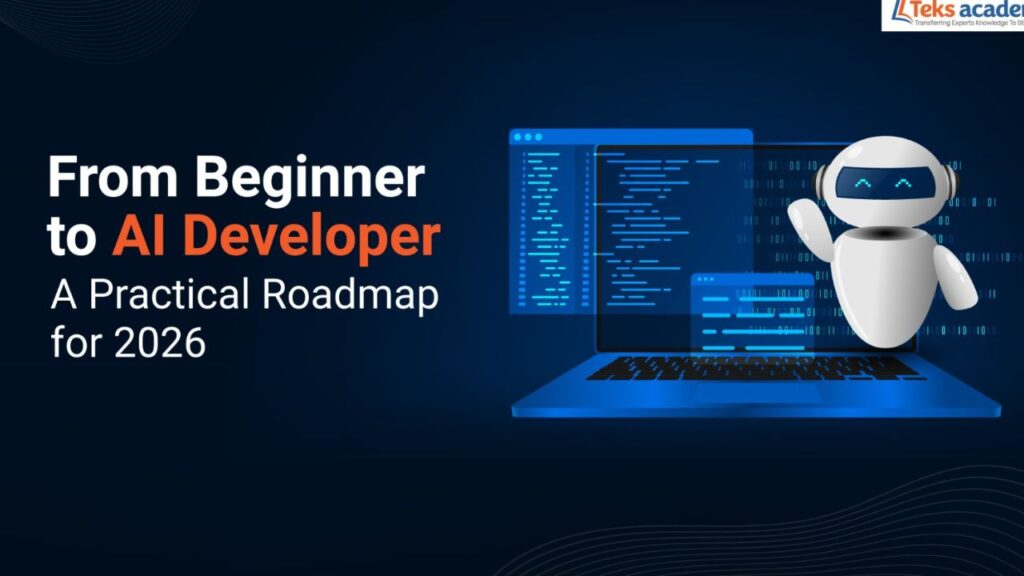
From Beginner to AI Developer: A Practical Roadmap for 2026
A year ago, I didn’t know what a variable was. Today I’m deploying LLM-powered apps. Here’s the honest, structured roadmap that got me there and how you can walk it too.
Let me be direct with you: the internet is full of AI developer roadmaps that feel written for people who already know how to code. This one is not. I’m writing this because twelve months ago, I was a marketing manager who wanted to understand AI, not just use it. The journey from “What is Python?” Building a functioning LLM app was messier, more exciting, and more achievable than I ever expected.
The good news? 2026 is genuinely the best time in history to start this journey. The tools are mature, the learning resources are extensive, and companies are desperate for people who can bridge the gap between business problems and AI solutions. What you need is the right sequence, not the fastest one – the right on
Phase 1 – Build a real Python foundation
Most beginners make the mistake of jumping straight into AI frameworks before learning to write proper Python code. I made this exact mistake. I spent two weeks trying to understand LangChain before I properly understood what a function, or list comprehension, was. Don’t do that.
Start with a Python course for beginners that covers the actual fundamentals: variables, data types, loops, functions, error handling, and working with files. These are not boring prerequisites — they’re the grammar of everything you’ll do later. When an API returns a JSON If you don’t know how to loop through the object, you’re stuck. And if you don’t know how to loop through it, you’re stuck. When an LLM throws a timeout error and you haven’t learned exception handling, you’re lost.
Spend 6–8 weeks learning the basics and practicing at the same time. Work on small projects like a to-do app, a web scraper, or a file renaming tool. They might feel simple, but they’re important for building your foundation.
Phase 2 – Go full-stack before you go AI
This is a step many learners tend to skip, yet it plays a crucial role in their growth. It often marks the difference between developers who can build real-world applications and those who are limited to running code in notebooks.
A full-stack Python course helps you understand how web systems work, including HTTP requests, databases, APIs, and backend–frontend communication.
You don’t need to become an expert in all of this. But you need to understand enough to build a working web application. Why? Because almost every LLM-powered product you’ll build lives inside a web app. A chatbot needs a front end. A document summarizer needs a way to upload files. A recommendation engine needs somewhere to store user history. Without full-stack knowledge, your AI features lack a suitable environment.
Python frameworks like Flask or FastAPI are excellent starting points here. FastAPI has become the go-to for building AI backends because it’s fast, modern, and pairs beautifully with async LLM calls. By the end of this phase, you should be able to build a working API that accepts user input and returns a response. That’s the core of almost every AI app.
Phase 3 – Enter the world of LLMs
Now—and only now—you’re ready to seriously work with large language models. Not because you need permission, but because everything you’ve built up to this point makes LLM development dramatically less frustrating.
1. Learn the Anthropic or OpenAI SDK
Start by working directly with an LLM API—without using any frameworks. This helps you understand key concepts like tokens, system prompts, message history, and temperature settings in a practical way.
2. Master prompt engineering
The quality of your output depends enormously on how you write your prompts. Learn few-shot prompting, chain-of-thought, and role-based instructions before moving on.
3. Build with RAG (Retrieval-Augmented Generation)
In real-world applications, AI systems often need to use custom data. RAG helps LLMs answer questions using your own documents. This is where you should learn about embedding and vector databases.
4. Deploy something real
Put your app on Railway, Render, or Fly.io. Until it’s live and accessible to others, it’s a prototype. Deployment is where real learning happens.
The mindset that actually matters
I want to be honest about something: this path takes time. Not years, but genuine months of consistent effort. The people who succeed aren’t always the fastest learners — they’re the ones who build something every single week, even when it’s small.
The market for Python developers who understand LLMs is enormous right now. Companies are no longer just hiring ML engineers with PhD-level credentials. They need developers who can take a business problem, translate it into a prompt, wire it into an app, and ship it. That’s a learnable, practicable skill set — and it starts with writing your first Python function.
You don’t need a computer science degree. You don’t need to understand transformer architecture. You need a clear roadmap, discipline to follow it, and curiosity to keep experimenting until things work.
That’s the job. Start today.