Effective Cybersecurity Training for Employees

Effective Cybersecurity Training for Employees
Effective cybersecurity training for employees does more than just tick a compliance box; it arms your team with the skills and awareness to spot, flag, and stop cyber threats before they cause damage. A well-trained team transforms from a potential vulnerability into your most powerful first line of defence. This guide will walk you through why this training is critical and how to build a program that delivers real results.
At Tbourke Solutions, we specialise in creating and implementing customised cybersecurity training programs. We help businesses like yours build a resilient ‘human firewall’ by delivering practical, engaging content tailored to your specific risks and team roles.
Why Employee Training Is Your Strongest Defence
You can spend a fortune on the latest security software, but your best investment will always be in your people. For most small and medium enterprises (SMEs), a single mistake by an untrained employee is the most common way a devastating breach begins. This isn’t about pointing fingers; it’s about empowerment.
When your team understands why certain security rules exist, they stop being obstacles and start becoming second nature. This mindset shift is vital. The cost of a breach goes far beyond the initial financial hit; it can shatter your reputation, erode customer trust, and even lead to hefty regulatory fines.
Building Your Human Firewall
Think of your team as a ‘human firewall’—an active, thinking layer of security. When they’re properly trained, your staff can catch suspicious activity that even the most sophisticated automated systems might miss. They become proactive, not just reactive.
Let’s look at a classic real-world example. An accounts team member gets an email, seemingly from a regular supplier, with an urgent request to change the bank details for an invoice that’s due. An untrained employee, under pressure, might just make the change and process the payment.
But a trained employee would immediately see red flags. They’d know to:
- Pause and think. The urgency is a classic social engineering tactic.
- Verify independently. They’d pick up the phone and call their known contact at the supplier to confirm the request, rather than replying to the email.
- Report it. They would flag the email to their manager or the IT department as a likely business email compromise (BEC) attempt.
That one simple, trained response can prevent a massive financial loss before it even has a chance to happen.
The Growing Need for Training in Australia
Here in Australia, the conversation around cybersecurity training for employees has never been more urgent. We’ve all seen the headlines about major incidents like the Medibank breach, which affected a staggering 9.7 million people. These events serve as a stark reminder that security lapses at any level can have massive consequences. It’s no surprise that more Australian businesses are now rightfully dedicating more time and budget to getting this right.
A security-aware culture doesn’t happen by accident. It’s built through consistent, relevant training that makes cybersecurity a shared responsibility, not just an IT problem.
At Tbourke Solutions, we specialise in creating customised training programs that build that crucial cultural shift. We go beyond the generic, off-the-shelf modules to deliver training that actually makes sense for your team’s day-to-day roles and the specific risks you face. By making security practical and relatable, we help you build that resilient human firewall.
For more practical advice on this topic, have a look at our guide on https://tbourke-solutions.com.au/how-to-prevent-data-breaches/.
Designing a Training Program That Resonates
Let’s be honest: generic, off-the-shelf cybersecurity training is a waste of everyone’s time. If you want to create a program that genuinely changes how your team behaves, you need to go beyond just ticking a compliance box. The goal is to build an experience that’s relevant, engaging, and directly tackles the real threats your business faces every day.
The starting point is always a practical needs assessment. Before you can build a solution, you have to truly understand the problem. This means getting granular about your company’s unique vulnerabilities and figuring out where the biggest knowledge gaps are. Are your sales staff constantly being hit with phishing emails? Does your finance team handle sensitive client data over shared networks? Knowing the answers is everything.
Set Clear and Measurable Objectives
Once you’ve identified your weak spots, you can ditch vague goals like “making employees more aware.” An effective training program is built on solid, measurable objectives—the kind you can actually track and report on.
Think in specifics. A great objective sounds like this: “Reduce successful phishing clicks by 80% within six months.” Another could be: “Ensure 100% of new hires complete foundational security training within their first week.” These goals give your program a clear direction and, more importantly, let you prove its value down the line.
This is all about disrupting the common attack chain before it even gets started.
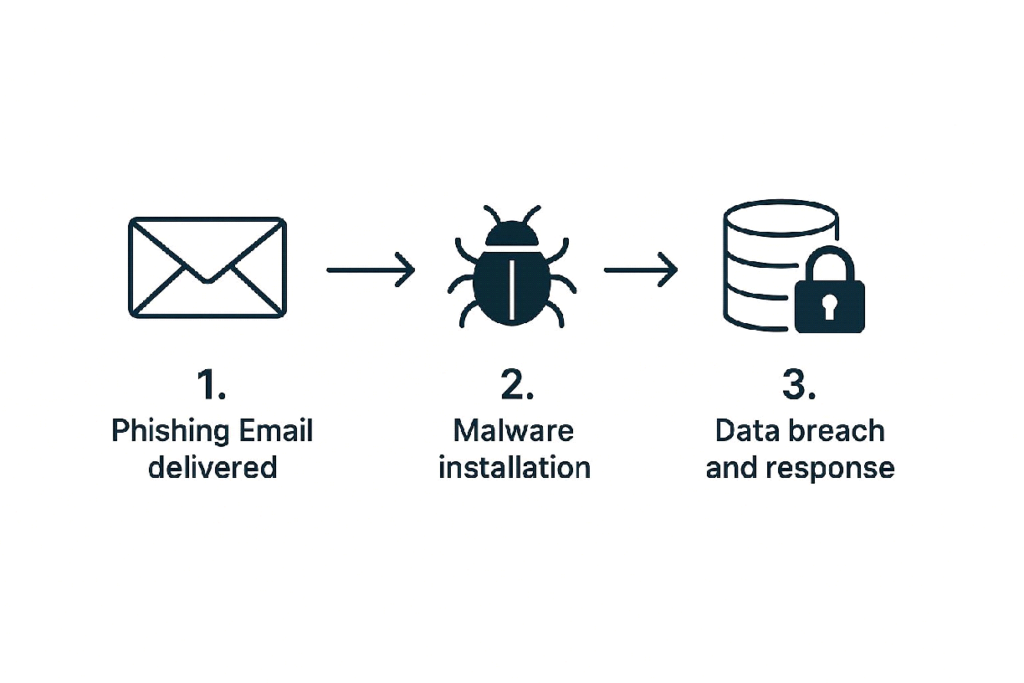
As you can see, a single phishing attempt can quickly snowball into a full-blown data breach. That’s why interrupting the process at the very first step is so critical.
Choose the Right Training Formats
Not all training methods are created equal, and frankly, people learn in different ways. The best programs I’ve seen always mix and match formats to keep the content fresh and make the lessons stick.
- Interactive eLearning Modules: These are fantastic for covering the fundamentals. They let employees learn at their own pace and can include short quizzes to check they’ve grasped the key concepts.
- Live Workshops: Whether it’s in-person or virtual, a workshop is perfect for a deep dive into tricky topics like social engineering. It creates space for real-time questions and group discussion, which makes the content far more memorable.
- Phishing Simulations: This is where the rubber meets the road. Sending simulated phishing emails to your team is one of the most powerful ways to see how they’ll react in the real world. It provides instant, practical feedback right when they need it most.
The trick is to build a curriculum that actually holds people’s attention. A dry, hour-long video will be forgotten by lunchtime, but a hands-on simulation creates a lesson they won’t forget.
A successful training program isn’t about scaring employees. It’s about equipping them with the confidence to recognise and respond to threats correctly. It turns that feeling of anxiety into decisive action.
Tailor Content to Specific Roles
The final piece of the puzzle is customisation. A “one-size-fits-all” approach to cybersecurity training for employees is a recipe for disengagement. Think about it: the security risks faced by your CFO are completely different from those of a junior marketing assistant.
Your CFO needs in-depth training on business email compromise (BEC) and wire transfer fraud. A sales rep, on the other hand, needs to know the risks of using public Wi-Fi on the road and how to handle customer data securely in the CRM.
By tailoring the content to specific job functions, you make it immediately relevant. People are far more likely to tune in when they can see exactly how the information protects them—and the company—in their day-to-day work.
At Tbourke Solutions, we help businesses navigate this entire design process. We kick things off with a thorough assessment to pinpoint your specific risks, then work with you to craft a training curriculum that aligns with your business goals. Our expert team can provide the strategic direction you need; to learn more, explore our specialised IT consultancy services. We’ll ensure your program is not just informative but truly effective, creating a lasting impact on your security culture.
Essential Topics Every Employee Should Master

Once you’ve got the framework for your program, it’s time to dive into the curriculum. A truly effective cybersecurity training program goes way beyond vague warnings. It needs to arm your team with the practical skills to handle the real-world threats they’ll face every single day.
Simply telling everyone to “be careful online” just doesn’t cut it anymore. Your people need to see what a malicious link actually looks like, understand the subtle giveaways in a phishing email, and recognise the psychological tricks attackers use. This is where theory gets real.
Identifying Phishing and Social Engineering
Phishing is still, by far, the most common way attackers get a foot in the door. The days of phishing emails riddled with obvious spelling mistakes are long gone. Today’s attempts are slick, persuasive, and incredibly hard to spot. Your training has to cover the whole gamut of these attacks.
Your team must be able to identify:
- Generic Phishing: Those mass emails sent to thousands of people, often disguised as alerts from big names like Microsoft, Australia Post, or the major banks.
- Spear Phishing: These are the scary ones. Highly targeted attacks that use personal details—like a person’s name, job title, or recent projects—to look completely legitimate and build trust.
- Business Email Compromise (BEC): Scams where attackers impersonate senior executives or suppliers, trying to trick employees into making dodgy payments or sharing sensitive data.
The threat is getting more complex, too. Cyber threats to Australian organisations have surged, with AI-driven phishing attempts doubling and ransomware now affecting one in three Australian firms. Attackers are getting better at exploiting human error, which makes regular, practical training an absolute necessity.
Real-world scenarios are your best friend here. Don’t just list red flags. Show your team an actual example of a fraudulent invoice email. Walk them through the tell-tale signs: the mismatched reply-to address, the manufactured sense of urgency, and the subtle changes in the sender’s domain name.
Mastering Password Hygiene and Authentication
Weak or reused passwords are like leaving the front door wide open for attackers. This part of the training is all about building strong habits that genuinely reduce risk. It’s not just about complexity; it’s about strategy.
Here are the core principles to hammer home:
- Create Strong Passphrases: It’s time to move away from short, complex passwords. Encourage longer passphrases (think “CorrectHorseBatteryStaple”) that are easy for a person to remember but almost impossible for a machine to crack.
- The Power of a Password Manager: Teach your team how to use a password manager. It can generate and store unique, strong passwords for every single account, finally breaking the dangerous habit of reusing passwords.
- Understand Multi-Factor Authentication (MFA): Explain why MFA is so crucial. I like to call it a digital deadbolt—even if an attacker steals the key (the password), they still can’t get in without that second factor, like a code from an app on their phone.
To really nail secure communications, it helps if your team understands the basics. Our guide on how to set up a business email securely is a great starting point.
Safe Use of Public Wi-Fi and Mobile Devices
For most businesses, work isn’t confined to the office anymore. Your team is likely connecting from cafes, airports, and hotels, often using unsecured public Wi-Fi. This convenience brings some serious risks that you need to tackle head-on.
Your training needs to lay down clear, non-negotiable rules for working on the go. Teach your team that using public Wi-Fi is like having a private conversation in a crowded room—anyone could be listening in. This means never, ever accessing sensitive company or client data on these networks without a Virtual Private Network (VPN). A VPN encrypts their connection, creating a secure, private tunnel for their data to travel through.
Responsible Data Handling Practices
Every single employee, no matter their role, handles company data. From customer lists and financial records to internal strategy documents, this information is valuable and needs to be protected. Good training creates clear guidelines for managing sensitive information from its creation to its disposal.
This comes down to teaching practical skills, such as:
- Recognising Sensitive Data: Helping staff understand what actually counts as confidential information.
- Secure Storage: Explaining where sensitive files should be saved (e.g., approved cloud storage) and where they definitely shouldn’t (e.g., their personal desktop).
- Proper Disposal: Outlining the correct procedures for securely deleting data when it’s no longer needed.
At Tbourke Solutions, we build our training modules around these core topics. We make it stick by using recent Australian breach examples, showing your team exactly how these threats play out in contexts they already understand. By grounding the training in local, relatable scenarios, we ensure the lessons land and empower your employees to become your strongest line of defence.
How to Implement and Deliver Your Training

Having a well-designed training program is a fantastic start, but its success truly hinges on how you roll it out. The logistics—choosing the right platform, scheduling sessions, and getting people engaged—are where your plan becomes reality. The goal is to make training a seamless, positive experience, not just another tedious task on your team’s to-do list.
For most Aussie businesses, particularly those with remote or hybrid teams, flexible online platforms are the clear winner. They let you scale your training effortlessly, reaching everyone from the Melbourne office to a sales rep working from home in Perth without pulling them away from their day jobs for hours on end. That flexibility is non-negotiable for maintaining productivity.
The growth here is undeniable. The cybersecurity training market in Australia is projected to hit USD 308.2 million by 2030. Online delivery is leading the charge, making up nearly 47% of the market in 2023, mainly because it lets businesses train staff without causing major workflow headaches. You can dig into the numbers in the full cybersecurity training market research.
Crafting a Realistic Training Schedule
One of the biggest mistakes I see is businesses trying to cram a year’s worth of security knowledge into a single, overwhelming session. It just doesn’t work. Information overload sets in, and most of it is forgotten by the next day.
Instead, think of cybersecurity training for employees as an ongoing conversation.
A much better approach is to blend different timelines and formats to keep the learning fresh:
- A Comprehensive Kick-Off Session: Start with a solid foundation. This first session, maybe an hour or two, should cover all the core essentials we’ve talked about. It gets everyone on the same page from day one.
- Bite-Sized Monthly Refreshers: Keep security top-of-mind with short, sharp monthly updates. These could be five-minute videos on a new phishing trend or a quick quiz on creating strong passphrases.
- Quarterly Phishing Simulations: Put your team’s skills to the test with regular simulated phishing attacks. This gives them practical, real-world experience in a safe environment where a mistake is a learning opportunity, not a disaster.
This layered approach ensures security awareness becomes part of the daily routine, rather than a distant memory from an annual seminar.
Securing Leadership Buy-In and Engagement
You can have the best training content in the world, but if your leadership team isn’t visibly on board, your employees simply won’t take it seriously. Leadership buy-in is the secret ingredient that transforms training from a box-ticking exercise into a core part of your company culture.
When managers and executives actively participate and champion the training’s importance, it sends a powerful message. Encourage them to talk about security in team meetings or give a shout-out to employees who report suspicious activity. This public support dramatically increases engagement and reinforces that security is everyone’s responsibility, from the top down.
Effective training is less about instruction and more about inspiration. It’s about showing your team that their vigilance matters and that they play a direct role in protecting the business they help build.
Making Training an Experience, Not a Chore
Finally, let’s talk about engagement. Nobody looks forward to dry, text-heavy modules. A little creativity can go a long way in making the lessons stick and even making the process enjoyable.
Try incorporating elements like:
- Gamification: Use points, badges, and leaderboards to create a sense of achievement and friendly competition among teams.
- Real-World Scenarios: Base your training on recent, relatable security incidents that have happened right here in Australia. It makes the threat feel real.
- Interactive Quizzes: Break up the learning with quick, engaging quizzes that test knowledge in a low-pressure way.
At Tbourke Solutions, we handle the entire implementation process for you. From setting up the online platform and enrolling users to tracking progress and sending reminders, we make sure the rollout is smooth and effective. Our goal is to take the logistical burden off your shoulders so you can focus on running your business.
Explore our full range of cybersecurity services to see how we can help protect your organisation.
Keeping Your Security-Aware Culture Alive and Kicking
Here’s a hard truth: cybersecurity training isn’t a “set and forget” exercise. You can’t just run a workshop, tick a box, and consider the job done. The real work begins after the initial training, in the day-to-day effort of building a lasting security-aware culture.
Think of it less like a project and more like a permanent shift in how your business operates. The goal is to make security awareness as second nature as locking the office doors at the end of the day. It’s about nurturing an environment where security becomes a shared responsibility, not just an “IT problem.” When your team feels empowered to speak up, you build genuine organisational resilience.
How Do You Know if It’s Actually Working?
You can’t manage what you don’t measure. If you want to know whether your training is hitting the mark, you need to track the right things. This isn’t just about proving ROI; it’s about figuring out what’s working and where you need to double down on your efforts.
Forget about simple completion rates. Anyone can sit through a video. What you really need to measure is a change in behaviour.
Here are the metrics that actually matter:
- Phishing Simulation Click-Rates: This is your most direct measure of success. Are fewer people falling for your simulated phishing emails over time? That’s a huge win.
- Suspicious Email Reports: This one might seem counterintuitive, but an increase in reported emails is a fantastic sign. It means your team is paying attention, they know what to look for, and they’re not afraid to flag something that feels off.
- Incident Response Times: How long does it take from the moment a threat is spotted to when it’s dealt with? Faster response times mean your team is becoming more vigilant, which can dramatically reduce the damage from a real attack.
These numbers tell the real story of your team’s progress and give you a clear roadmap for what to focus on next.
Keep the Momentum Going with Continuous Reinforcement
People forget. It’s human nature. New threats also pop up all the time. That’s why a single annual training session just doesn’t cut it anymore. Within a few weeks, most of that information is gone.
Continuous reinforcement is the key to keeping security top-of-mind.
A security-aware culture thrives on consistency, not intensity. Small, regular reinforcements are far more effective than a single, overwhelming annual training session.
It doesn’t have to be a huge effort. Simple, consistent touches make all the difference:
- Quick Tips in Newsletters: Pop a simple, actionable security tip into your regular company comms.
- Micro-Learning Videos: Short, sharp videos (think 2-3 minutes) on a new scam or a password best practice are easy to digest.
- Posters and Reminders: A few well-placed posters in the break room can be surprisingly effective at keeping key messages front and centre.
These small, consistent efforts are what weave security into the very fabric of your daily work life.
Build a Culture Where It’s Safe to Speak Up
This might be the most important piece of the puzzle. You need to create a blame-free environment for reporting potential security issues. If an employee is terrified of getting in trouble for clicking a bad link, what are they going to do? They’ll hide it. That delay can be the difference between a minor hiccup and a full-blown disaster.
The message has to be crystal clear: we want you to report everything, even if you think you’ve made a mistake. Frame reporting not as an admission of guilt, but as a proactive step that protects the entire team. When people feel safe to raise their hand, you get the early warnings you need to stop an attack before it gathers steam.
At Tbourke Solutions, we know that building this kind of culture is a partnership. We provide the tools and ongoing support to make sure your investment in training pays off for the long haul. With our detailed reporting dashboards to track progress, quarterly reviews to assess what’s working, and fresh content on the latest threats, we help you maintain momentum and build a truly resilient security mindset across your entire organisation.
Common Questions About Employee Cybersecurity Training
Even with a solid plan, it’s completely normal to have a few questions before you invest time and resources into a new initiative. Building a truly effective cybersecurity training for employees program is a big step, but I’ve found that the most common hurdles are often the easiest to clear once you have the right information.
Let’s walk through some of the questions I hear most often from business owners so you can move forward with confidence.
How Often Should We Actually Be Doing This Training?
This is probably the number one question I get asked, and the answer isn’t a simple “once a year.” The best approach isn’t a single event; it’s a layered, ongoing effort designed to build and maintain security awareness over time.
Think of it as a continuous cycle, not a one-off task:
- Day One Onboarding: Every new person who walks through the door should get foundational cybersecurity training as part of their induction. This sets the standard from the very beginning.
- Annual Refreshers: A comprehensive yearly session is still essential. It’s the perfect time to cover core principles again and introduce new policies or threats that have popped up.
- Quarterly Phishing Drills: These are non-negotiable in my book. Regular, simulated phishing attacks give your team practical, hands-on experience and keep their threat-spotting skills sharp.
- Ongoing Micro-Learning: Don’t underestimate the power of small, frequent updates. A quick five-minute video, a security tip in the monthly newsletter, or a brief mention in a team meeting keeps security top-of-mind without causing training fatigue.
This blended approach ensures security is part of the daily conversation, not just a forgotten annual checkbox.
What’s The Biggest Mistake Businesses Make?
Easy. The single biggest misstep is rolling out generic, boring, and completely irrelevant content. So many businesses grab a standard training module off the shelf, make everyone click through it, and call it a day. This strategy is pretty much doomed from the start because it completely misses the human element.
When the training is dry and has nothing to do with an employee’s actual role, they see it as just another chore to get through as fast as possible. The information never sinks in because it isn’t engaging or meaningful to their work.
The goal of training isn’t just to download information into someone’s brain; it’s to genuinely change their behaviour. That only happens when the content is relatable and tackles the real-world scenarios your team actually faces.
This is where a bit of tailoring makes a world of difference. Your finance team needs to know about business email compromise and invoice fraud. Your sales team, on the other hand, needs to be well-versed in the risks of using public Wi-Fi on the road. When people see how these practices directly protect them and their work, they start to listen.
How Do We Get Employees to Actually Care?
This is the million-dollar question, isn’t it? The answer boils down to two things: culture and connection. You can’t just issue a memo telling people to care; you have to show them why they should.
First, your leadership team has to be on board and visible. When managers and executives are actively participating in the training and talking about why it matters, it sends a powerful signal that this isn’t just an IT thing—it’s a core business priority.
Second, you need to connect the dots between their work life and their personal life. The skills they’re learning to protect the company—like spotting phishing scams, creating strong passwords, and using multi-factor authentication—are the exact same skills that protect their personal bank accounts, social media profiles, and family’s data. Framing the training as a personal benefit makes it far more valuable. Making this connection is a key part of the dedicated IT support for small business in Melbourne that we provide.
Ultimately, you get your team to care by showing them that you care. Invest in high-quality, engaging training, and make it clear that their vigilance is a crucial and valued part of the company’s success.
At Tbourke Solutions, we help you answer these questions and build a program that genuinely works. We focus on creating training experiences that are not only informative but also engaging and tailored to your specific business needs, ensuring your team is ready for any threat.
Ready to build a stronger human firewall? Tbourke Solutions can help you design and implement a cybersecurity training program that protects your business from the inside out. Visit us at https://tbourke-solutions.com.au/ to learn more.