How UK Importers Can Cut Costs on Container Shipping from China
why freight costs remain a challenge for UK importers in 2025
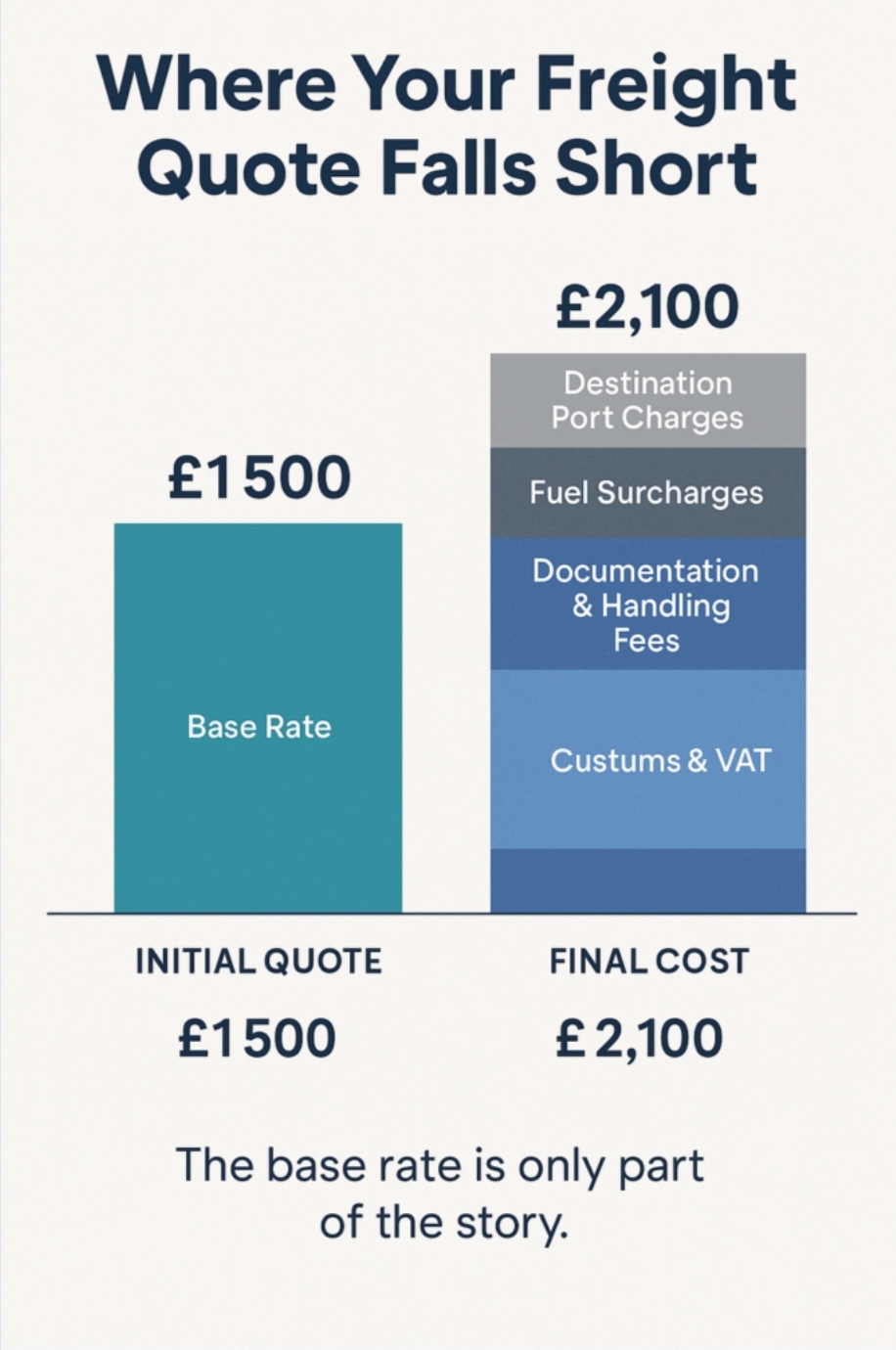
Your supplier quotes £1,500. Your freight invoice says £2,100. What happened?
In 2025, UK importers are still dealing with freight invoices 20–30% higher than anticipated — even as global container rates stabilize post-pandemic. What many don’t realize is that these price jumps come not from the base rate, but from all the extras that weren’t clearly shown upfront.
These include:
- Destination port charges
- Fuel and equipment surcharges
- Documentation and handling fees
- Delay-related costs like demurrage or detention
It’s not uncommon to see a “door-to-door” quote increase by up to a third once these are included.
Importers often fixate on getting the cheapest rate per container. But if that quote doesn’t spell out who handles VAT, haulage, or customs paperwork, it’s not just incomplete — it’s misleading.
For SMEs, even small miscalculations in freight cost can throw off margins, lead to delivery delays, and create cash flow problems.
the real cost control challenge in 2025
Container shipping has become more stable — but also more layered. Today, cutting freight costs is less about aggressive negotiation and more about understanding:
- What’s actually included in the quote
- Which costs appear later
- How your choices (like shipping mode or Incoterms) impact total landed cost
By the end of this guide, you’ll understand:
- What really drives your shipping costs
- Which choices help you avoid unnecessary fees
- How to structure shipments more efficiently from China to the UK
Let’s begin with the basics — and uncover where your freight bill might be hiding its most expensive surprises.
Modes, Ports, and Paperwork: Setting Up Your First China–UK Shipment
Before you try to cut costs on container shipping, it’s essential to understand how the freight process actually works — especially if you’re managing your first shipment from China to the UK.
Choosing the right shipping mode
The two most common sea freight options are:
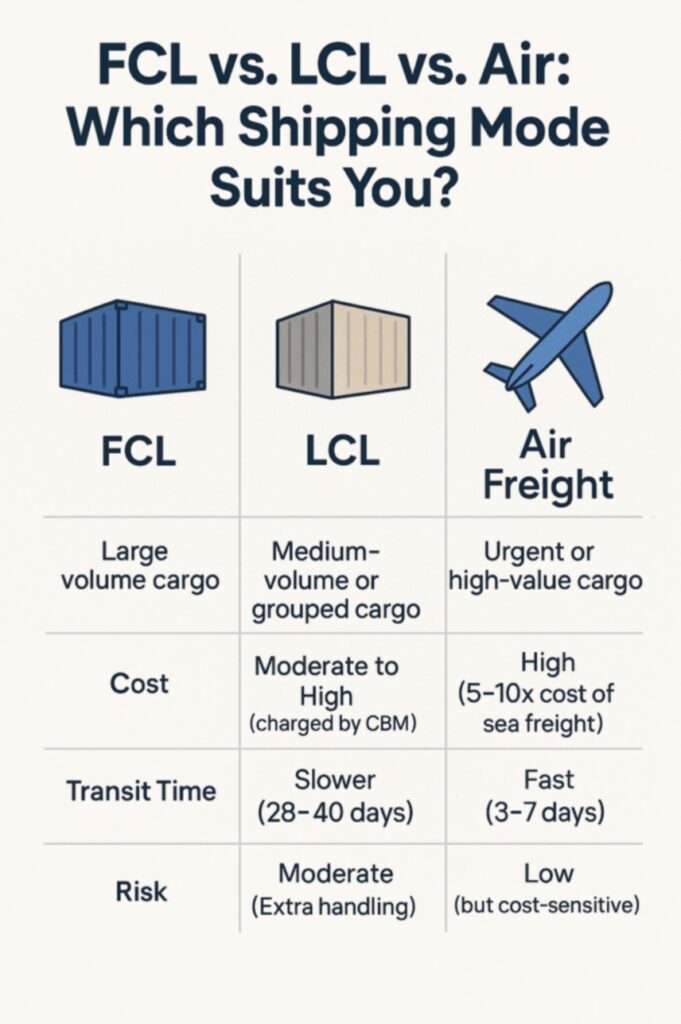
- FCL (Full Container Load): You book an entire container (typically 20ft or 40ft), regardless of whether you fill it completely. FCL is usually more cost-efficient for shipments over 15–18 CBM.
- LCL (Less than Container Load): You share a container with other shippers and pay based on volume (CBM). LCL is flexible but can involve extra handling charges and longer customs times.
For high-value or time-sensitive cargo, air freight is also an option — though it’s 5–10x more expensive than sea shipping.
Understanding origin and destination ports
Your route choice significantly affects both transit time and charges. The most common routes for China–UK freight are:
- Origin Ports: Shenzhen, Ningbo, Shanghai, Qingdao
- UK Ports: Felixstowe, London Gateway, Southampton
Each port has different handling fees, customs clearance timelines, and congestion levels — which affect both cost and reliability.
Documentation essentials
Even small errors in paperwork can lead to costly delays at UK customs. Make sure your shipping partner helps you prepare:
- Bill of Lading (B/L)
- Commercial Invoice & Packing List
- Import declaration / EORI registration
- Certificates (if applicable): e.g. CE marking, HS code classification
If you’re shipping to Amazon FBA warehouses in the UK, ensure you also comply with:
- FBA labeling requirements
- Booking window restrictions
- Delivery appointment scheduling
When to consider working with a freight forwarder
For most UK SMEs or first-time importers, working with an experienced freight forwarder simplifies the process. A good forwarder helps you:
- Choose the right mode (FCL vs. LCL)
- Avoid quote confusion
- Manage customs documentation
- Arrange final delivery to warehouse or FBA
Learn more about how this works in practice by exploring freight shipping from China to UK, including documentation and delivery coordination examples.
What Drives Your Shipping Costs — and How to Control Them
Ask ten importers what they pay for shipping, and you’ll likely get ten different answers — even if they’re shipping the same container size from the same Chinese port.
Why? Because container pricing is rarely just about distance or volume. In reality, freight quotes are built on multiple layers of charges — many of which are variable, time-sensitive, or hidden in fine print.
Core cost components in a container shipping quote
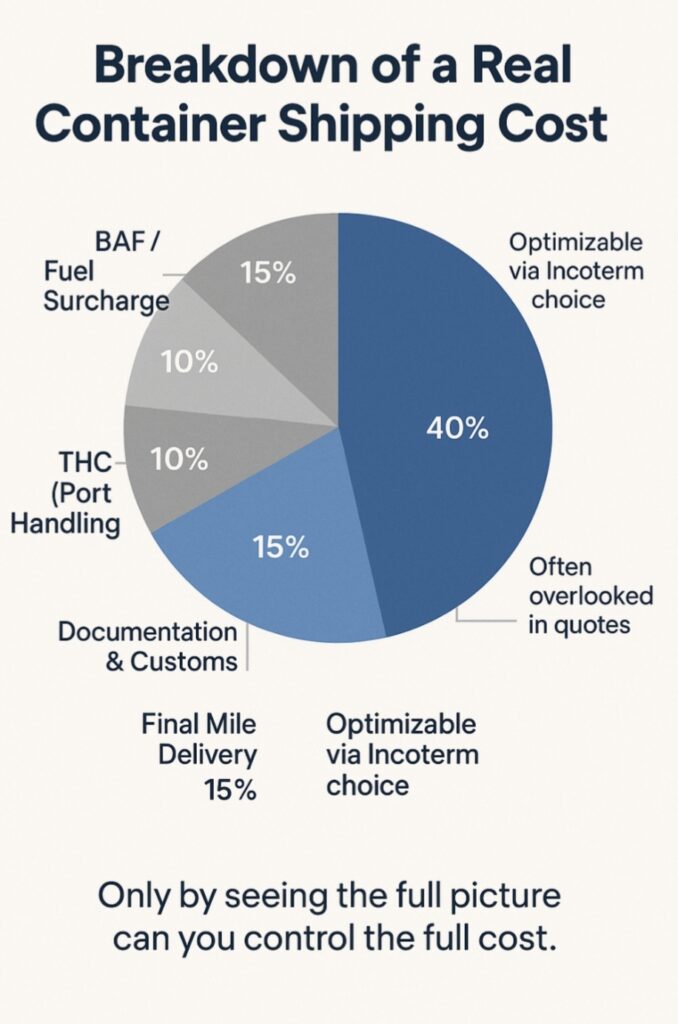
- Base Rate: The core fee for port-to-port shipping (usually per container or per CBM)
- BAF (Bunker Adjustment): Surcharge based on global fuel costs
- THC (Terminal Handling): Charges for loading/unloading at both origin and destination ports
- Documentation Fee: For preparing B/L, customs declarations, etc.
- Customs Clearance: Can vary by port, cargo type, and freight term (e.g., FOB vs DDP)
- Delivery / Haulage: Final-mile trucking from UK port to warehouse or FBA centre
- VAT and Duty: Government charges on imported goods (depends on HS code + Incoterm used)
To learn how these fees typically apply in real-world scenarios, see this detailed guide on container shipping prices.
What makes shipping costs go up (even when base rates go down)
- Port Congestion and Peak Season Surcharges: Delays at ports can trigger storage, demurrage, or re-routing costs. High-volume periods (e.g. pre-Christmas, Q3 restocking) bring seasonal surcharges.
- LCL-Specific Handling Fees: Expect to pay for consolidation, palletisation, and deconsolidation — all of which don’t apply to FCL.
- Fuel Index Volatility: Bunker fuel charges fluctuate monthly. Some forwarders pass these on separately; others include them.
- Incoterms Impact: If using EXW or FOB, you may be responsible for UK-side costs like delivery and VAT — which can add 15–25% to your landed cost.
How to take control
- Request an itemised quote, not just a total.
- Confirm whether your quote includes:
- Destination port handling
- UK customs clearance
- Final delivery
- Understand your Incoterm and its implications.
- Always compare total landed cost, not just base freight rate.
how to benchmark container shipping quotes
Even experienced importers can struggle to compare freight quotes apples-to-apples — especially when forwarders present rates in different formats, currencies, or levels of detail.
To benchmark quotes effectively:
- Always ask for DDP-equivalent cost: Even if you choose FOB, ask the forwarder to show the total landed cost to your UK warehouse, including VAT and haulage.
- Normalize units: If one quote shows per-CBM and another per-container, ask them to convert both to total shipment cost.
- List all exclusions: Don’t assume anything is included. Make the provider specify: is delivery included? What about customs clearance or storage risk?
- Factor in reliability: A slightly higher quote from a provider with better documentation support or FBA experience may save you money long-term.
When in doubt, share the quote with a third-party logistics consultant or a second freight forwarder for a “sanity check.” Good forwarders won’t mind being vetted — and may even help you decode confusing terms.
conclusion: turn freight into a strategic advantage
Container shipping from China to the UK doesn’t have to be unpredictable or more expensive than expected. By understanding the true cost structure behind every quote — and comparing FCL, LCL, and Incoterm scenarios with your real margins in mind — you can turn logistics from a budgeting risk into a competitive edge.
Smart importers aren’t just chasing lower freight rates — they’re choosing the right routes, asking better questions, and planning for efficiency long before their cargo hits the water.
Make freight work for you — not against you.