What Happens When You Trap Your Team in a Room With Zero Instructions?
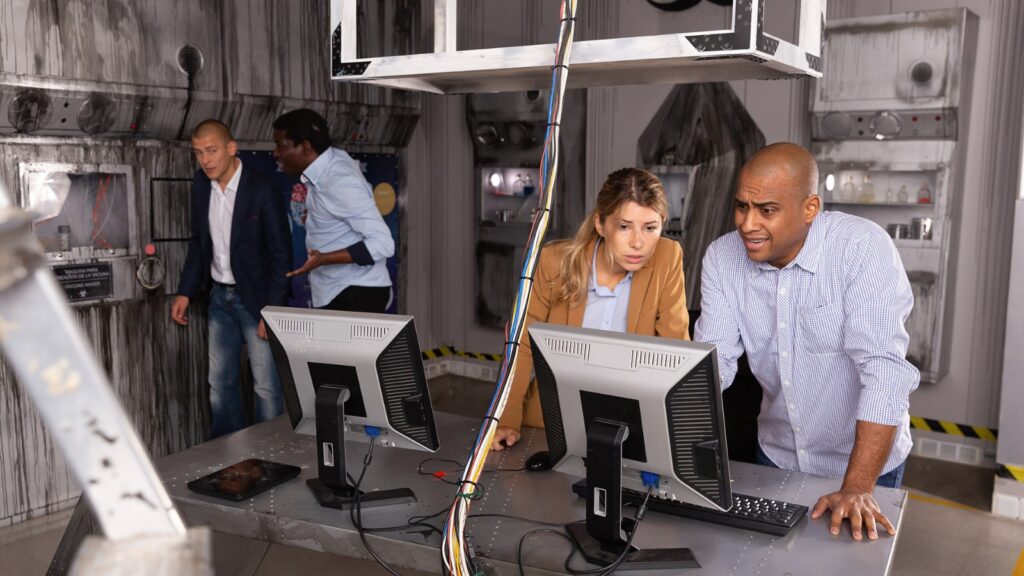
Consider this scenario: your whole team is imprisoned in an enigmatic room. There is no manual, no guidebook, and most definitely no “easy” button. Just a network of mysterious escape room puzzles that need to be solved, the ticking of the clock, and the collective fear of the unknown.
Welcome to the world of escape rooms, where one of the best corporate team-building activities available combines chaos, creativity, and communication.
However, what occurs when a team is locked inside without any guidance? Let’s dissect it.
1. The Panic Phase: Breaking the Ice with Pressure
The door closes. The timer goes off. And your group looks around, perplexed. Nobody is sure what to do first.
Although it might seem ineffective, this first period of uncertainty is very beneficial for team dynamics. Why? Because personality is revealed under pressure. Some members of the team jump right in, looking for hints. Others take a back seat and watch. A couple of lighthearted jokes to lighten the mood.
These are the times when groups realise they must rely on one another to get out, when natural leaders show their abilities, and when quiet thinkers shine.
This is a great place to start for organisations trying to replace awkward trust falls with real collaboration.
2. Organised Chaos: Collaboration With a Script
Roles are well-defined in the majority of work environments. However, job titles are meaningless in an escape room. Collaboration is the only way to succeed, and it must happen quickly. Without guidance, teams have to:
- Assign work according to strengths.
- Communicate the results.
- Solve problems under time constraints.
Escape room puzzles are a potent metaphor for project work, strict deadlines, and innovative problem-solving in the workplace because these challenges replicate actual business situations.
Furthermore, how often do you get to witness your intern cracking a cypher like a pro or your CFO scuttling under furniture?
3. The “Aha!” Moments: Discovering Strengths You Didn’t Know Existed
Something magical occurs as the team gradually advances. A code is cracked by someone who is normally quiet in meetings. A manager who is typically in charge realises that listening works better than leading. A pair that has never collaborated before clicks right away.
Teams can work in a neutral environment in escape rooms where ideas are valued more than hierarchy.
What’s the best part? These “aha!” experiences frequently carry over into the workplace, improving teamwork and fostering an environment where everyone’s opinions are respected.
4. Adaptability in Action: Pivoting When Plans Fail
Not all ideas are successful. Not every hint points in the right direction. The most self-assured team member can occasionally lead the group astray. That is a component of both the enjoyment and the education.
The capacity to change course is an essential skill in the fast-paced business world of today. Teams learn how to reorganise swiftly, reevaluate, and reroute through escape rooms. Additionally, they provide a safe environment for failure, which is essential for encouraging creativity at work.
5. The Countdown Effect: Building Unity Through Shared Urgency
A ticking clock has a very unifying effect. It creates urgency, unites people, and focuses attention.
Time becomes the most powerful motivator in escape rooms. From planning and execution to review and outcome, teams go through a shortened version of a high-pressure project cycle. Additionally, because they are working side by side, they leave with more than just fresh perspectives; they also carry a common narrative of success (or hilarious failure).
6. Post-Escape Reflections: Conversations That Count
The actual team-building starts as soon as the door opens and the clock stops.
Teams are always encouraged to conduct a post-event debriefing at Great Escape Bendigo. What was effective? What didn’t work? Who took the initiative? What would they do differently?
While having fun, these reflections assist teams in gaining insight into their group dynamics, communication styles, and decision-making processes.
Additionally, the lessons learned in an escape room don’t feel forced, in contrast to conventional training seminars. They believe they have earned it.
Why Escape Rooms Are the Future of Corporate Team-Building Activities
The business world has changed. Engagement, not lectures, is what employees want. Teams need more than just another day of PowerPoint presentations and icebreakers; they need bonding experiences that are challenging, collaborative, and unforgettable.
Escape room puzzles can help to:
- Develop trust by working together to solve problems.
- Improve communication naturally.
- Display and hone your leadership abilities.
- Encourage flexibility and strategic thinking.
- Provide prompt, interactive feedback.
To put it another way, when done properly, escape rooms are a great way to engage in contemporary corporate team-building activities.
Why the Bendigo Team Loves Great Escape
Situated in the centre of Bendigo, Great Escape serves as a hub for team transformation in addition to being an entertainment venue.
Every experience at Great Escape is created to challenge, engage, and inspire through the use of intricately designed escape room puzzles. Our corporate team-building activities are designed to help you improve relationships and boost productivity, regardless of how big or small your company is.
And don’t worry, your team will eventually be released. (Unless they wish to remain!)
Ready to lock in your team’s growth?
Try a hands-on, minds-on experience that yields tangible results if you want to replace boring seminars with something truly memorable. Get away from the norm. Unleash the potential of your team. And find out what occurs when you put your team in a room with no instructions.
Spoiler alert: They grow, learn, and form an unbreakable bond.
Contact Great Escape Bendigo to schedule your upcoming corporate team-building activity right now. Your team will appreciate it and most likely talk about it incessantly.
FAQs:
1. What are the common puzzles in an escape room?
Hidden objects, pattern recognition, logic riddles, codes and cyphers, physical challenges, jigsaw puzzles, and combination locks are examples of common escape room puzzles. In order to find clues and eventually escape within a certain amount of time, players frequently have to solve these in order.
2. What to know before you visit an escape room?
Go early, dress casually, communicate well with your team, and observe the theme and difficulty level. Escape room puzzles are all about teamwork, observation, and fun under pressure, so listen to the game master and don’t overthink it.
3. Can 12 people do an escape room?
Yes, if it is a venue that has multiple rooms available or large-group activities, 12 people.