How to Use a Santoku Knife for Meat, Fish, and Veggies
Introduction
If you spend time in the kitchen, chances are you’ve come across the Santoku knife. Born in Japan, its name translates to “three virtues” or “three uses”—meat, fish, and vegetables. This versatile knife has become a favorite for both home cooks and professional chefs because it combines precision with efficiency. But to really get the most out of it, you need to understand how to use it properly for each type of food.
Getting to Know Your Santoku Knife
A Santoku knife usually measures between 5 to 7 inches, making it slightly shorter and lighter than a Western chef’s knife. Its blade has a straighter edge with a rounded tip, designed for quick, clean slicing rather than rocking motions. Many Santoku knives also feature a Granton edge—those little dimples along the blade—which prevent thin slices of meat or vegetables from sticking.
Unlike a chef’s knife that often uses a rocking chop, the Santoku is best suited for a push-cut motion: moving the knife forward and downward in a straight line. This method gives you cleaner cuts and better control, especially when dealing with delicate ingredients.
Tip: Always grip the knife just above the handle with your thumb and index finger on either side of the blade for maximum control and safety.
Using a Santoku Knife for Meat
The Santoku is excellent for slicing boneless cuts of meat. Think chicken breasts, pork tenderloin, or thin strips of beef for stir-fry. Its thinner blade glides smoothly through protein, giving you even slices without shredding the fibers.
If you’re preparing a roast, the Santoku can help you achieve neat, uniform cuts that look great on the plate. Just remember—this isn’t the knife to reach for when you need to cut through bones or frozen meat. Doing so can chip the edge. Stick to clean, boneless cuts, and your Santoku will reward you with effortless slicing.
Using a Santoku Knife for Fish
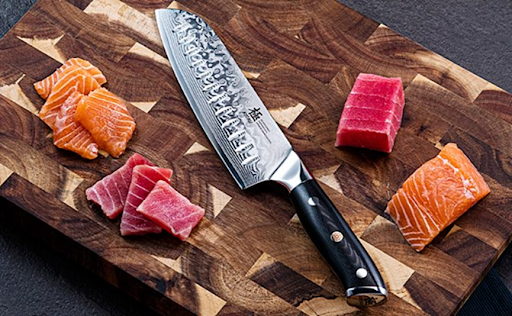
When it comes to fish, the Santoku is a surprisingly capable tool. It excels at portioning fillets, trimming skin, or slicing delicate cuts for sushi or sashimi. Its fine edge reduces tearing and helps preserve the natural texture of the fish.
That said, it’s not a replacement for a flexible fillet knife. If you’re deboning or working with very thin fillets, a fillet knife might be better. But for everyday prep—like cutting salmon for grilling or portioning white fish for stir-fries—the Santoku is more than up to the task.
Using a Santoku Knife for Vegetables
This is where the Santoku really shines. Its sharp, flat edge makes short work of vegetables, whether you’re dicing onions, julienning carrots, or chopping herbs. Because the blade is wide, it doubles as a scoop—you can easily transfer your freshly chopped veggies from the board straight into the pan.
For quick weeknight stir-fries, a Santoku is your best friend. It slices through hard vegetables like sweet potatoes or squash just as easily as it dices softer ones like tomatoes or zucchini. Use the push-cut technique to maintain speed and consistency, and you’ll notice how much cleaner and more efficient your prep becomes.
Care and Maintenance for Your Santoku Knife
A well-maintained knife doesn’t just perform better—it lasts longer too. Always hand wash your Santoku with warm, soapy water and dry it immediately to prevent corrosion. Store it in a knife block, sheath, or on a magnetic strip rather than tossing it in a drawer, where it can get damaged.
To keep the blade razor-sharp, hone it regularly with a honing rod and sharpen it when necessary with a whetstone or professional service. Also, avoid glass or marble cutting boards. Stick to wood or plastic boards, which are gentler on the edge.
When to Choose a Santoku Knife Over Others
So how do you decide between a Santoku and a chef’s knife? A chef’s knife is great for rocking cuts, larger tasks, or breaking down poultry. The Santoku, however, is lighter, more precise, and perfect for everyday prep. If you’re looking for speed and accuracy with boneless meat, fish, or vegetables, the Santoku is often the better choice.
It’s not ideal for heavy-duty tasks like cutting through bones, hard shells, or frozen foods, but for everything else, it’s a workhorse you’ll find yourself reaching for again and again. For those looking to invest, Kyoku offers Santoku knives in several series—from their affordable Samurai Series, ideal for everyday cooks, to the Daimyo Series, crafted for professionals who want premium balance and edge retention. No matter your cooking style, there’s a Kyoku Santoku to match your needs.
Conclusion
The Santoku knife truly lives up to its name, excelling at the “three virtues” of meat, fish, and vegetables. With its sharp, versatile blade and efficient push-cutting style, it makes everyday cooking faster, easier, and more precise. By learning how to use and care for it properly, you’ll turn this Japanese kitchen staple into one of your most trusted tools.