Overcoming Precision Machining Challenges: A Strategic Guide to Selecting a CNC Milling Partner for Optimal Quality and Efficiency
Introduction
OEM engineers and procurement managers frequently encounter significant setbacks when launching new products or addressing urgent orders, often stemming from the selection of an underqualified CNC milling supplier. Common repercussions include subpar part surface quality, high scrap rates due to an inability to machine complex features, and project delays caused by communication failures . These issues typically originate from a fundamental lack of understanding of the core processes involved in precision CNC milling and the absence of a systematic framework for evaluating potential partners .
This article provides a strategic guide designed to demystify these processes and establish clear, actionable criteria for selecting a reliable supplier, thereby mitigating project risks and ensuring successful outcomes. To make an informed decision, it is crucial to first understand what constitutes a comprehensive CNC milling service beyond basic machining.
What Constitutes a Comprehensive CNC Milling Service Beyond Basic Machining?
A top-tier service is defined not by a single operation but by an integrated quality assurance system that spans the entire production lifecycle. This system embodies the process-oriented quality management idea championed by international standards like ISO 9001 . It encompasses a series of critical, interconnected steps that ensure reliability and precision from concept to delivery.
The Critical Role of Front-End Engineering and Collaboration
The foundation of a successful project is laid long before any material is cut. A key differentiator of an advanced service provider is the offering of DFM analysis as a standard value-added practice. This collaborative process involves experienced engineers analyzing a component’s design to suggest optimizations for manufacturability, which can dramatically reduce costs and mitigate risks at the design stage . Effective DFM can lead to structural simplification and part consolidation, converting complex assemblies into single, more efficient components.
Meticulous Digital and Physical Preparation
The transition from design to physical part hinges on rigorous digital and physical setup processes that are critical for quality and efficiency.
l Advanced CAM Programming and Simulation:
Sophisticated Computer-Aided Manufacturing (CAM) software is used to create optimal tool paths and cutting strategies. Crucially, the use of simulation software allows engineers to visualize the entire machining process to proactively avoid tool collisions, gouging, or vibrations, ensuring the program is both safe and efficient
l Precision Tooling and Fixture Design:
For complex or high-volume parts, the design and creation of custom fixtures are essential. Well-designed fixtures ensure stable part positioning during machining, which minimizes distortion and enhances consistency and accuracy across a production run
Rigorous Verification and Final Quality Assurance
The commitment to quality extends into the post-machining phase. This includes applying specified Surface Finishing treatments and, most importantly, implementing a closed-loop Quality Control process. A robust system involves first-article inspection, in-process checks, and a comprehensive final inspection report, ensuring every step is documented and meets specifications for full traceability .
How Does Multi-Axis Machining Technology Impact the Capability to Produce Complex Parts?
The capabilities of a supplier are largely defined by the Types of CNC milling technology they employ. Understanding the progression from 3-axis to 5-axis machining is fundamental to matching part complexity with a supplier’s technical capacity .
The Spectrum of Capabilities: From 3-Axis to 5-Axis
The number of axes dictates the directions in which a cutting tool can move, directly influencing the geometric complexity of producible parts.
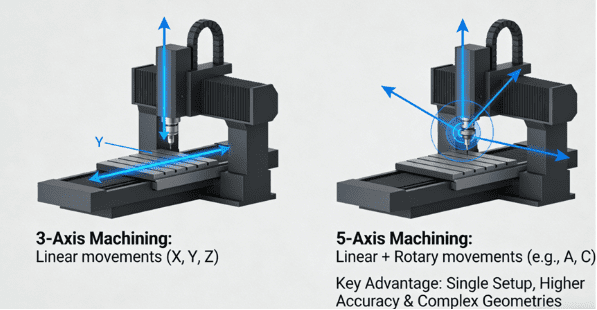
l 3-Axis Machining:The tool moves linearly along the X, Y, and Z axes. It is economical and suitable for prismatic parts but cannot efficiently machine complex contours or multi-sided features without multiple time-consuming setups.
l 5-Axis Machining:This method simultaneously controls three linear and two rotational axes, allowing the tool to approach the workpiece from virtually any direction in a single setup. It is the ultimate solution for Precision Engineering of complex geometries like impellers, turbine blades, and orthopedic implants
The Transformative Advantages of Multi-Axis Machining
For complex parts, Multi-axis machining offers benefits that transcend the capabilities of traditional 3-axis systems.
l Unmatched Precision via Single Setup:
The principal advantage of 5-axis technology is the ability to complete machining on five sides in a single clamping. This eliminates the cumulative errors (tolerance stack-up) associated with repositioning the workpiece between multiple setups, significantly improving the dimensional accuracy and positional tolerances between features.
l Enhanced Surface Finish and Efficiency:
The ability to maintain optimal tool orientation allows the tool’s cutting edge to be used more effectively, often resulting in a superior surface finish. Furthermore, it drastically reduces cycle times by consolidating operations and minimizing manual intervention, leading to substantial cost savings.
What Are the Critical Dimensions for Evaluating a Reliable CNC Milling Supplier?
Selecting a manufacturing partner is a strategic decision that requires a systematic evaluation beyond unit price. Several key dimensions must be scrutinized to identify a reliable CNC milling supplier.
Technical Capabilities and Quality Certifications
The physical foundation of a supplier’s capability lies in its technology and quality systems. A supplier’s machine portfolio—including the availability of advanced technology like 5-axis machining centers—is a primary indicator of its ability to handle complex work . Equally important are high-precision inspection equipment like Coordinate Measuring Machines (CMMs) and adherence to certified quality management systems (e.g., ISO 9001, IATF 16949, AS9100D), which are non-negotiable for ensuring consistent quality and full traceability . For readers seeking a deeper dive into the CNC milling supplier selection criteria, a comprehensive guide detailing these evaluation metrics and more is available.
Engineering Expertise and Project Experience
Sophisticated equipment is only as effective as the people operating it. An experienced engineering team can transform a challenging design into a manufacturable part. Reviewing a supplier’s project case studies, especially within your industry (e.g., medical, aerospace), provides tangible proof of their ability to meet specific requirements and understand unique challenges . This expertise is a hallmark of Industry Best Practices.
Communication and Project Management
Reliable delivery is built on transparent processes and proactive communication. A supplier’s responsiveness during the quoting stage, willingness to provide regular progress updates, and clarity of their project management workflow are strong indicators of a collaborative partnership . A single point of contact and a defined process for order confirmation, first article inspection, and final delivery are essential for project success .
How Can Material Selection and Advanced Surface Finishing Enhance Part Performance?
The final performance of a part is a function of both its base material and its surface condition. Strategic Material selection for CNC projects and appropriate Surface Finishing are critical for achieving functional requirements, longevity, and aesthetics .
Selecting the Right Material for the Application
Different materials dictate machining strategies, cost, and final part characteristics. Aluminum alloys are popular for their light weight and excellent machinability, while stainless steels are chosen for corrosion resistance but present machining challenges due to work-hardening . Engineering plastics like PEEK offer high strength and biocompatibility for demanding medical applications, but require specialized machining parameters .
Enhancing Performance through Surface Treatment
Surface Finishing processes are applied to raw machined parts to meet specific application demands. Anodizing enhances the corrosion resistance and wear resistance of aluminum, and detailed standards for this process are well-established . Other finishes like electropolishing for stainless steel or passivation further enhance corrosion resistance, while sandblasting can create a uniform matte finish for aesthetics or as a paint base .This ability to guide clients from material grade to the final finish based on the operational environment is a key aspect of Customized Production .
What Strategies Effectively Control Costs in CNC Milling Projects Without Sacrificing Quality?
Cost control in precision machining is about intelligent optimization, not cutting corners. Understanding the components of a custom CNC milling quote is the first step in implementing effective cost control strategies and achieving Supply Chain Optimization.
Deconstructing the Quotation: Key Cost Drivers
A detailed quote typically includes several elements: engineering costs (DFM, programming), machining costs (driven by material, machine time, and tooling), and costs for post-processing and quality control . Strict tolerances and superior surface finishes will inevitably increase machining time and cost.
Strategic Levers for Cost Optimization
Several strategies can significantly reduce costs without compromising the part’s core function. Collaborative DFM is the most powerful cost-saving lever, as simplifying geometries and relaxing non-critical tolerances can dramatically reduce programming and machining difficulty . Other strategies include consolidating orders to amortize setup costs and selecting the most cost-effective material that meets the functional requirements . To obtain a transparent and optimized custom CNC milling quote based on your specific part design and quantity, consulting with experts who provide Precision CNC Milling services is recommended.
What Does a Collaborative Partnership with a Precision Machining Provider Typically Entail?
An ideal partnership transcends a simple transaction; it is a transparent, communicative, and highly coordinated manufacturing process. A standardized workflow forms the backbone of Quality Assurance and is the practical expression of a Collaborative partnership .
From Inquiry to Order: Laying the Foundation
The process begins with a detailed request for quote (RFQ) including 3D CAD models and 2D drawings. The supplier should review these files and provide a preliminary DFM analysis, leading to a formal quote and project plan that establishes technical and commercial consensus .
Execution with Oversight and Final Delivery
Upon order confirmation, the internal production process begins: final CAM programming, tooling preparation, and material procurement. A critical step is the production and inspection of a first article, often accompanied by a First Article Inspection (FAI) report for client approval before full batch production commences .
Ensuring Long-Term Success
Throughout production, regular progress updates and open communication channels keep the client informed. Upon completion, all parts undergo final inspection and are delivered with complete quality documentation. This entire process, built on transparency and expertise, fosters a long-term, strategic manufacturing alliance .
Conclusion
Selecting a CNC milling partner is a strategic decision with far-reaching implications for product reliability, project predictability, and supply chain resilience. By deeply understanding the end-to-end service workflow, technical capabilities like multi-axis machining, rigorous quality systems, and cost structures, decision-makers can move beyond simple price comparison to establish value-based, long-term manufacturing partnerships. Such collaboration ensures not only the success of current projects but also provides a solid foundation for innovating and responding to future market challenges.
Author Bio
This article was developed with insights from precision manufacturing experts at JS Precision. The company specializes in turning complex designs into high-quality reality through comprehensive manufacturing solutions. Contact their expert team today for a free DFM analysis and a personalized solution quote for your project.
FAQ
Q1: What is the typical lead time for precision CNC milling services?
A: Lead times vary based on part complexity, quantity, and current production schedule. Typically, prototypes can be delivered within 5-10 working days, while larger production runs may take 2-4 weeks. Suppliers offering expedited services can accommodate urgent requests, though this may incur additional costs. It is always recommended to discuss timeline expectations early in the quoting process.
Q2: How is intellectual property (IP) protected when outsourcing CNC milling?
A: Reputable suppliers prioritize IP protection. This is typically ensured through strict non-disclosure agreements (NDAs) that are signed before any project information is exchanged. Additionally, secure IT systems for file transfer and storage, coupled with internal confidentiality protocols for employees, provide multiple layers of security. Clients should always verify a supplier’s IP protection policies before engagement.
Q3: Can CNC milling services handle both small-batch prototypes and high-volume production?
A: Yes, many leading providers are equipped for both. They utilize flexible manufacturing strategies and a range of equipment to efficiently handle low-volume, rapid prototyping needs as well as high-volume production runs. This scalability allows clients to partner with a single supplier throughout their product lifecycle, from initial concept validation to market launch and beyond.
Q4: What file formats are required for requesting a CNC milling quote?
A: Standard 3D CAD file formats are preferred for accurate quoting and manufacturing. Commonly accepted formats include STEP, IGES. These formats contain the necessary geometric data. It is also helpful to provide a 2D drawing specifying critical dimensions, tolerances, and surface finish requirements.
Q5: What quality documentation is provided with the finished parts?
A: A comprehensive quality package is a mark of a reliable supplier. This typically includes a First Article Inspection (FAI) report, material certification (MTC), and a final inspection report. For parts machined under specific standards like AS9100D or IATF 16949, additional compliance documentation will be provided, offering full traceability and peace of mind.