Navigating the Rapid Prototyping CNC Service Landscape: A Guide to Selecting Your Ideal Partner
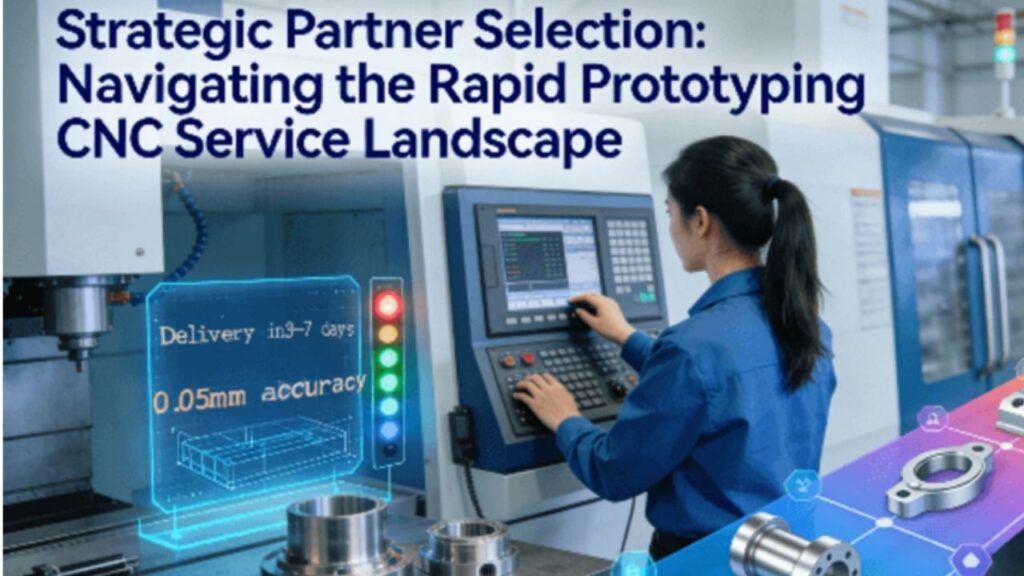
In fast-moving product development, teams face a familiar tradeoff: you need prototypes quickly, but you also need them to behave like the final production part. 3D printing can be excellent for early form checks, but it may fall short for functional validation when strength, temperature resistance, or real-world reliability is required. Traditional machining, on the other hand, can deliver production-grade parts—but may not match aggressive iteration timelines unless you choose a partner optimized for speed.
The biggest risk isn’t the technology. It’s selecting a supplier based on price or vague claims without a structured evaluation. That approach often leads to delays, redesign churn, unexpected fees, and prototypes that fail functional testing—costing more time than you saved.
This guide gives you a practical selection framework to evaluate a rapid prototyping CNC service provider beyond the bottom line—so your prototype phase accelerates production instead of slowing it down.
Why Rapid Prototyping CNC Machining Wins for Functional Validation
When your prototype must perform like the real part (not just look like it), CNC machining offers advantages other methods can’t consistently match.
1) Real Production Materials for Real Testing
CNC prototyping uses the same engineering materials commonly specified for final parts—aluminum alloys, stainless steels, titanium, and high-performance plastics like PEEK. That means your prototype can be tested for true mechanical behavior, heat resistance, wear, and chemical exposure with far higher confidence.
2) Stronger, More Predictable Parts
Machined prototypes are typically monolithic and isotropic, meaning they don’t suffer from directional weakness often seen in layer-built processes. This matters for brackets, housings, mounts, interfaces, and any part that will see stress, vibration, or load.
3) A Clearer Path to Production
CNC prototypes often double as first articles for pilot builds. You can catch manufacturability problems early (feature access, tolerances, assembly stack-ups) and reduce the risk of surprises when you shift toward low-volume or full production.
Does Your Project Actually Need CNC Prototyping?
Not every prototype requires CNC. Use CNC prototyping when you need one or more of the following:
- Functional testing is mandatory (load, vibration, thermal cycling, chemical exposure)
- Critical interfaces must fit perfectly (mating surfaces, press-fits, sealing features, alignment pins, bearing seats)
- You’re bridging prototype → pilot/low-volume production (avoiding supplier re-qualification and maintaining consistency)
If you only need a quick shape model, other methods may be faster and cheaper. But if failure costs time and credibility, CNC is usually the safer choice.
The Non-Negotiable Capabilities of a Top Rapid Prototyping CNC Partner
A strong supplier isn’t “fast” because they rush. They’re fast because their systems are designed for rapid throughput with controlled quality.
1) Technical Capability That Matches Your Geometry
Look for:
- 3-axis for simpler prismatic parts
- 4-axis for indexing and more efficient multi-side machining
- 5-axis for complex contours and fewer setups (often faster and more accurate)
- A broad material range (metals, plastics, specialty alloys)
- In-house or well-managed finishing options (anodizing, passivation, bead blasting, etc.)
If a supplier lacks the right axis capability, they may compensate with multiple setups—slowing delivery and increasing tolerance risk.
2) A Real Quality System (Not “We Check It at the End”)
Even for prototypes, a quality system matters. Ask how they handle:
- First-article checks and documentation
- In-process inspection (especially for tight tolerances)
- Final inspection reports and traceability when needed
- Calibration discipline and inspection equipment (CMM availability is a strong signal)
Certifications can help indicate maturity, but you still want to understand how quality is executed day-to-day.
3) Engineering Support That Improves Your Design (DFM)
A true partner includes DFM as a standard part of the workflow. The goal is to help you:
- Reduce machining risk (thin walls, tool access, deep pockets)
- Improve strength (fillet radii, wall thickness, stress points)
- Lower cost and shorten cycle time (relaxing non-critical tolerances, simplifying features)
If a shop only “makes exactly what you send” with no feedback, you’ll often pay for it later.
4) Operational Transparency and Predictable Communication
Speed without visibility creates chaos. You should expect:
- Clear quoting assumptions and lead times
- Order tracking and milestone communication
- A defined workflow (RFQ → DFM → quote → machining → inspection → delivery)
- A single point of contact who owns the timeline
The best partners reduce your project management burden, not increase it.
Decoding the Quote: What Matters Beyond the Price
A quote tells you more than cost—it reveals how the supplier works.
Main Cost Drivers You Should See Clearly
A transparent quote typically reflects:
- Programming / CAM time
- Machine time (driven by complexity + tolerance + surface finish)
- Material (type, size, availability)
- Post-processing and finishing
- Inspection requirements and reporting
Red Flags: Hidden Costs and Vague Pricing
Be cautious if a quote is only a lump sum with no detail. Hidden costs often show up later as:
- Engineering change fees
- “Expedite” add-ons that were never stated upfront
- Minimum billing increments
- Additional inspection charges for “tight tolerance” features
For deeper insight on evaluating quotes and partner capability, a comprehensive guide to rapid prototyping CNC service can be a useful reference when building your internal sourcing checklist.
Best Practices to Get Faster Quotes and Better Prototypes
Even the best supplier can’t compensate for unclear inputs. To improve speed and results:
1) Send Clean Design Files
- Provide STEP or Parasolid (.x_t)
- Include 2D drawings/spec sheets for critical tolerances and surfaces
- Flag functional surfaces, datum structure, and key interfaces
2) Treat DFM as a Feedback Loop
DFM isn’t criticism—it’s risk reduction. When suppliers suggest changes like radius adjustments or wall thickness tweaks, they’re usually trying to protect strength, machinability, and delivery time.
3) Plan for Iterations
Product development is iterative. Choose a partner who can handle design updates smoothly, without restarting the entire process or turning every revision into a costly delay.
Conclusion
Choosing the right rapid CNC partner is not a simple “lowest quote wins” decision. The best outcomes come from a rapid prototyping CNC service provider that combines multi-axis capability, a disciplined quality process, proactive DFM engineering, and transparent project communication.
When you apply this evaluation framework, your prototype phase becomes a controlled, repeatable engine for learning—reducing risk, accelerating time-to-market, and smoothing the transition into low-volume production and beyond.
FAQs
Q1: What is a typical lead time for rapid CNC prototyping?
Many rapid-focused providers deliver in 3–7 working days, depending on complexity, finishing, and material availability.
Q2: Is there a minimum order quantity (MOQ)?
Most reputable prototyping services accept single-piece orders because prototyping is inherently iterative.
Q3: How is dimensional accuracy ensured?
Through capable machines, controlled setups, and inspection processes—often including in-process checks and final verification using precision metrology tools (CMMs when needed).
Q4: Can the same supplier support low-volume production after prototyping?
Yes—and it’s often a strategic advantage. You reduce transition risk and maintain continuity between prototype and production parts.
Q5: What file formats are best for requesting a quote?
STEP and Parasolid (.x_t) are commonly preferred, plus a 2D drawing/spec for tolerances, finishing, and any inspection requirements.