How co-occurring mental health conditions change the treatment plan
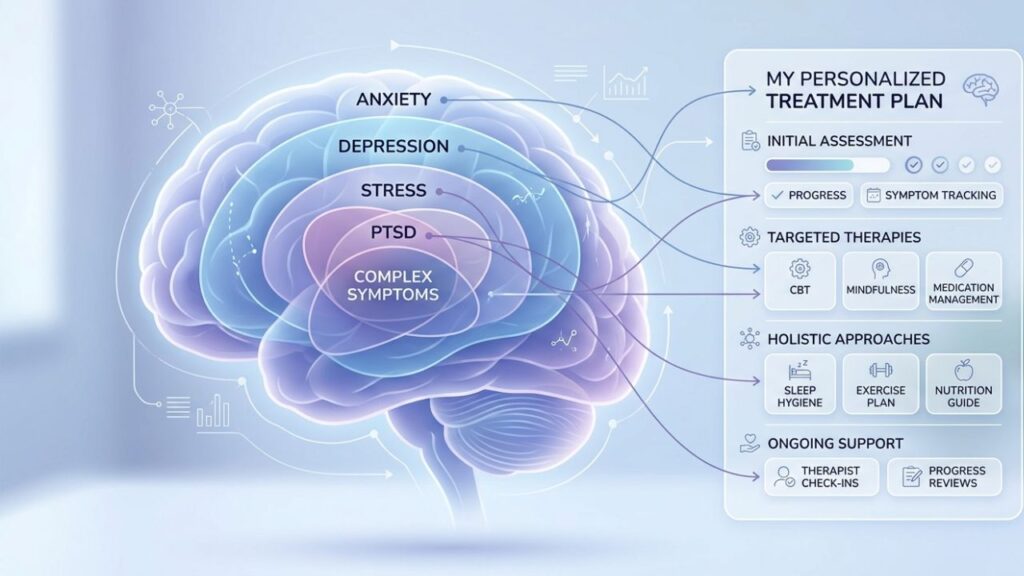
Most people who develop a substance use disorder are also living with at least one mental health condition. Depression, anxiety, PTSD, ADHD, and bipolar disorder show up at much higher rates among people with addiction than in the general population, and the relationship usually runs in both directions. The mental health condition makes substances feel like relief, the substance use makes the mental health condition worse, and the cycle reinforces itself over time.
When treatment focuses on the addiction without addressing the mental health condition underneath, it tends to produce short-lived results. The conditions that drove the use in the first place do not disappear during a treatment stay, and they are still there when the person leaves.
The terminology, briefly
The clinical term is co-occurring disorders, sometimes shortened to COD or referred to as dual diagnosis. All of these phrases describe the same situation: a substance use disorder occurring alongside one or more mental health conditions.
Almost every program advertises that it treats co-occurring disorders, but the term has been used loosely enough that it no longer signals much. The depth and quality of mental health care across programs varies widely, and the family’s job is to figure out what the program actually means by it.
Why integrated treatment matters
There are essentially three ways a program can handle a person with co-occurring conditions. The worst is sequential treatment, where the program insists the addiction must be addressed first, and the mental health condition can be looked at later. Decades of research have shown this approach to be less effective than the alternatives.
The middle option is parallel treatment, where the addiction is treated by one team and the mental health condition is treated by another, with limited coordination between them. This is better than sequential, but the seams show. Medications, therapy goals, and treatment messages can pull in different directions.
The strongest model is integrated treatment, where the same clinical team addresses both conditions in a coordinated way. The therapist knows the medications, the prescriber knows the therapy work, and the treatment plan is built around the interaction between the conditions rather than treating them as separate problems that happen to share a body.
Trauma deserves its own conversation
A high percentage of people with substance use disorders, particularly women, have a trauma history. PTSD and complex trauma respond to specific evidence-based therapies, including EMDR, cognitive processing therapy, and trauma-focused CBT. These are not interchangeable with general counseling, and asking whether a program offers trauma-focused therapy specifically is different from asking whether it has therapists.
A program that does not have at least one clinician trained in a trauma-specific modality is not equipped to do the deeper work for people whose substance use is closely tied to a trauma history.
Medication changes the picture
Untreated psychiatric conditions are one of the most reliable drivers of relapse after treatment. A person with treated depression has a meaningfully different prognosis than a person with untreated depression, and the same is true for anxiety disorders, bipolar disorder, and ADHD.
The right psychiatric medication, prescribed and managed by a clinician who actually understands addiction, can be one of the most useful things that happens during a treatment stay. The wrong medication, or no medication when one is needed, is one of the quieter ways treatment fails.
What to ask a program about co-occurring care
Useful questions for a program: Who does the psychiatric assessment, and when does it happen relative to admission? Is there a psychiatrist or psychiatric nurse practitioner on staff, and how often does each client see them? What therapeutic modalities are available specifically for trauma, depression, anxiety, or whatever conditions are relevant for your loved one? Are the therapy and medication management coordinated within the same team?
Programs that take co-occurring care seriously tend to give specific answers to these questions. Programs that do not tend to give general ones.
Families looking for treatment that integrates mental health care alongside addiction work sometimes consider Lanier Recovery Center as part of that search, particularly when previous treatment did not address the conditions underneath the substance use.
Looking at programs in the Atlanta area
The Atlanta metro area has a deeper bench of psychiatric and clinical specialty providers than many regions, which means programs in Georgia have more options for building genuine integrated care than programs in less resourced areas. Whether a specific program takes advantage of that depth varies, and the difference shows up in how seriously the program treats co-occurring conditions.
Families researching a drug rehab atlanta ga with serious dual-diagnosis needs in mind benefit from looking past the marketing language and asking specific questions about who provides psychiatric care, how often, and how integrated that care is with the rest of the treatment plan.