From Lab Notes to Masterpiece: Crafting Reproducible Notebooks for Unshakeable Data Science Projects
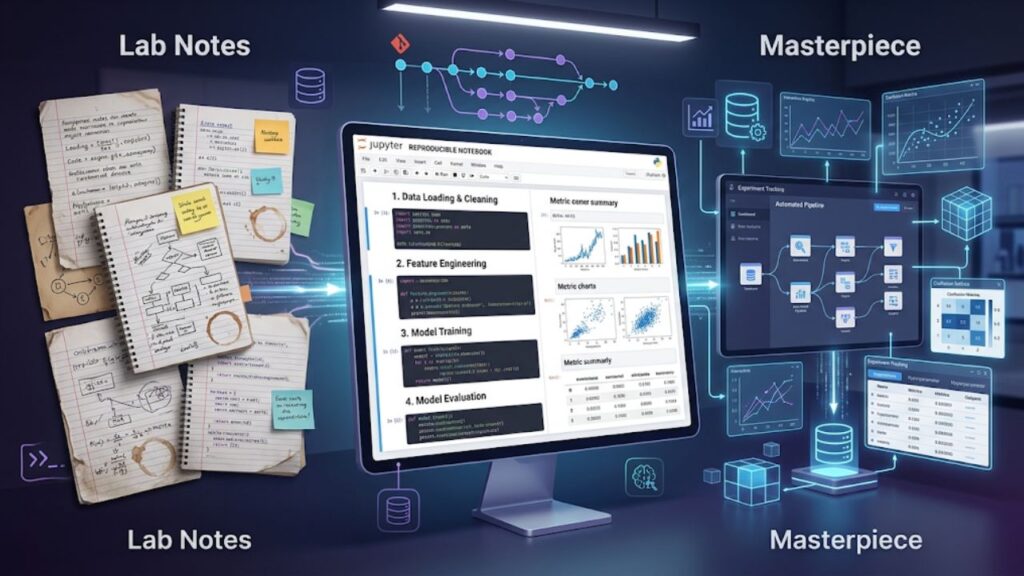
Let’s think of data science as being like a great culinary adventure. You’re not simply cooking; you’re an experienced explorer, mapping out uncharted areas of information, collecting unusual ingredients (data), and preparing powerful elixirs (insights). Your notebook, which acts as a reliable friend throughout the journey, is the place where you carefully note down each step—the exact temperature of the oven, the precise amount of spices, and the special technique that turned the raw ingredients into a gastronomic discovery. Yet what occurs when your fellow explorers, or even you yourself months later, attempt to reproduce your award-winning dish and fail? The magic disappears, the flavour is wrong, and the whole expedition then seems like a risk.
This exactly is the danger that affects a large number of data science projects when they lack reproducible notebooks; such projects are like culinary masterpieces which cannot be replicated, groundbreaking discoveries that disappear into thin air since the recipe has been lost or is defective. Reproducibility is not merely a fashionable term; it is the fundamental basis of reliable and scalable data science, guaranteeing that whatever complexity your work may have, it can be revisited, verified and built upon by others or even by yourself in the future.
The Alchemy of Environment: Taming the Wild Data Ecosystem
Imagine the environment in which your project is carried out as being like the kitchen in which you carry out your culinary experiments. It’s not merely a matter of the stove and the knives; it also comes down to the exact type of flour, the particular strain of yeast, and even the level of humidity in the air. In the case of data science, this means the specific versions of the programming languages, the libraries, and the dependencies that enable the analysis. A slight difference in a library version is similar to replacing a delicate saffron with a pungent turmeric – the results will be very different.
If we are to ensure reproducibility, then we have to carefully document and manage the environment. Tools such as Conda or Pipenv enable us to set up isolated environments, which is equivalent to creating a virtual “kitchen” for your project. When you specify the exact versions of all the libraries that are used (for example, pandas==1.4.2, scikit-learn==1.0.2), you are making sure that anyone who enters your kitchen will find themselves with the same arrangement. This is a basic step that is always stressed in any thorough data scientist course.
The Serialized Story: Capturing Every Culinary Sensation
Your notebook goes beyond being a simple collection of code; it serves as a narrative outlining your exploration. Every cell and each line of code functions as a sentence, forming a paragraph that explains how you reached your conclusions. In order to ensure reproducibility, it is necessary that this story be told with complete clarity and thoroughness. This requires more than just producing code that works; it requires writing code that is easy to understand.
Adopt the practice of writing clear comments. Instead of merely stating what you’re doing, explain the reason for taking a particular action. Choose variable names that are descriptive and easy to understand. If you were explaining your recipe to a person who had never cooked before, your notebook should serve a similar function for your data science project. This kind of detail is important, particularly if you’re thinking about enrolling in a structured data science course, since practical application and clear communication are essential in such a course. Think of it as marking each spice jar with its precise name and origin
The Immutable Ingredient List: Version Control’s Guiding Hand
Using the analogy of cooking, version control is similar to keeping a master record of all the different versions of a recipe. Have you altered the mixture of spices? Have you changed the cooking time? Version control systems such as Git enable you to keep track of each and every change made to your codebase and your notebooks; each commit functions as a save point, a snapshot of your project at a particular time.
It allows you to go back to any earlier state, see what has changed and why it has changed. Should a new modification cause an error, you can simply restore a stable version. The feature also promotes collaboration, so that several explorers can work on the same expedition without interfering with one another. It is the safety net which guarantees that your culinary journey doesn’t turn chaotic.
The Final Flourish: From Notebook to Report and Beyond
The conclusion of our expedition is a report, a presentation of our findings which has been neatly put together on the basis of the insights obtained from our reproducible notebooks. Nevertheless, reproducibility does not stop with the notebook itself; consider how your results are visualised or exported. Is it possible to generate the plots consistently? Are the output files saved in a known format?
You should use tools which enable the automatic production of reports straight from your notebooks, for example NbConvert or those built into platforms such as JupyterLab. This means that the final presentation of your dish is automated and is just as reliable as the recipe. When you are doing a comprehensive data scientist course, you will find out that the final output has to be just as robust as the analysis.
Conclusion: Building Legacies of Reliable Insight
It is not an afterthought to create reproducible notebooks; rather, it is a fundamental aspect of the data science craft. Such an approach turns temporary experiments into lasting legacies of reliable insights. If you carefully manage your environment, write a clear and coherent narrative, make use of version control, and guarantee the consistency of your final results, you will be laying a solid foundation for your data science work. This dedication to reproducibility doesn’t just improve the quality and reliability of your work but also promotes collaboration and speeds up the process of discovery. Therefore, I urge you, fellow explorers, to make sure that your masterpieces of data can be enjoyed, replicated, and built upon for generations to come.
Business name: ExcelR – Data Science, Data Analyst Course Training
Address: 1st Floor, East Court Phoenix Market City, F-02, Clover Park, Viman Nagar, Pune, Maharashtra 411014
Phone: 09699753213