Is That Tree Dangerous? Signs Sydney Homeowners Shouldn’t Ignore
Sydney’s mature trees give its suburbs shade, privacy and character, but a falling branch or trunk can wreck a roof, a car or a fence in seconds. Coastal storms, long dry spells and hot summer afternoons all put large trees under strain. The good news is that most failures are not completely random, because trees usually show visible stress well before something gives way. When those signs need to be confirmed and documented, a qualified arborist can carry out a hazard or risk assessment, which is the kind of arborist report Sydney councils often expect to see before approving work on a protected tree. Learning to spot the warning signs yourself helps you judge when that step is worth taking.
Cracks, Splits and Weak Branch Unions
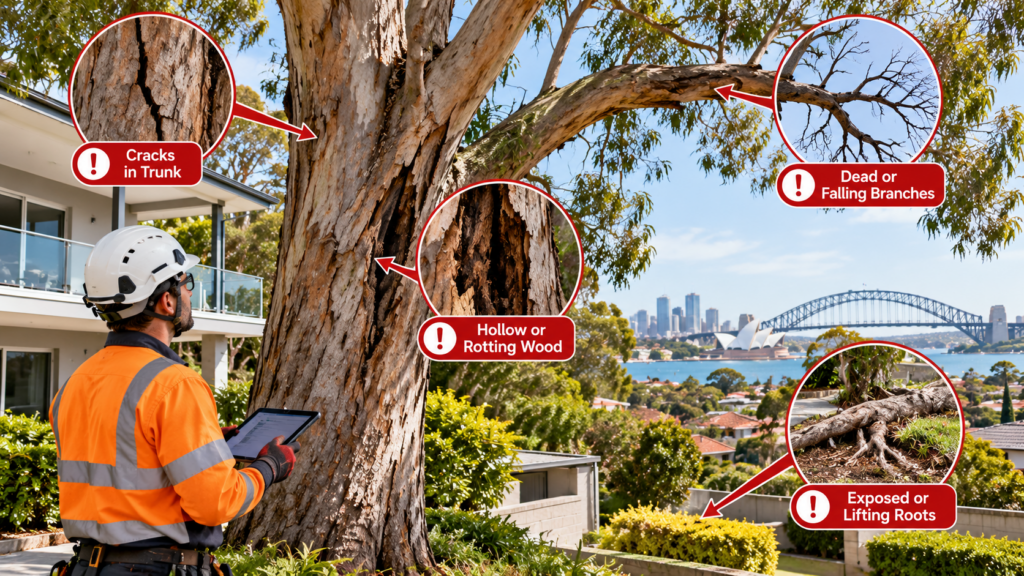
Start by looking at where the trunk divides and where large limbs join it. A healthy union usually forms a U shape with a raised ridge of bark on top. A tight V shape is more concerning, especially when bark is trapped inside the fork. This “included bark” stops the wood from fusing properly, so the two stems are held together more weakly than they look.
Vertical cracks in the trunk, splits running down from a fork, or a seam that seems to widen after wind are all signs to take seriously. Fresh cracks after a storm deserve particular attention, since they can indicate a limb or stem that has already been partly loaded beyond its strength.
Dead Wood and a Thinning Canopy
Every tree drops the odd dead twig, but large dead branches are a different matter. They become brittle as they dry, and they can fall on a calm day with no wind at all. Look for limbs with no leaves during the growing season, bark peeling away to expose grey wood, or branches that snap cleanly rather than bending.
A canopy that thins out over a season or two can point to root problems, drought stress or disease. Dieback from the top of the crown is a common pattern. Comparing photos taken from the same spot each year is a simple way to notice changes that are easy to miss day to day.
Some species, including many eucalypts, are also known for dropping large, healthy-looking limbs on hot, still days. The causes of this summer branch drop are not fully understood, so it is sensible to avoid parking, playing or setting up outdoor seating directly beneath big overhanging limbs during heatwaves.
Fungi, Cavities and Hidden Decay
Fungi growing on the trunk, at the base or across the root zone can be a sign of internal decay. Bracket fungi (shelf-like growths on the bark) are the most obvious example. Not every fungus is harmful, and some live harmlessly on surface debris, but fruiting bodies near the base or on major roots are worth having checked.
Other clues include:
- Cavities or hollows, particularly where a large branch was once removed
- Dark weeping or oozing patches on the bark
- Sawdust-like material at the base, which can indicate borers or termites
- Soft, crumbly wood or a hollow sound when the trunk is tapped
A tree can look leafy and green while its inner structure is compromised. That is why decay is one of the harder problems to judge from the ground and one of the most common reasons for a professional inspection.
Leaning Trunks and Root Plate Movement
A lean is not automatically a problem. Many trees grow at an angle towards light and develop wood that supports that position for decades. What matters is change. A tree that has started leaning recently, or appears to lean more after heavy rain or wind, may be losing its grip on the soil.
Check the ground on the side opposite the lean. Cracked, mounded or lifting soil suggests the root plate is moving. Exposed or broken roots, fungi around the root zone and waterlogged ground all add to the risk.
Root damage often comes from nearby works rather than the tree itself. Trenching for pipes, new driveways, retaining walls and changes in soil level can cut or smother roots. The effects may not appear for several years, so recent construction is worth mentioning to anyone assessing the tree.
What to Do When You Spot a Warning Sign
If a tree or large limb looks likely to fail right now, keep people and vehicles clear and treat it as an emergency. After storms, the NSW State Emergency Service can be contacted on 132 500 for help with fallen or dangerous trees affecting a home.
For less urgent concerns, resist the urge to climb, cut or remove large branches yourself. Working at height with a chainsaw is risky, and poor cuts can create new decay entry points. It can also breach local rules. Most Sydney councils protect trees above certain sizes, and pruning or removal often needs approval first. Councils may allow faster action for dead or dangerous trees, but they generally want supporting evidence from a suitably qualified arborist, commonly someone holding an AQF Level 5 qualification.
Before an inspection, note what you have seen, when it started, and any recent storms or building work. Photos from different angles are useful.
If the tree belongs to a neighbour, raise the concern with them early and in writing where possible. In NSW, unresolved disputes about trees on neighbouring land can be taken to the Land and Environment Court under the Trees (Disputes Between Neighbours) Act 2006, and a clear record of the tree’s condition makes any conversation more productive.