A Deep Dive into Powder Coating Machine Features That Improve Finish Smoothness
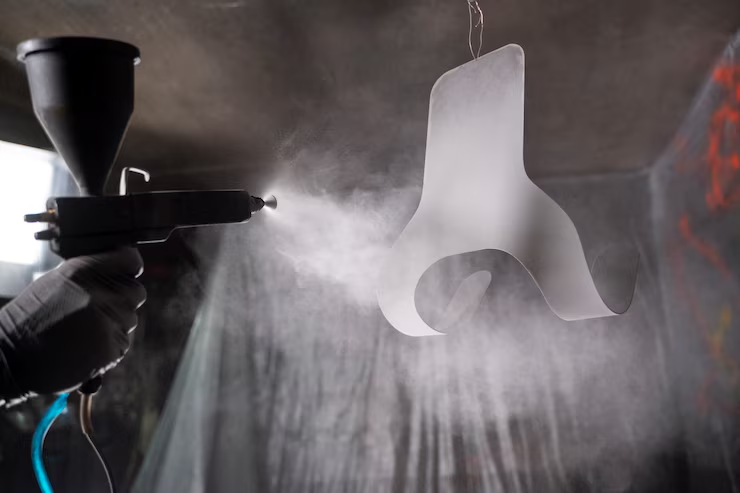
Anyone who’s watched a metal part go from dull gray to a glossy, flawless coat knows there’s more to that transformation than meets the eye. The shine, texture, and consistency all trace back to how well the powder coating machine does its job. And behind that polished surface? Smart design features doing the heavy lifting.
Convection Balancing Ensures Uniform Surface Flow
Inside a powder coating oven, air movement plays a bigger role than most realize. Convection balancing helps distribute heat evenly across the entire surface of the part, preventing uneven curing. Without it, some spots might end up glossier or rougher than others—not exactly ideal for a high-quality finish. A powder coating machine with smart airflow control pushes hot air precisely where it’s needed, keeping temperatures stable from edge to edge.
Well-balanced convection doesn’t just smooth out inconsistencies. It also shortens cure times, saving energy and reducing overspray waste. That’s because consistent airflow ensures that powder melts and flows evenly across curves, edges, and corners. The end result is a uniform, professional look that holds up under close inspection.
Controlled Ramp-and-Hold Cycles Refine Finish Texture
Getting that sleek, flawless surface comes down to how heat is applied over time. A powder coating machine with customizable ramp-and-hold cycles gives operators control over how quickly the oven heats up and how long it holds at a set temperature. This matters a lot more than people think. A fast ramp can cause powder to gel before it flows properly, while a slow one lets it smooth out perfectly.
By controlling these cycles, finish texture becomes more predictable and refined. Operators can fine-tune settings based on the material or coating type, resulting in fewer defects and smoother results. It’s like baking—rush it and the cake collapses, but get the timing right and it comes out perfect every time. That same level of precision is now standard in high-end powder coating machines.
Particle Charging Stability Maximizes Coating Evenness
One of the most technical features in any powder coating machine is how it charges the powder particles before they hit the part. An unstable charge means some particles drift, clump, or even bounce off the surface instead of sticking. But stable electrostatic charging ensures powder clings evenly, reducing uneven thickness and patchy spots.
This is especially helpful for complex parts with tight crevices or sharp bends. With consistent particle charging, the powder wraps smoothly around the entire shape. That keeps coverage even, regardless of angles or curves. Less wasted powder and better adhesion? That’s a win across the board.
Closed-Loop Temperature Regulation Guarantees Uniform Results
Temperature swings inside a powder coating machine can ruin a great job. Closed-loop regulation solves this by constantly monitoring and adjusting heat levels to stay within tight margins. The system checks readings in real-time and makes micro-adjustments to keep the temperature stable throughout the curing process.
For finish quality, this means no hot spots or cool patches that could distort the coating. Parts come out with a consistent gloss and feel, even if they’re packed in different positions. This kind of control is vital, especially when processing parts in batches or working with sensitive materials that don’t tolerate heat variations well.
Powder Atomization Techniques Enhance Surface Flatness
Getting powder to spray as a fine, even mist makes a world of difference. Atomization affects how well the powder flows and sticks once it’s sprayed. In some powder coating machines, advanced nozzles and airflow design help break up powder into uniform particles before they even leave the gun. This improves distribution and helps avoid clumping or texture inconsistencies.
Better atomization means fewer touch-ups and smoother finishes, especially on large flat panels or intricate parts. Combined with good booth airflow, it helps the powder land softly and evenly—like snow settling on a surface—rather than blasting on too thick or uneven. The result? A flatter, more polished coat that holds its appeal longer.
Humidity-Controlled Chambers Eliminate Finish Imperfections
Moisture and powder don’t mix well. In a humid environment, powder can clump, clog the sprayer, or cure with bubbles and pitting. That’s where humidity-controlled chambers come in. A powder coating machine with built-in moisture regulation creates the perfect climate for spraying, no matter what the weather is doing outside.
This feature is especially useful in places with seasonal weather shifts. Without it, the same settings that worked in winter might fail in summer. With consistent humidity levels, though, the powder flows predictably and evenly—reducing surface defects and making sure the final finish stays smooth and clean.
Exhaust Flow Calibration Maintains Contaminant-Free Surfaces
One overlooked factor in finish quality is how well the exhaust system removes stray particles and fumes. Poor airflow can lead to recirculated dust settling back on freshly coated surfaces. But with precise exhaust flow calibration, the powder coating machine keeps the work zone clean and pressure balanced.
This helps prevent lint, overspray, and other contaminants from sticking to the part before curing. It also improves worker safety by reducing airborne particles. Clean air means a cleaner coat, which is especially critical for high-gloss finishes where every imperfection shows.
READ ALSO: Best Charging Solutions: Anker’s Fast and Safe Chargers