Cattle IVF vs. Artificial Insemination in Cattle: Comparing Top Breeding Methods — Which Is Better for Your Herd?
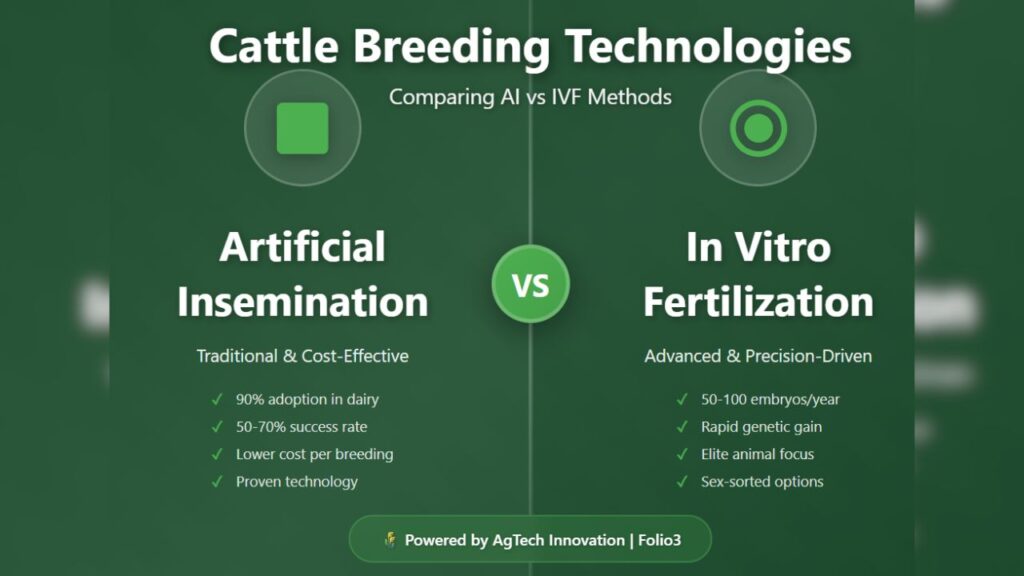
Breeding decisions shape everything in a cattle operation: genetic progress, fertility, calving intervals, replacement quality, and long-term profitability. Two technologies dominate modern genetic improvement programs—Artificial Insemination (AI) and In Vitro Fertilization (IVF). AI is widely used in dairy systems, with some references noting that in countries with substantial dairy industries, more than 60% of dairy cattle are bred using AI.
IVF, especially OPU-IVF (ovum pick-up + IVF), is a higher-input method that can multiply elite female genetics far faster than natural reproduction. The “better” option depends on your goals, budget, labor capacity, and the genetic value of your cows.
1) Artificial Insemination (AI) in Cattle: What It Is and How It Works
AI is the process of placing semen into the cow’s reproductive tract at the right time, using trained technique and proper semen handling. The biggest driver of AI success is timing and procedure quality—identification, hygiene, semen handling, and correct deposition site all matter for acceptable outcomes.
Key steps in an AI program
- Heat (estrus) detection or a timed-AI protocol
- Thawing and handling semen correctly
- Insemination by a trained technician
- Optional: estrus synchronization to reduce heat-detection workload and breed groups on a schedule
Best-fit use case for AI
AI is ideal when you want steady genetic improvement across many cows, control venereal disease risk (no bull contact), and keep per-breeding costs relatively manageable.
2) Cattle IVF: What It Is and Why It’s Powerful
IVF is a lab-based method where eggs (oocytes) are collected from a donor female, fertilized outside the body, cultured, and then transferred into synchronized recipient cows.
A common modern approach is OPU-IVF, where oocytes are collected from a live donor via ovum pick-up, fertilized in the lab, and embryos are typically transferred about 7 days after fertilization.
The IVF workflow (simplified)
- Select and prepare donor
- OPU (egg collection)
- Fertilization + embryo culture
- Embryo transfer into recipient cows
- Pregnancy check + calving management
Best-fit use case for IVF
IVF makes the most sense when you have elite donor cows (top genetics, rare lines, high market value) and want to produce many offspring from those females in a short time.
3) AI vs IVF: Side-by-Side Comparison That Matters on Farm
Genetic gain
- AI: spreads superior male genetics widely and consistently
- IVF: multiplies superior female genetics rapidly (big advantage when your donors are exceptional)
Success rates and realism
Pregnancy outcomes vary with management, nutrition, heat stress, and technician skill. Research discussions often compare conception/pregnancy rates after AI and embryo transfer (ET), showing they can be in a similar range depending on conditions and management.
Commercial ET providers also report strong pregnancy rates in well-managed recipients, with fresh embryos often higher than frozen-thawed.
Bottom line: IVF isn’t “guaranteed faster” per transfer—its power is that you can produce many embryos from one donor, accelerating genetic progress even if each individual transfer has variable results.
Cost and complexity
- AI: generally lower cost per breeding, simpler logistics
- IVF: higher cost per embryo/pregnancy + lab dependence + more coordination (donor/recipient management)
Labor and management intensity
- AI: requires strong heat detection (or a timed-AI program) and consistent process discipline
- IVF: requires donor scheduling, OPU sessions, recipient synchronization, embryo inventory, and careful timing
Welfare considerations
- AI: minimally invasive when performed correctly
- IVF: more intensive (repeated handling, OPU procedures, synchronization)—best run with veterinary oversight and careful monitoring
4) Which Is Better for Your Herd?
Choose AI if you want:
- Reliable, scalable herd-wide improvement
- Lower cost per breeding
- Simpler implementation and fewer moving parts
- A proven system that works well with good heat detection or timed-AI protocols
Choose IVF if you have:
- A small number of truly elite donor females
- A goal to multiply those genetics quickly
- Access to strong recipients and professional IVF services
- The budget and management capacity to run a higher-input program
Best practice for many farms: use both
A common high-performance strategy is:
- AI for the main herd (broad improvement)
- IVF for the top 5–10% females (rapid multiplication of best genetics)
5) Where Technology Helps (Without Adding More Chaos)
Because IVF involves many animals, schedules, protocols, and outcomes, organized tracking matters. A good cattle IVF software setup can help teams manage donor cycles, OPU schedules, recipient synchronization, embryo inventory, and success-rate reporting—so decisions are based on data, not memory or spreadsheets.
Conclusion
AI is the best “foundation” breeding tool for most herds: cost-effective, scalable, and proven. IVF is the best “accelerator” when you have elite cows worth multiplying fast. If you’re serious about genetic progress, the real answer is often AI + targeted IVF—using each method where it delivers the strongest return.
If you want, tell me your herd type (dairy or beef) and your main goal (milk, fertility, carcass traits, replacements, show genetics), and I’ll tailor a shorter decision framework that fits your operation.