How Facility Scheduling and Event Management Software Cuts Admin Time by 40% for Community Centers
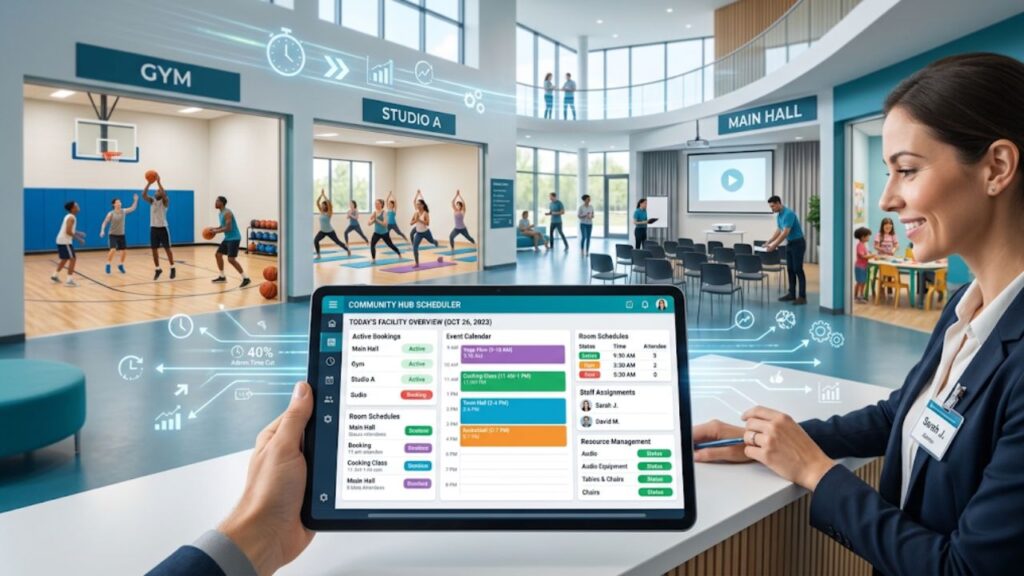
Community centers operate under a specific kind of administrative pressure that is easy to underestimate from the outside. On any given week, staff are managing room reservations from dozens of different user groups, coordinating equipment setups, processing rental agreements, handling deposit tracking, and fielding phone calls from people who want to know whether the gymnasium is available on a Saturday morning three weeks from now. None of these tasks are complex in isolation, but together they consume a disproportionate share of staff time — time that could otherwise go toward programming, community outreach, or facility maintenance.
The problem is not a lack of effort. Most community center staff are highly organized and genuinely committed to running things well. The problem is that manual scheduling systems — whether spreadsheets, shared calendars, or paper-based booking logs — introduce coordination gaps that compound over time. A double booking gets missed. A deposit goes unrecorded. A rental agreement is sent late. Each of these small failures creates a downstream correction that takes longer to resolve than the original task would have taken if the workflow had been structured correctly from the start.
This is why more community centers are moving toward purpose-built scheduling systems. The administrative savings are real, documented, and measurable. But the more meaningful shift is operational: staff spend less time managing information and more time doing the work that actually serves the community.
What Scheduling Software Actually Does at the Operational Level
When community center administrators evaluate facility scheduling and event management software, the conversation often starts with features — booking calendars, automated confirmations, online payment processing. These are real capabilities, but they describe the surface of the system rather than its function. What this category of software actually does, at an operational level, is replace a collection of disconnected manual steps with a single coordinated workflow.
A typical facility booking at a community center without dedicated software might involve three or four separate steps handled by different people at different times: a phone or email inquiry, a manual check of availability, a follow-up to confirm the booking, and a separate process to issue and track the rental agreement and payment. Each handoff between steps creates an opportunity for something to fall through. The booking exists in one place, the payment in another, and the agreement in a third.
Purpose-built facility scheduling and event management software consolidates these steps so that when a booking is confirmed, the system automatically generates the agreement, logs the payment requirement, sends the confirmation to the renter, and updates the availability calendar in real time. The staff member who managed the inquiry does not need to circle back to three separate systems to complete the task. It happens as part of one workflow.
The Role of Centralized Availability in Reducing Errors
One of the most consistent sources of administrative error in community center operations is fragmented availability information. When multiple staff members can make bookings across multiple channels — phone, email, walk-in — without a single source of truth for current availability, double bookings are almost inevitable. Resolving a double booking takes significantly more time than preventing one. It typically involves contacting both parties, finding an alternative time or space for one of them, reissuing agreements, and managing any dissatisfaction that results from the disruption.
A centralized scheduling system eliminates this problem structurally. Availability is updated the moment a booking is confirmed, and every staff member working from the system sees the same real-time calendar. The risk of conflicting bookings drops substantially, not because staff are more careful, but because the system removes the condition that made the error possible in the first place.
Automated Communications and Their Effect on Staff Workload
A significant portion of the time community center staff spend on scheduling is not spent on scheduling decisions — it is spent on communications that exist to support scheduling decisions. Confirmation emails, reminder messages, follow-up requests for signed agreements, payment reminders, and post-event check-ins all take time to write and send manually, even when the content is largely repetitive.
Scheduling software handles these communications through automated triggers. When a booking reaches a certain status — confirmed, one week out, payment due — the system sends the appropriate message without requiring staff input. This does not eliminate human communication from the process; staff still handle questions, disputes, and special circumstances. But it removes the routine, repetitive layer of communication work that consumes time without requiring judgment or expertise.
Where the 40% Time Reduction Comes From
The figure of a 40% reduction in administrative time is not a theoretical projection. It reflects what community centers and multi-use facilities consistently report after implementing structured scheduling systems, and it aligns with broader research on the relationship between workflow automation and administrative efficiency across the public and nonprofit sectors. The Urban Institute, which studies nonprofit and government service operations, has documented similar efficiency patterns when manual coordination processes are replaced by integrated systems.
The reduction does not come from a single dramatic change. It comes from the accumulation of smaller time savings across every part of the booking workflow: fewer phone calls to confirm availability, fewer emails to chase down signed agreements, fewer corrections to fix double bookings, and fewer hours reconciling payment records at the end of the month. Each of these individually might represent fifteen or thirty minutes. Across dozens of bookings per week, over a full program year, the total is substantial.
Reporting and Record-Keeping as Hidden Time Costs
Community centers are often required to produce usage reports for municipal governments, boards, or funders. These reports document which spaces were used, how often, by which groups, and what revenue was generated. When this information lives in spreadsheets or booking logs, compiling a report requires manual data collection and formatting that can take hours each quarter.
Scheduling software stores this data automatically as a byproduct of normal booking operations. When a report is needed, staff can generate it directly from the system rather than reconstructing it from scattered records. This shifts report preparation from a time-intensive task to a routine output, which is a meaningful change for small administrative teams with limited capacity.
The Compounding Effect on Staff Capacity
For community centers that operate with lean administrative teams, the time savings from scheduling software do not just reduce individual task durations — they change what the team is able to accomplish during a given workday. When two or three hours of repetitive scheduling work is removed from a staff member’s week, that capacity becomes available for programming coordination, community engagement, or facility planning work that previously got deferred.
This compounding effect is one reason the administrative impact of facility event management software tends to grow over time. In the first months of implementation, staff are still building familiarity with the system. By the end of the first full program year, the efficiency gains are embedded in the workflow and the team’s capacity has genuinely expanded.
Implementation Considerations for Community Center Environments
Community centers present a specific set of operational characteristics that affect how scheduling software should be configured and rolled out. Unlike private event venues or corporate facilities, community centers typically serve a wide range of user groups with different levels of technical comfort — youth sports leagues, senior programs, civic organizations, after-school providers, and private renters all may book through the same system. The software needs to be accessible to a broad range of users, not just technically proficient ones.
This consideration affects both the choice of system and the configuration of the public-facing booking interface. If the online booking process is too complex, user groups will revert to calling the front desk, which reintroduces the manual workload the software was intended to reduce. Keeping the renter-side experience simple and clear is as important as the administrative functionality on the back end.
Staff Training and Adoption as Operational Variables
The efficiency gains from scheduling software depend significantly on consistent adoption by the full administrative team. A system that only some staff members use, or that gets bypassed for certain booking types, creates the same fragmented information problem that existed before. When some bookings are in the system and others are on a separate spreadsheet, the availability calendar is no longer a reliable single source of truth.
Successful implementation generally requires a defined transition period during which the old system is fully retired and all bookings are processed through the new one. This can feel disruptive in the short term, but partial adoption tends to extend the transition period indefinitely and prevents the team from realizing the full efficiency benefit.
Integration with Payment Processing and Agreement Management
The administrative value of event management software for facilities is highest when booking, payment, and agreement management are handled within the same system. When these functions are separated — bookings in one tool, payments in another, agreements in a third — staff still need to reconcile records manually, and the efficiency gain from any one system is limited by the gaps between them.
Community centers that get the most from their scheduling infrastructure typically prioritize systems that handle the full transaction cycle: from initial inquiry through payment collection, agreement execution, and post-event documentation. This end-to-end coverage is what makes the administrative time reduction measurable rather than marginal.
Closing Perspective
Administrative inefficiency in community center operations is rarely the result of poor management. It is almost always the result of workflows that were designed for lower booking volumes and simpler operations than the center now manages. Manual systems that worked reasonably well when a facility handled twenty bookings per month start to break down when that number reaches two hundred.
Facility scheduling and event management software addresses this by providing the structural foundation that manual systems cannot: a single source of current availability, automated communications that reduce routine workload, and integrated record-keeping that makes reporting straightforward. The 40% reduction in administrative time that community centers consistently report is not a marketing claim — it reflects what becomes possible when staff are no longer spending their days managing information gaps that a well-configured system would have prevented.
For community center administrators evaluating whether a structured scheduling system is worth the investment, the more useful question is not whether the software pays for itself. It almost always does. The more useful question is how much of the current administrative burden is genuinely necessary, and how much of it exists because the operational infrastructure has not kept pace with the workload it is being asked to support.