How Quantum Search Optimization Works with Grover’s Algorithm
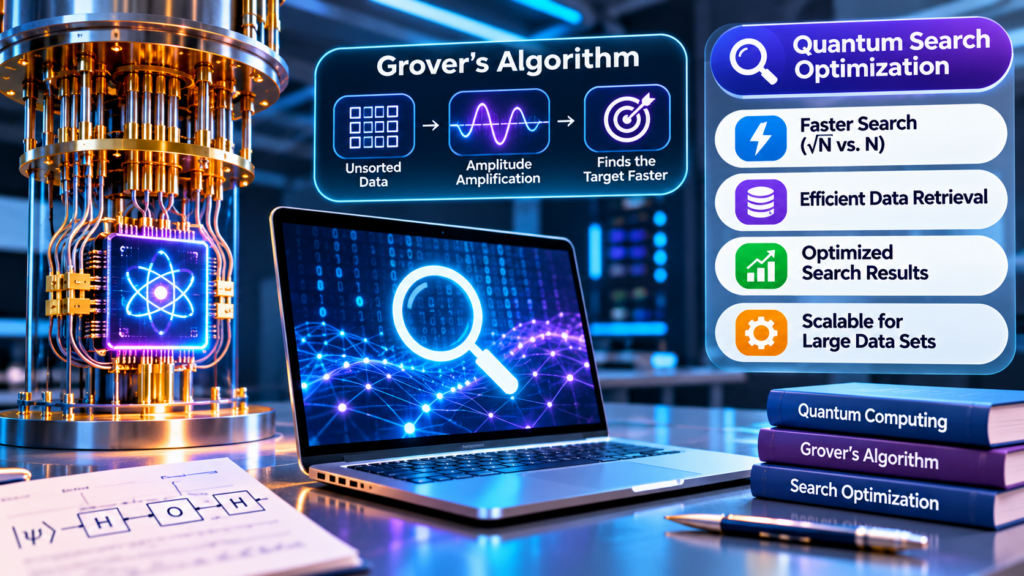
Finding specific information within large datasets can require substantial computational effort, especially when the data has no useful organizing structure. Classical computers check possible solutions one by one — making extensive searches increasingly expensive as the number of possibilities grows. Quantum computing offers a different approach through algorithms built to improve specific computational tasks.
It’s one of the clearest examples of quantum doing something classical hardware genuinely can’t match at scale. Grover’s algorithm provides a quadratic speedup for unstructured search — relevant to optimization, data analysis, and cybersecurity. Understanding how it works reveals both the potential benefits and the practical challenges.
What Is Quantum Search Optimization?
Start here. Quantum search optimization uses quantum computing to tackle certain search problems differently. Rather than walking through candidates in order, it uses quantum states to make the desired result more probable at readout. Search problems involve checking possible answers against specific conditions — finding a matching record or spotting a valid solution, that kind of work. Grover’s algorithm is the clearest example: a well-defined quantum procedure that cuts the operations required to locate a correct answer in an unstructured space, without leaning on the structure that classical algorithms depend on.
But quantum search earns its keep with unstructured problems, where no pattern helps narrow down the field. Through superposition and interference, quantum algorithms can improve search efficiency, as demonstrated by Grover’s algorithm search optimization.
How Grover’s Algorithm Search Optimization Works
Lov Grover published this in 1996. Here’s the short version: every candidate sits in the system at once, and the algorithm keeps nudging probability toward the right answer with each cycle. Measure at the end and you’ll land on the correct result most of the time — without ever scanning through candidates one by one.
Here’s what actually happens under the hood, broken into five steps:
· Creating superposition: The qubits start in a known state, then gates push them into superposition — every candidate answer gets represented at once. No loop, no checking one by one. Everything’s in play from the start.
· Marking the target: The oracle step tags the right answer — not by revealing it, but by flipping its phase. Everything else stays untouched. The marked state is now primed for amplification.
· Amplifying the probability: A diffusion operation increases the amplitude of marked states while reducing the relative amplitude of unmarked states.
· Repeating the process: The oracle and diffusion operations are repeated a carefully selected number of times. Too few iterations and you get an unreliable result. Run too many, and the probability swings back past the peak — over-rotation degrades the result just as surely as stopping too early.
· Measuring the result: The quantum state is measured, producing a candidate solution that can then be checked.
Understanding Grover’s Search Speed Advantage
Real speedup. Take N possible candidates — classical unstructured search can hit O(N) evaluations in the worst case. Grover cuts that to roughly O(√N) oracle queries. The gap sounds abstract until you put actual numbers on it.
For example, imagine searching through one million possibilities. Classical unstructured search needs roughly 1,000,000 operations — Grover’s cuts that to around 1,000. The difference is stark.
That’s the theoretical picture — not a guaranteed wall-clock improvement. Quantum hardware, circuit depth, and the overhead of building the oracle all cut into those gains. And the speedup is quadratic, not exponential, so it’s most valuable when the problem genuinely has no structure a classical algorithm could already exploit.
Applications of Grover’s Algorithm in Optimization
Real breadth. Grover’s algorithm and related amplitude amplification techniques can support several computational applications — the scope is wider than most people initially expect.
1. Constraint satisfaction: Problems involving many conditions can sometimes be expressed as searches for solutions that satisfy those constraints. valid candidates get amplified rather than discovered through exhaustive enumeration — that’s the core insight.
2. Combinatorial optimization: Some optimization problems can be reframed as a search over possible configurations. Quantum search might help explore that space faster — though whether you actually get a useful speedup depends a lot on the problem structure and how clean the oracle implementation turns out to be.
3. Database search: This approach offers a theoretical path to finding matching items in an unstructured collection. But efficient access to large datasets remains a major challenge for practical quantum systems.
4. Artificial intelligence and machine learning: Search and amplitude amplification can potentially support selected tasks involving candidate selection or optimization. These remain active research areas — not a universal replacement for classical methods.
The oracle and diffusion operations — how they interact to shift probability toward the target — are covered in depth in the step-by-step explanation of Grover’s algorithm.
Grover’s Algorithm and Cybersecurity
This is where things get concrete for security teams. The algorithm’s quadratic speedup could reduce the computational effort behind certain brute-force attacks — not wipe them out, but shrink them in ways that matter.
For example, an attacker attempting to guess a cryptographic key faces a large number of possible candidates. This algorithm could theoretically cut the number of search operations required to find a matching key. That doesn’t mean quantum computers can easily break modern encryption. The speedup is quadratic — and practical attacks would still need powerful quantum hardware plus substantial computational resources.
Symmetric encryption systems may need reassessing for long-term security given this potential speedup. Larger key sizes help compensate for the theoretical reduction in brute-force complexity. Research into quantum search and cryptographic applications continues to examine these implications — ignoring them is a mistake.
Challenges and Limitations of Quantum Search
Tough obstacles. Real barriers stand between the theory and large-scale use — mostly hardware-related. The practical picture is significantly messier than the theoretical case suggests, and that gap isn’t closing as fast as early timelines predicted.
· Hardware limitations: Today’s quantum processors are small and noisy — qubit counts are limited, and errors accumulate fast.
· Circuit complexity: Every oracle-plus-diffusion pass adds gate operations. that cost stacks up quickly, and on near-term hardware it matters a lot.
· Oracle construction: Building an efficient oracle can be difficult and it’ll often consume significant computational resources.
· Data access: Loading and accessing large datasets efficiently remains a major obstacle. There’s no clean workaround — that process itself can eat up any speedup the algorithm offers.
· Iteration count: Run too few cycles and the probability hasn’t peaked — the measurement comes back wrong. Run too many and it swings past the peak, also wrong. The sweet spot is tied directly to the size of the search space, so you can’t just guess.
Final Thoughts
The algorithm shows how quantum computing can tackle unstructured search through amplitude amplification — and it does it cleanly. The quadratic speedup has real implications for optimization and data analysis — and the cybersecurity angle raises questions about cryptographic security that won’t go away.
The hardware isn’t there yet for anything at scale. But teams that actually understand how this works — not just the headline claims — are in a better position to judge when it starts to matter.
FAQs
What is Grover’s algorithm used for?
It searches unstructured problem spaces more efficiently by increasing the probability of finding the right answer. Not hypothetical — it’s a well-defined algorithm with a proven complexity advantage.
How much faster is Grover’s algorithm?
It offers a quadratic speedup in theory — O(N) becomes O(√N) oracle queries. Put a million candidates in, and classical search might need a million checks while Grover’s gets there in roughly a thousand. Whether you see those gains in practice comes down to hardware and how well the oracle is built.
Can Grover’s algorithm break encryption?
It could theoretically speed up brute-force attacks against certain cryptographic systems, but it doesn’t automatically break modern encryption. Hardware requirements alone make that a long way off.
Is Grover’s algorithm practical today?
Not at a useful scale, no. Today’s quantum processors are too noisy and too small. The few implementations that exist are proof-of-concept work on tiny problem sizes — nowhere near what you’d need for a real search task.