Transforming Healthcare Employee Training Through Simulation-Based Learning
It is necessary to put knowledge into practice in the healthcare industry. A doctor must make well-informed decisions under pressure, a nurse must react confidently to a patient’s changing condition, and administrative staff must negotiate intricate healthcare systems without jeopardizing patient data. In any circumstance, understanding how to accomplish a task is just as important as being able to do it correctly.
Nevertheless, personnel are not always adequately prepared for these demands in the real world by standard employee healthcare training. Important knowledge can be communicated through classroom sessions, presentations, manuals, and demonstrations, but there aren’t many chances to practice, make mistakes, and learn from them in a real-world setting. This is where the use of simulation-based learning in healthcare is having an impact.
Simulation-based learning is revolutionizing the way hospitals and healthcare organizations increase workforce competency by enabling healthcare professionals to practice clinical procedures, manage difficult situations, and traverse digital systems in a controlled environment. It makes training more useful, interesting, and directly related to the tasks workers perform on a daily basis.
Let’s examine how this strategy is changing employee training in the healthcare industry and why it is becoming a crucial component of contemporary workforce development.
Why a New Method Is Needed for Traditional Healthcare Employee Training?
Healthcare workers operate in settings where even minor errors can have serious repercussions. However, traditional training approaches frequently rely on academic understanding and little real-world experience.
A new level of preparation is needed, though, when employing that knowledge to manage several patients, use an electronic health record (EHR) system, and react to unforeseen circumstances. Typical difficulties with traditional healthcare training include the following:
- Minimal practical experience
Employees may have a theoretical understanding of procedures but not enough opportunities to put them into practice.
- Risk of mistakes
In clinical settings, learning directly by trial and error may put patients at unnecessary risk.
- Delivering training inconsistently
Employee competency may differ depending on the methods used by various trainers, departments, and locations.
- Knowledge retention training
Employees may not receive enough reinforcement from one-time training sessions to help them remember and implement the material.
- Complex healthcare technology
In addition to their clinical duties, staff members must constantly master new EHR platforms, hospital administration systems, and digital workflows.
The above challenges demonstrate the need for a more useful strategy that links education to real-world business demands.
What is Simulation-Based Learning in Healthcare?
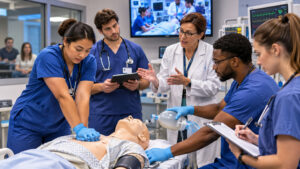
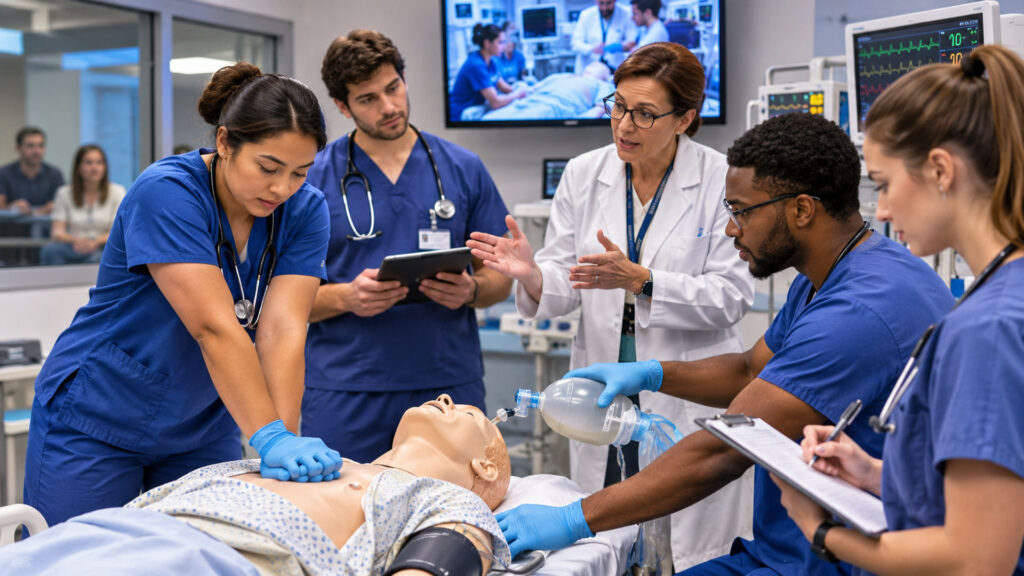
Simulation-based learning is a training method that replicates real-world scenarios in a safe environment. Employees can practice tasks without putting real patients or operational systems at unnecessary risk.
Simulations in the healthcare industry can mimic digital operations, clinical procedures, emergency scenarios, patient contacts, and the use of medical equipment.
How is Simulation-Based Learning Changing Training for Healthcare Employees?
Healthcare training is being transformed by simulation-based learning in significant ways. Rather than depending solely on explanations and demonstrations, companies can design learning opportunities for their team practice, make choices, and perform better. Some of the biggest advantages are listed below.
- Build useful skills without risking patients
Employees may practice critical skills without working on real patients, which is one of the main benefits of healthcare simulation training.
- Enhance clinical competency and employee confidence
There’s a difference between knowing what to do and feeling ready to accomplish it. Simulation-based learning aids in closing this gap with frequent practice and instant feedback.
- Enhance communication and teamwork
Patient care doesn’t rely solely on one person. To provide successful care, medical professionals, nurses, pharmacists, technicians, and administrative teams must coordinate their efforts. Employees from many departments can practice collaborating in real-world situations through simulation-based team training.
- Improve training in healthcare technology
Clinical competency is just one aspect of developing healthcare workers. Software simulation provides a more useful substitute. It replicates the processes and interface of the program, enabling clinicians to rehearse activities in a safe setting without having to deal with actual patient data.
- Enhances knowledge retention and promotes ongoing learning
Simulation-based learning makes continuous learning more practical by allowing employees to review scenarios and solidify their knowledge. Additionally, frequent practice allows trainers to highlight areas where employees need more assistance.
Empowering Healthcare with Assima’s Simulation-Based Training
Adopting new healthcare technology is only half the story. What really counts is making sure healthcare professionals can use it with confidence. Assima assists healthcare organizations with realistic, interactive software simulations that enable them to learn by doing.
Organizations can develop role-specific training experiences, get teams ready before system go-lives, and swiftly update learning materials when applications change with the help of hyper-realistic, object-based simulations. Assima helps healthcare teams develop software expertise, embrace digital change, and get more out of the technology they use on a daily basis by tying together practical experience with continuing support and learning analytics.
Conclusion
Information delivery is only one aspect of employee training in healthcare. They must be able to put what they have learned into practice, handle difficult circumstances, and confidently carry out their duties. Simulation-based learning makes this possible by linking theoretical understanding with real-world experience. It gives employees the chance to improve their abilities in a safe setting, by learning complex healthcare software, practicing clinical procedures, or enhancing team communication.
Combining clinical simulation with digital simulation and practical software training can assist organizations in developing a workforce that is better equipped to handle shifting patient care needs and changing digital environments as healthcare continues to become more technology driven.