When to Replace Your Microscope Slide Cabinet
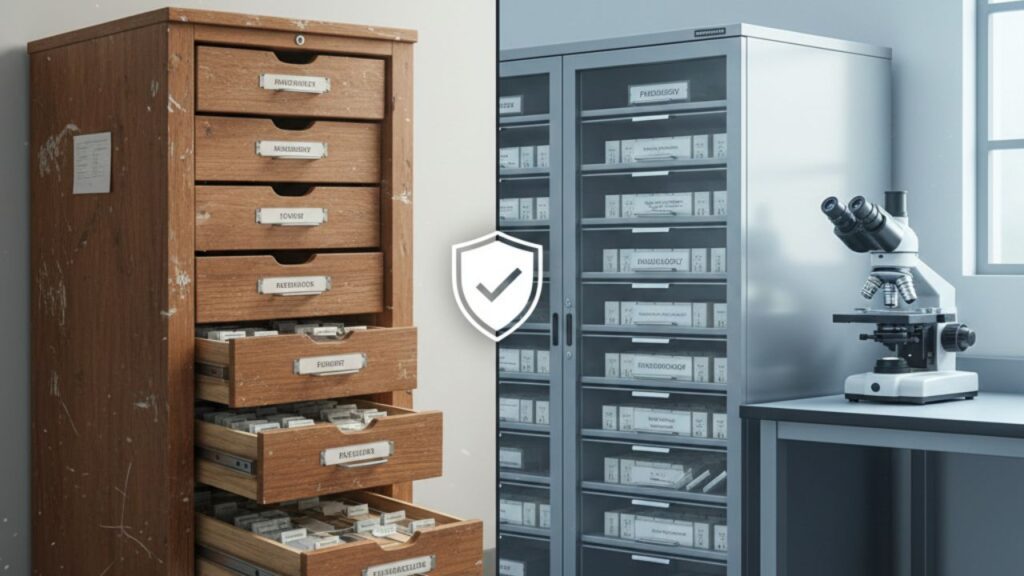
The drawer sticks.
You pull again. Harder this time.
It opens with a tired groan—the kind that sounds like it’s filing a formal complaint with HR. Inside? A hundred meticulously prepared slides. Years of work. Patient samples. Research history.
And suddenly you’re thinking: Is this cabinet… one bad morning away from disaster?
Welcome to the quiet drama of aging microscope slide cabinets.
The Slow Creep of Structural Decay
Nobody wakes up and says, “Today feels like a cabinet replacement day.”
It’s gradual. A drawer that doesn’t glide. Tracks that scrape. Corners that don’t quite meet anymore. Wood that subtly warps after years of humidity shifts. Metal that’s tired of pretending it’s still level.
Here’s the problem: microscope slide cabinets aren’t decorative furniture. They’re environmental control systems in disguise.
According to the National Archives (NARA.gov), proper archival storage is essential for long-term preservation. That means tight seals. Stable materials. Protection from dust, light, and moisture. When drawers misalign or gaps appear, you lose that micro-environment.
And slides don’t forgive exposure.
If your cabinets:
- Don’t close flush
- Feel unstable under load
- Show cracks, swelling, or surface breakdown
- Require “a little lift” to shut properly
…you’re not maintaining storage. You’re gambling with it.
Outdated Materials in a Modern Lab
Let’s be honest. Some cabinets were built in an era when “good enough” was the design philosophy.
Today’s standards are different.
The National Institutes of Health emphasizes controlled storage environments for research materials (NIH.gov). Climate control matters. So does the cabinet itself. Older composite woods can off-gas. Finishes can deteriorate. Drawer engineering from decades ago doesn’t account for today’s density or handling frequency.
And labeling systems? Entirely different world.
If your storage system feels like it belongs in a lab museum exhibit, it might be time to admit what you already suspect: your infrastructure hasn’t kept pace with your science.
Modern microscope slide cabinets are built with archival-grade materials, smooth-glide full-extension drawers, and structural reinforcement that actually anticipates long-term use. Manufacturers like Eberbach Cabinets specialize in purpose-built laboratory storage rather than retrofitted furniture solutions.
Storage should evolve when science does.
When Growth Turns Into Clutter
Here’s a quiet warning sign: staff stacking slides horizontally because “we’re out of room.”
That’s not innovation. That’s overflow.
As collections expand—whether in pathology labs, universities, or research institutions—capacity becomes critical. Overfilled drawers strain tracks. Retrieval slows. Misfiling risk increases. And suddenly routine access feels like a scavenger hunt.
The CDC highlights the importance of proper specimen handling and documentation (CDC.gov). Organization is not administrative fluff. It’s compliance. It’s integrity.
If retrieving a slide now takes twice as long as it did five years ago, your cabinets aren’t just full—they’re bottlenecks.
Compliance Anxiety (The Quiet Kind)
Nobody likes inspections.
And while cabinets aren’t always named explicitly in regulatory checklists, they’re part of the chain of custody. If storage conditions compromise specimen integrity, that becomes your problem.
Upgrading aging cabinets during facility updates or accreditation cycles sends a clear message: this lab invests in preservation, not patchwork repairs.
Because “we’ve always used these” isn’t a compliance strategy.
Safety: The Thing We Pretend Isn’t an Issue
That drawer that tilts slightly forward when extended? That’s not character. That’s physics.
Repeated strain from stiff slides affects ergonomics. Uneven weight distribution increases tip risk. Faulty stops can turn a drawer into a projectile.
Modern designs incorporate anti-tip engineering, balanced drawer load distribution, and smoother track systems. They don’t fight you every time you need access.
And honestly—storage shouldn’t require upper-body strength training.
The Reputation Factor
Picture a visiting researcher walking through your facility.
The microscopes are pristine. The imaging system is state-of-the-art. Then they see cabinets with chipped veneer, mismatched hardware, and drawers that groan louder than the building’s HVAC.
It doesn’t ruin credibility—but it whispers.
Infrastructure communicates standards. Uniform, well-built storage reinforces professionalism. Aging cabinets suggest deferred maintenance—even if your research is flawless.
Perception matters.
The Real Question
Are you maintaining your cabinets… or nursing them along?
If repairs are becoming routine.
If drawers require finesse.
If capacity feels tight.
If staff are adapting to flaws instead of fixing them.
It might be time.
Microscope slides often represent years of research, patient diagnostics, or irreplaceable teaching collections. The cabinet protecting them should feel like the most stable thing in the room—not the weakest.
Because when that drawer sticks for the last time, it won’t announce itself in advance.
It’ll just fail.
And that’s not a risk worth taking.