Back Office Management Software vs Best Workflow Management Tools: Choosing What’s Right for Your Business
Every business – whether small or large – relies on smooth internal operations to keep things moving. Managing employees, invoices, and records can become complex without the right innovation software. Two types of solutions often come up when organizations look to simplify operations: back office management software and best workflow management tools. While both aim to improve efficiency, they serve slightly different purposes. Understanding their strengths, differences, and ideal use cases can help you decide which option fits your business needs best.
What is Back Office Management Software?
Back office management software is designed to streamline the administrative functions of a company. These functions are not always customer-facing, but they are essential for the smooth running of operations. Common tasks include:
- Employee data management
- Payroll and finance tracking
- Procurement and vendor management
- Compliance and reporting
- Document storage and access
The main focus of back office tools is to improve accuracy, reduce manual effort, and provide central visibility into internal activities. For example, instead of maintaining Excel sheets for payroll or purchase orders, a company can use one platform to automate calculations, generate reports, and send approvals to managers instantly.
What are Workflow Management Tools?
Workflow management tools are built to map, track, and automate business processes. Unlike back office software that targets specific operational tasks, workflow tools are more flexible and can be customized for any type of process.
Key features usually include:
- Visual workflow builders (drag-and-drop process mapping)
- Automated task assignments
- Integration with other apps like email, CRM, and ERP
- Approval flows with notifications
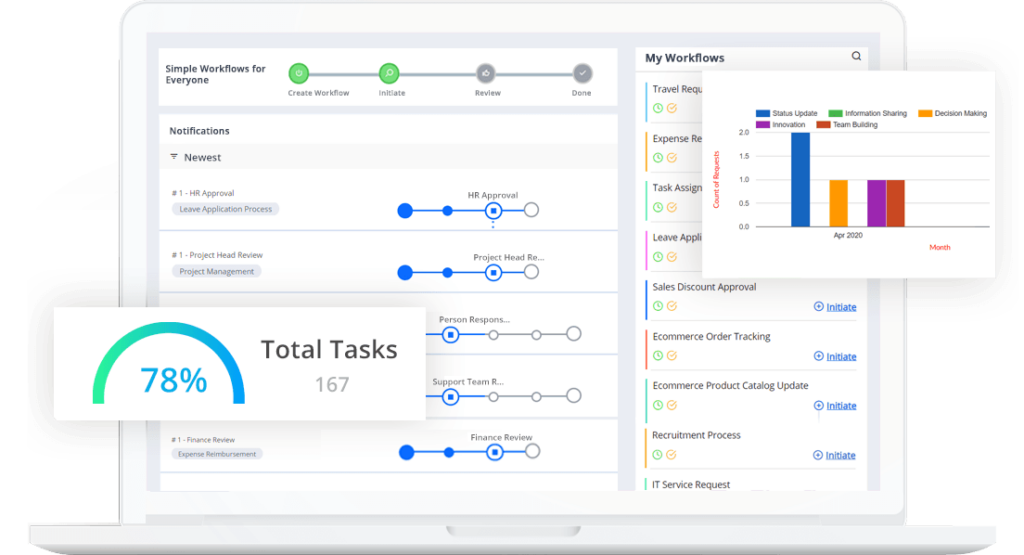
- Real-time dashboards and analytics
These tools allow teams to reduce repetitive work, speed up approvals, and maintain accountability across departments. For example, if a sales team needs approvals for discounts, the workflow can be automated so requests go to the right manager instantly, cutting down delays.
Key Differences Between Back Office Software and Workflow Tools
- Scope of Use
- Back office management software focuses on standard functions like HR, payroll, procurement, and compliance.
- Workflow tools apply to a broader set of tasks, from marketing approvals to IT service requests.
- Back office management software focuses on standard functions like HR, payroll, procurement, and compliance.
- Flexibility
- Back office software often comes with predefined modules (HR, finance, procurement).
- Workflow tools are more adaptable and allow businesses to design processes based on unique requirements.
- Back office software often comes with predefined modules (HR, finance, procurement).
- Integration
- Back office systems typically integrate with finance and HR platforms.
- Workflow tools can connect with a wider range of applications, including CRM, ERP, email, and project management tools.
- Back office systems typically integrate with finance and HR platforms.
- User Base
- Back office tools are mainly used by administrative, HR, and finance teams.
- Workflow management tools are used by almost every department—sales, marketing, operations, IT, procurement, and more.
- Back office tools are mainly used by administrative, HR, and finance teams.
When to Choose Back Office Management Software
You should consider back office management software if:
- Your main challenge is handling administrative and compliance-heavy tasks.
- You need structured systems for payroll, vendor management, or finance.
- Accuracy, regulatory compliance, and record-keeping are your top priorities.
For example, a mid-sized business struggling with manual payroll and late vendor payments would benefit from adopting a dedicated back office system to automate these repetitive tasks.
When to Choose Workflow Management Tools
Workflow management tools are the better option if:
- Your processes are spread across multiple departments.
- You need flexibility to design workflows unique to your business.
- Collaboration and visibility across teams are a priority.
For instance, a company that needs to manage purchase requests, marketing approvals, and IT support tickets simultaneously would find workflow management tools more effective.
The Middle Ground: Using Both Together
It’s important to note that these tools are not always competitors. In fact, many businesses use both to cover different areas. A back office system may handle payroll, vendor records, and compliance, while a workflow management tool automates approvals, document routing, and inter-departmental processes.
Together, they create a connected system where routine tasks are automated, errors are reduced, and employees spend more time on strategic work.
Benefits of Choosing the Right Tool
- Increased Efficiency: Automation reduces manual errors and speeds up processes.
- Cost Savings: Businesses save on time, labour, and operational overheads.
- Improved Collaboration: Teams can see workflows in real time, avoiding delays.
- Scalability: The right software grows with your business needs.
- Compliance and Security: Especially with back office systems, keeping accurate records ensures regulatory safety.
Conclusion
Both back office management software and workflow management tools play critical roles in helping businesses run smoothly. If your pain points revolve around payroll, vendor management, and compliance, then a dedicated back office tool is the right choice. If your challenge lies in cross-team processes, approvals, and flexibility, a workflow management system is more suitable.
For many businesses, the best solution is a combination of both—back office software for structured tasks and workflow tools for dynamic processes. By carefully evaluating your current needs and long-term goals, you can choose the right solution to make your business more efficient, transparent, and future-ready.