Why Is Testing So Important in Modern Electronics Manufacturing?

A board that looks perfect under a microscope can still fail the moment it hits real world voltage. That’s the uncomfortable truth a lot of buyers learn the hard way, usually after a return shipment or an angry email from a field technician. Testing isn’t a formality tacked onto the end of a production run. It’s the thing standing between a working product and a very expensive mistake.
I’ve spent enough time on shop floors and in quality reviews to know that “it passed visual inspection” means almost nothing on its own. Solder joints can look clean and still carry a cold connection. A connector can seat properly and still have a pin that’s out of spec by a fraction of a millimeter. None of that shows up unless someone actually tests for it.
The Cost of Skipping Verification
Manufacturers who cut corners on testing usually don’t feel the pain immediately. The defect gets shipped, the invoice gets paid, and everyone moves on. Then three months later a batch of units starts failing in the field, and now you’re dealing with warranty claims, reverse logistics, and a customer who no longer trusts your quality process.
Math rarely works in favor of skipping tests. Industry estimates commonly cite a rule of thumb where the cost of catching a defect multiplies roughly tenfold at each stage it moves downstream, from component to board to finished assembly to the customer’s hands. Whether or not that exact ratio holds for every product, the direction is right. A five cent testing step at the component stage is a lot cheaper than a full product recall.
Where SMT PCB Assembly Testing Actually Happens
SMT PCB assembly is where most of the invisible defects originate, and it’s also where the best opportunities to catch them exist. Automated optical inspection systems scan boards right after reflow, looking for tombstoned components, insufficient solder, bridging, and misalignment. That’s a good first pass, but it only sees what’s on the surface.
That’s why most serious contract manufacturers pair AOI with in circuit testing or flying probe testing before the board ever leaves the line. Circuit testing checks each component against expected electrical values, resistance, capacitance, continuity and flags anything outside tolerance. Flying probe testing does something similar without needing a custom fixture, which makes it a better fit for lower volume or prototype runs.
Functional testing comes next, and this is where a board gets powered up and put through the paces it will actually face in the field. Does it boot? Does it communicate over the expected protocol? Does it hold a stable output under load? A board can pass every electrical test and still fail here if the firmware or the design has a logic issue that only shows up under real operating conditions.
None of this is glamorous work. It’s repetitive, it requires calibrated equipment, and it slows down the line compared to just boxing product and shipping it. But it’s also the difference between a supplier you trust and one you stop calling after the second bad batch.
Testing in Cable Harness Production
Cable harness production gets less attention than board assembly, probably because a wiring harness looks simple compared to a populated circuit board. It isn’t. A single harness might have dozens of individual wires, each terminated to a specific pin, each carrying a specific signal or power load, and each one needs to be right.
Continuity testing confirms every wire goes where it’s supposed to go and nowhere else. Hipot testing, short for high potential testing, applies a higher than normal voltage briefly to check for insulation breakdown between conductors. It sounds aggressive, and it kind of is, but it’s the only reliable way to catch a nick in the insulation that a visual check would miss.
Pull testing on crimped terminals matters too. A crimp that looks fine can still pull apart under vibration if the crimp force wasn’t within spec. That’s a serious problem in any application involving movement or thermal cycling, and it’s exactly the kind of failure that doesn’t show up until the product is already in the customer’s hands.
Cable harness production also benefits from statistical sampling on top of unit level testing. Pulling a percentage of harnesses from each batch for destructive testing, cutting them open, checking crimp cross sections, verifying wire gauge, gives a manufacturer confidence that the whole batch is consistent, not just the units that happened to get tested individually.
High Stakes Applications Raise the Bar
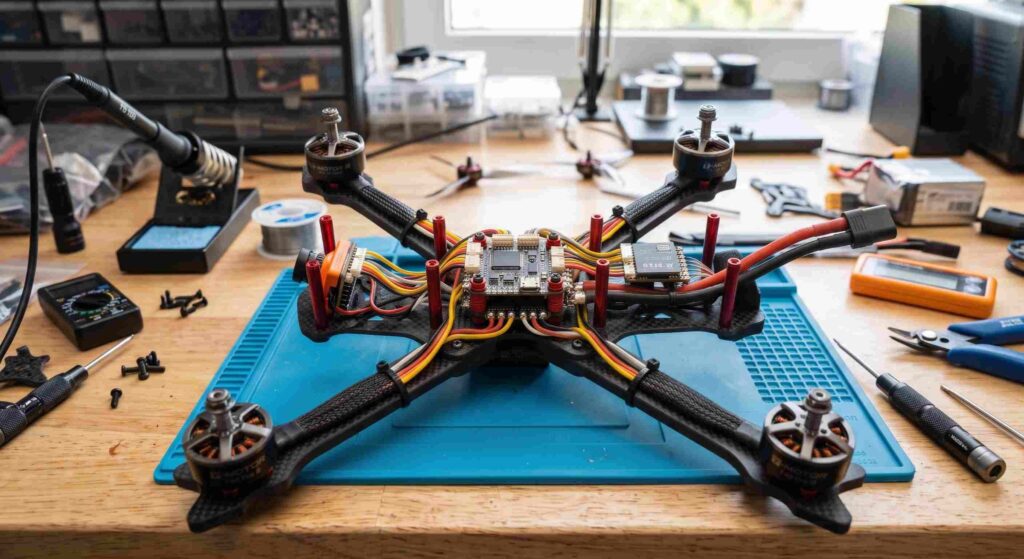
Some applications simply don’t tolerate a shortcut anywhere in the process. A drone wiring harness is a good example. It’s operating in a vibration heavy environment, often in temperature extremes, and a single loose connection at altitude isn’t a minor inconvenience. It’s a lost aircraft, or worse, a safety incident if that drone happens to be flying over people or property.
Harnesses built for drones typically go through additional environmental stress testing beyond the standard electrical checks. Vibration testing on a shaker table simulates flight conditions before the harness ever gets installed. Thermal cycling checks whether repeated expansion and contraction loosens a crimp or cracks a solder joint over time. None of this is overkill. It’s proportional to what happens if the part fails mid flight.
What This Means for Buyers
If you’re sourcing electronics assembly or cable work from a contract manufacturer, ask what testing protocols they actually run, not just what certifications hang on the wall. Certifications tell you a process exists on paper. Test data tells you whether that process is actually catching problems.
A good supplier will hand you test reports without being asked twice. They’ll know their first pass yield rate off the top of their head. They’ll be able to tell you exactly which test caught a defect and at what stage, because they’re tracking that data as a matter of routine, not scrambling to produce it for an audit.
Testing costs money and it costs time. There’s no way around that. But the alternative, shipping product on faith and hoping nothing breaks, costs a lot more once you factor in warranty returns, damaged reputation, and the customers who quietly stop calling. Pay for the testing up front. It’s cheaper every single time.