Why Solid Timber Floors Move During a Perth Summer
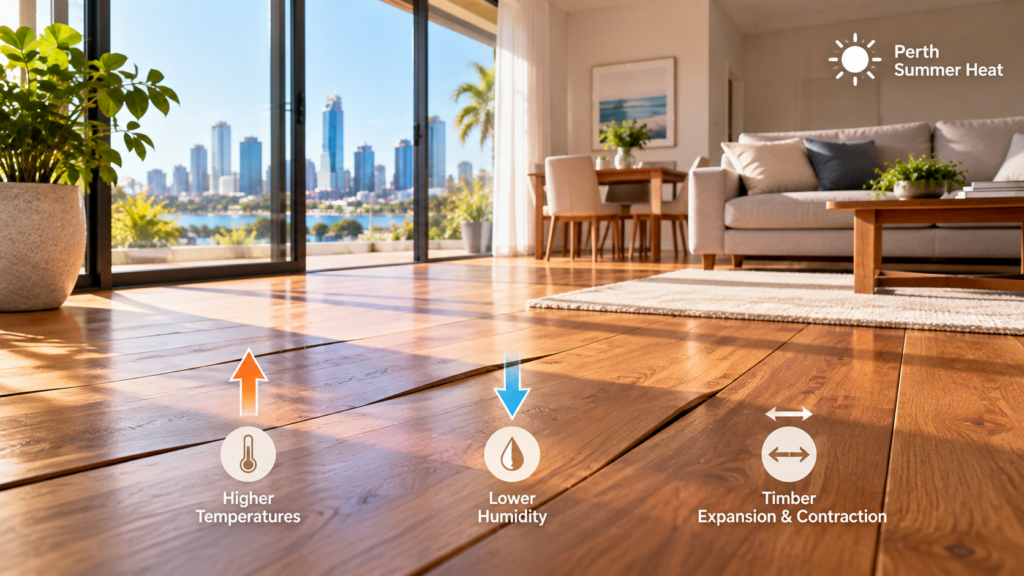
Walk across a timber floor in a Perth home in late February and you may spot something that was not there in July: fine gaps between the boards. For many homeowners, this is the first sign that their floor is reacting to the weather. Timber keeps exchanging moisture with the air around it long after it has been milled, and Perth’s climate gives it plenty to react to. Local hardwoods such as Jarrah, Marri and Blackbutt, along with eastern-state species like Spotted Gum, are common choices for solid timber floors Perth households install, and every one of them shrinks and swells to some degree. Understanding why this happens makes it much easier to separate normal seasonal movement from a genuine problem.
Perth’s Climate Puts Timber Through a Wide Swing
Perth has a hot-summer Mediterranean climate, with long, dry summers and mild, wet winters. Rain is scarce from December to February, and Bureau of Meteorology averages for stations around the metropolitan area show afternoon relative humidity dropping into the mid-30s or low 40s percent in January and February, compared with the mid-60s or higher in winter.
Hot easterly winds from the interior can dry the air further on some days, while the afternoon sea breeze brings cooler, moister air to coastal suburbs. Inside a house the swing is softer, but cooling systems change the picture. Refrigerated air conditioning tends to pull moisture out of indoor air, while evaporative coolers, which are common in Perth homes, add moisture. Two houses on the same street can therefore expose their floors to quite different conditions.
What Happens Inside the Boards
Timber is hygroscopic, meaning it absorbs and releases water vapour until it balances with the surrounding air. That balance point is called the equilibrium moisture content (EMC). When summer air dries out, the boards lose moisture and shrink, mostly across their width rather than along their length. The change in any single board is small, but a room contains dozens of boards, so the movement adds up.
The Australian Timber Flooring Association notes that the standard for solid hardwood flooring, AS 2796, allows a moisture range of 9% to 14%, and that boards are usually supplied at an average of around 10% to 11%. That level suits most major Australian cities, including Perth. The association also points out that where a building’s EMC shifts by about 3% or more between seasons, noticeable movement becomes likely. Finishes can slow how quickly a floor responds, according to the industry body WoodSolutions, but no coating stops timber movement altogether.
Normal Summer Movement Versus Warning Signs
Some gapping in dry months is expected. Small, fairly even gaps along board edges that narrow again once winter humidity returns are simply the floor doing what timber does. Gap sizes often vary a little across a room, especially near windows, heaters and doorways.
Other signs deserve a closer look:
- Wide gaps concentrated in one area. This can point to localised drying from strong sun, a heat source or a nearby air conditioning outlet.
- Boards separating in groups. Some coatings bond board edges together, so the floor shrinks in clusters and leaves a few wide gaps instead of many fine ones.
- Cracks or splits on the board surface. Severe or rapid drying can stress the timber beyond normal shrinkage.
- Gaps that never close in winter. This often suggests the boards were laid with too much moisture and have since dried well below their installed level.
- Cupping in summer. Edges rising above the centre of a board usually signal moisture coming from below, such as a leak, garden reticulation against an outside wall or a damp slab, rather than dry air.
Reducing Summer Stress on a Timber Floor
Most movement problems trace back to installation. WoodSolutions recommends installing timber within about 2% of its expected in-service EMC, so it is reasonable to ask an installer for moisture readings of both the boards and the subfloor before work begins. Adequate expansion gaps around the room’s edges also matter.
Day-to-day habits help too:
- Keep indoor conditions steady. Running refrigerated air conditioning at very low settings for long periods dries the air more than moderate settings do.
- Use blinds or curtains on windows that take strong afternoon sun. Direct sunlight heats and dries boards locally and gradually changes their colour.
- Avoid filling seasonal gaps with rigid filler in summer. When the boards swell again in winter, the filler has nowhere to go and can cause edges to crush or lift.
- Fix leaks and keep sprinkler spray away from external walls.
Planning a New Floor With Summer in Mind
If you are choosing a new floor, a few decisions made early can reduce how much summer movement you see later. Board width is one. Wider boards show larger individual gaps, while narrower boards spread the same total movement across more joints. Species is another, because shrinkage rates differ between timbers, so it is worth asking a supplier for stability information on the species you like.
Timing and subfloor preparation matter as well. Most Perth homes are built on concrete slabs, and slab moisture should be tested before any timber goes down. Where stability is the top priority, engineered flooring is worth comparing, since the Australian Timber Flooring Association notes it moves considerably less than solid boards because of how it is constructed. For those who prefer solid hardwood, boards laid at the right moisture content will handle Perth summers with only modest, predictable gaps that come and go with the seasons.