Gemini 3.8 Flash vs Grok 4.7: The Cheaper Card Holds Twice the Window
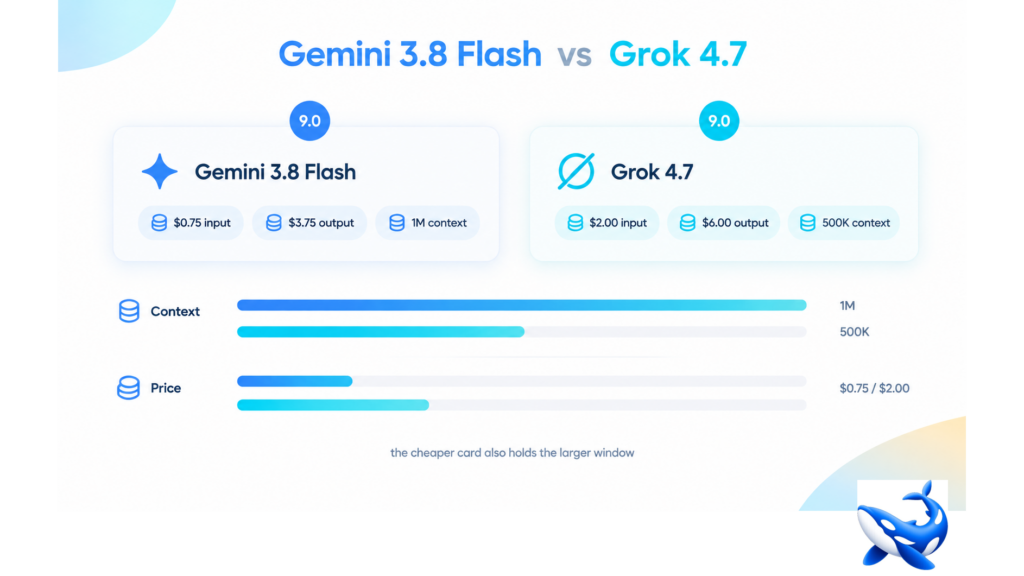
The usual shape of a model comparison is a trade: the expensive card buys the wider window, and the cheap card lives with a smaller one. On OrcaRouter the Gemini 3.8 Flash vs Grok 4.7 comparison runs the other way. Gemini 3.8 Flash is the cheaper card on both price lines and it holds twice the context window. Grok 4.7 costs more per token and carries the smaller window, and the two cards score identically on our composite. When the table stacks that way, the interesting question is not which card wins — it is what Grok 4.7 is selling.
The two cards side by side
Read on 2026-10-13:
| metric | Gemini 3.8 Flash | Grok 4.7 | gap |
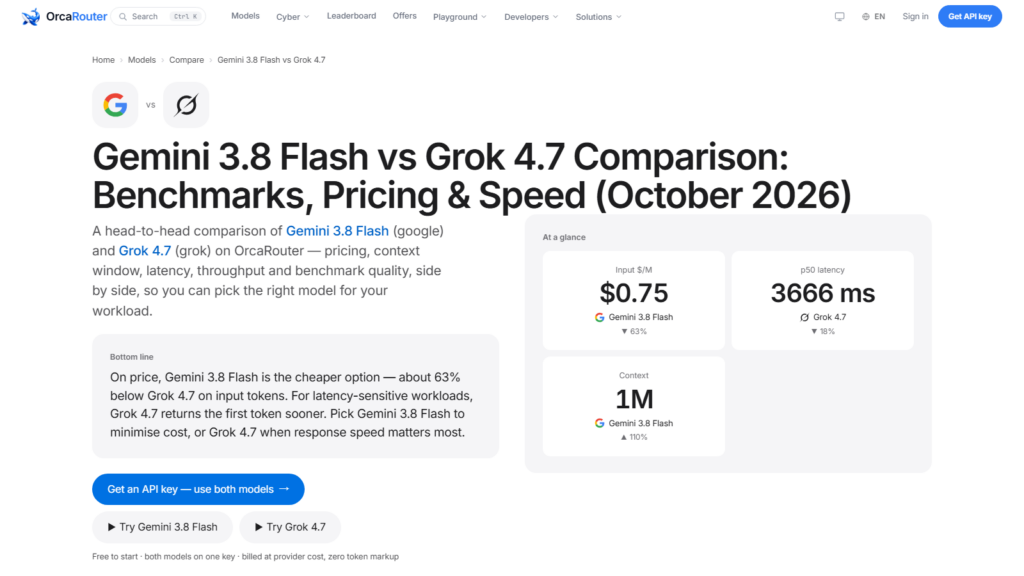
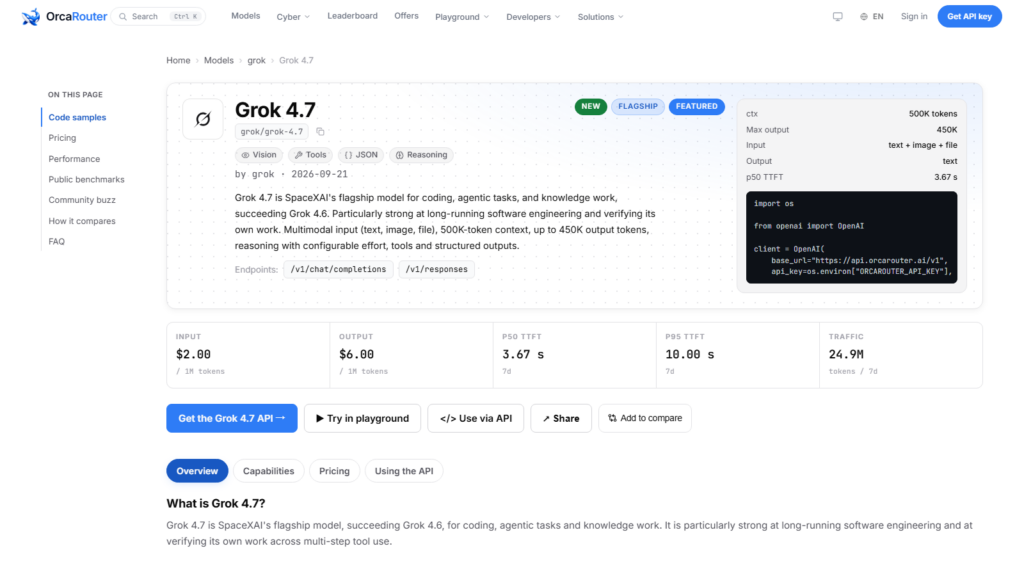
| input, per million tokens | $0.75 | $2.00 | Grok is 2.7x more expensive |
| output, per million tokens | $3.75 | $6.00 | Grok is 1.6x more expensive |
| output-to-input multiple | 5.0x | 3.0x | Grok bills more gently |
| context window | 1M | 500K | Flash holds twice as much |
| composite quality, 0–10 | 9.0 | 9.0 | tie |
Two rows favour each card, and they are not the same kind of row. Gemini 3.8 Flash wins on both price lines by a wide margin on input and a narrower one on output, and it wins on capacity by a factor of two. Grok 4.7 wins on the billing multiple — it charges three times input for generated tokens where Flash charges five — which means the output gap narrows as your workload writes more. On a heavily write-weighted pipeline the 1.6x output difference compresses toward the input line, where the gap is widest in Flash’s favour. On a read-weighted pipeline the multiple is nearly irrelevant and Flash’s advantage is at full strength on every row.
What capacity does and does not decide
A window is not a feature you use occasionally. It is the constraint the rest of your pipeline is built around. It decides whether a document is one call or five, whether a long agent trace fits in a single pass, and whether your architecture needs a chunking layer at all.
That is why the 1M-against-500K row matters more than its position in the table suggests. Eight of the twelve models we price carry a 1M window; Grok 4.7’s 500K puts it in a second tier that also holds nothing else — Kimi K2.6 sits at 262K and MiniMax M2.7 highspeed at 205K, so 500K is comfortably above the value tier and comfortably below the top one. It is a genuine middle. Whether that middle is enough is a question about your token distribution and nothing else.
The failure mode is worth naming because it is quiet. A window that is too small does not throw an error; it forces chunking, and chunking means reading overlapping spans more than once. Read the same document twice to work around a window that will not hold it and you have paid the input rate twice, which on Grok 4.7 means $4.00 per million instead of $2.00 — and that already exceeds what Gemini 3.8 Flash charges for a single unlimited pass. The workaround costs more than the card it is working around.
The 9.0 tie, read honestly
Our composite quality column is ours: a 0–10 figure we compute from four families of evaluation we run against each endpoint — reasoning, code generation, long-context retrieval and instruction following — averaged into one number. It is not a third-party leaderboard, and no other team can reproduce it on their own harness.
Both cards land at 9.0, the most crowded band in the set — six of the twelve models we price sit there. A tie in that band is the narrowest kind of claim: on the four families we run, neither card buys a measured capability advantage. It is not a claim that the two models behave alike. A composite averages across families, and two cards tied at 9.0 can still fail on entirely different inputs, one strong on long-context retrieval and weaker on code, the other the reverse. So the tie removes capability from this decision and leaves the price and capacity rows, where the two cards differ substantially.
Pricing the gap on a matched workload
The two price lines disagree about how big the gap is, so it is worth pricing a balanced pair rather than quoting a headline ratio. Read a million tokens and write a million through each card: Gemini 3.8 Flash bills $4.50, Grok 4.7 bills $8.00. The difference is $3.50 on a matched pair — and because Grok 4.7’s output multiple is the gentler one at 3.0x, that difference shrinks as your workload writes more and grows toward the input line as it reads more.
The shape of the crossover is what to take away. On a fully write-weighted pipeline the gap compresses to something close to the input ratio. On a fully read-weighted one it is at its widest, because $0.75 against $2.00 is a 2.7x difference on the exact tokens your pipeline consumes most. Since read-heavy traffic is also where capacity tends to bind — long documents are what fill a window — the two effects point the same way, and this pair gets less competitive for Grok 4.7 the more your workload looks like retrieval over long inputs.
Where the gentler multiple earns its place
One column on this page runs in Grok 4.7’s favour and deserves to be stated rather than buried. Its 3.0x output multiple is the gentlest in the pairs we publish — most of the twelve sit at 5.0x or 6.0x — and it means generated tokens are billed close to the input rate rather than at a steep premium.
For a pipeline that produces enormous volumes of text, that is not a rounding detail. A reasoning chain that emits ten thousand tokens per request, or an agent that narrates every step of a long tool sequence, generates vastly more tokens than it reads, and on those workloads the multiple does more work than the base rate. Grok 4.7’s advantage there is real but partial: it narrows the gap without closing it, because the base rate it multiplies is still 2.7 times Flash’s on input and 1.6 times on output. Closing a gap and winning a comparison are different things, and this page is an example of the difference.
The takeaway
Gemini 3.8 Flash and Grok 4.7 both score 9.0 on our composite, so this pair resolves on price and capacity rather than on measured capability. Gemini 3.8 Flash is cheaper on both lines — $0.75 against $2.00 on input, $3.75 against $6.00 on output — and carries a 1M context window against Grok 4.7’s 500K. Grok 4.7’s one structural advantage is its 3.0x output multiple, the gentlest we publish, which narrows the gap on write-heavy traffic without erasing it.
The stacking is what makes this pair unusual: the cheaper card is also the roomier one, which is the reverse of the usual trade. For read-heavy or long-document work, that combination is decisive, and the workaround for a window that is too small costs more than the card it works around. For heavily write-weighted, short-output traffic, the gentler multiple narrows the case to something worth pricing yourself. Both endpoints are live at list price behind a single key.
Sourcing note: prices, context windows and output-to-input multiples were read off our own comparison page for this pair on 2026-10-13. The composite quality column is OrcaRouter’s own 0–10 scale, computed from four evaluation families we run against each endpoint, and is not a third-party index. The comparison page and the model page linked above are OrcaRouter production pages. All checked 2026-10-13.