How Gemological Testing Reveals the True Quality of Natural Emeralds
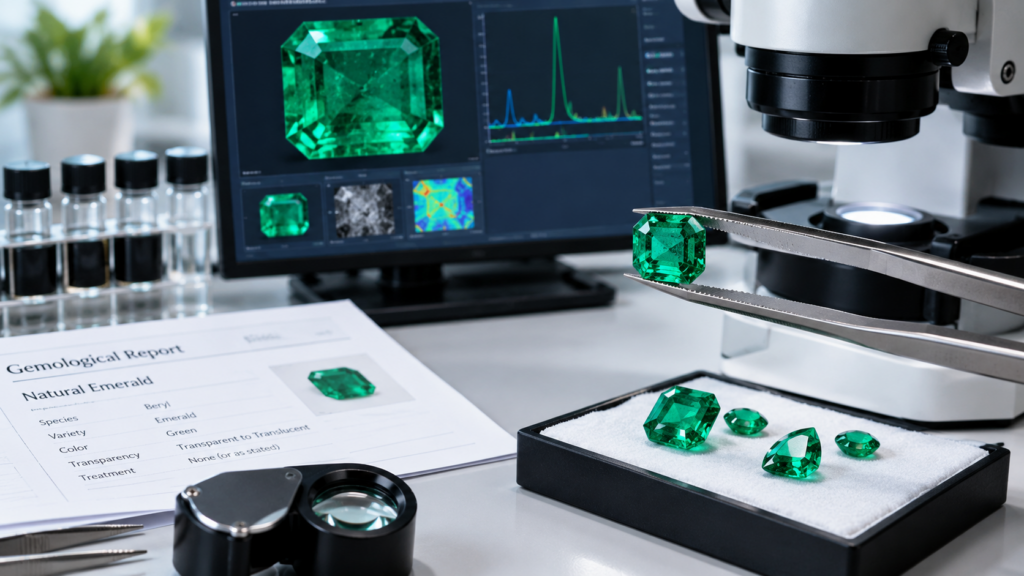
Hold a deep green stone up to the light and it’s easy to fall in love. The colour glows, the surface sparkles, and the seller says it’s genuine. But in the world of coloured gemstones, looks can mislead. Green glass, dyed quartz, lab-grown crystals and heavily treated beryl can all pass for the real thing in a shop window. That is why anyone who wants an original panna stone should understand what a gemologist actually checks before calling a stone a natural emerald. Let’s walk through the process in plain language, step by step.
Why the Eye Isn’t Enough
Emerald is the green variety of the mineral beryl. Its colour comes from tiny traces of chromium and sometimes vanadium inside the crystal. Natural emeralds are rarely perfect. They form under intense geological pressure, so they usually contain small internal features, which gem experts call inclusions.
That makes emerald tricky. A flawless-looking green stone might be synthetic or glass, while a stone with visible internal features might be perfectly natural. Only proper testing can tell the difference, and no amount of squinting at a stone under shop lighting will do that.
Step One: Is It Really Emerald?
The first question is simple: what material is this? A gemologist measures several basic properties:
- Refractive index: a refractometer measures how much light bends as it enters the stone. Emerald falls in a known range, which separates it from glass and many imitations.
- Specific gravity: how heavy the stone feels for its size. Emerald has a characteristic density.
- Optical behaviour: emerald shows different shades of green when viewed from different directions, a property called pleochroism, and it reacts in particular ways under a spectroscope.
- Hardness: emerald is fairly hard, but it is also brittle, so professionals avoid scratch tests that could damage it.
These checks quickly rule out common lookalikes such as green glass, green tourmaline, peridot and dyed quartz.
Step Two: Natural or Lab-Grown?
Even if a stone is emerald, it might not be natural. Laboratories can grow emeralds with the same basic chemistry as mined stones, using methods such as hydrothermal or flux growth. These are real emeralds in a chemical sense, but they are not natural, and their value is very different.
Here the microscope becomes the main tool. Natural emeralds often contain a fascinating mix of inclusions, including mineral crystals, fine fractures and tiny fluid-filled cavities with gas bubbles and sometimes small crystals inside, known as three-phase inclusions. These internal patterns, sometimes called the “jardin” or garden, act like a fingerprint of nature.
Synthetic stones tend to show different clues: wispy, veil-like patterns from flux growth, tiny nail-shaped features, or unusually clean interiors. Advanced instruments can analyse chemistry and light absorption to confirm the diagnosis. Every buyer who asks for an original panna stone is really asking this question: was this stone formed by nature, or made in a lab?
Step Three: Looking for Treatments
Almost every emerald on the market has had some form of clarity enhancement. Because natural emeralds are so fracture-prone, cutters often fill surface-reaching cracks with colourless oil or resin to make them less visible. This is a long-accepted practice when disclosed, but the type and amount of filling matter a lot.
A gemologist uses magnification and sometimes infrared spectroscopy to identify the filler and judge how heavy the treatment is. Reports typically describe it as none, minor, moderate or significant. A stone with minimal enhancement is generally more valuable and more stable than one that relies heavily on filler to look clean.
Heavy treatment may also need re-treatment over time, since some fillers can dry out or discolour. Colour can be treated too. Dyed stones, or green-tinted fillers, can fake a richer hue. Testing helps reveal whether the colour is natural or added.
Step Four: Judging the Quality Factors
Once the stone is confirmed as natural, quality grading begins. For emeralds, the key factors are:
- Colour: the most important element. The best stones show a vivid, evenly distributed, slightly bluish to pure green with strong saturation. Pale or overly dark stones are less valuable.
- Clarity: emeralds are expected to have inclusions, so graders look at how visible they are and whether they affect durability or beauty.
- Cut: a good cut maximises colour, protects the stone’s brittle edges and keeps proportions balanced.
- Carat weight: larger fine-quality stones are far rarer, so price rises sharply with size.
A report weighs these factors together. A beautifully coloured stone with moderate inclusions may be worth far more than a cleaner stone with weak colour.
Step Five: Understanding Origin
Where an emerald comes from can influence its desirability. Colombia, Zambia and Brazil are among the well-known sources, and each tends to produce stones with different characteristics. Laboratories can sometimes estimate geographic origin by studying inclusions and trace elements. This is often optional but can matter for collectors and high-value purchases.
How to Use a Lab Report
A lab report from a respected gemological laboratory such as GIA or IGI summarises these findings. When you receive one, check that it states:
- Whether the stone is natural or synthetic.
- The type and degree of clarity enhancement.
- Weight, dimensions and cut.
- Colour description.
- Origin, if requested.
- A report number that matches the stone.
Make sure the details match the actual gemstone in your hand, since a report only helps if it belongs to that particular stone. Ask questions, and be wary of any seller who is vague about treatments or unwilling to share documentation.
Conclusion
Gemological testing turns a beautiful green stone into a verified, understood gem. By confirming the material, separating natural from lab-grown stones, identifying treatments and grading colour, clarity, cut and weight, it shows what a stone is truly worth. Before you buy, insist on a trusted report and a transparent explanation. If you’re looking for a natural emerald in Bangalore, select a seller who welcomes testing, discloses treatments openly and helps you read the paperwork.
Knowledge is the best protection, and it ensures your emerald is as authentic as it looks. RudraTree is a Bangalore-based Rudraksha and gemstone house with a heritage dating to 1923. They source stones directly from mines, offer lab-tested gemstones with GIA and IGI certification, and hold ISO 9001:2015 TUV certification, helping buyers select authentic emeralds with confidence.