Dechecker AI Checker: Why Over-Editing Is the New Writing Mistake in 2026
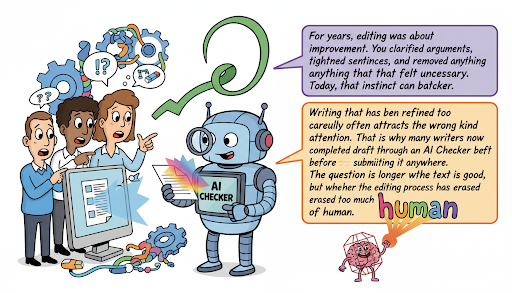
Editing used to be the easy part of writing: you tightened sentences, removed repetition, smoothed transitions, and hit publish. In 2026, that same instinct can create a new problem—text that’s so uniform, so clean, and so efficient that it resembles machine output to automated detection systems.
This is why many writers now run their final drafts through an AI Checker as a last-step diagnostic—not to “game” anything, but to confirm the writing still sounds like a human thinking on the page (with nuance, specificity, and natural variation).
Why “polished” writing now carries risk
A lot of organizations—schools, publishers, platforms, even some clients—use detection tools as a screening layer. But detection is not a truth machine. Well-known tools have documented limitations and have been criticized for false positives, and some institutions have paused or discontinued certain detector features after disputes.
That creates a messy reality:
- Writers feel pressure to “sound human” rather than simply write well.
- Editors over-correct until the work becomes generic.
- Clear, structured writing can get treated with suspicion.
The real issue: over-editing removes “evidence of thinking”
Over-editing often strips out the very signals that make human writing feel authentic:
1) You compress away the reasoning
When drafts get shortened, writers often delete the “middle”:
- the small hesitations
- the examples that explain why something is true
- the trade-offs, edge cases, and qualifiers
What remains is a smooth chain of conclusions—efficient, but sometimes unnaturally “frictionless,” which can resemble generated text patterns.
2) You flatten the rhythm
Uniform paragraph length, consistent sentence cadence, and repeated structure (problem → solution → takeaway, again and again) can make writing feel templated.
3) You replace specificity with safe generalities
When writers fear being “too detailed” or “too opinionated,” they drift into vague language:
- “It’s important to consider…”
- “There are many factors…”
- “This can be beneficial…”
That tone can read as high-fluency, low-commitment—exactly the kind of language detection tools tend to react to.
How to use an AI Checker the smart way (without weird “anti-AI” writing)
Use an AI Checker after your revision is basically done.
What to look for
- Clusters of flagged paragraphs, not a single odd sentence
- Sections that summarize without examples
- Transitions that feel too perfect or too generic
- Conclusions that claim certainty without showing how you got there
What to do when something is flagged
Instead of “breaking” the writing with awkward phrasing, try adding depth:
- Add one concrete example (a client scenario, a mini case study, a data point)
- Add one limitation (“This works best when…”)
- Add one human decision point (“Here’s what I’d do in practice…”)
- Add a small contrast (“This is different from…”)
This usually improves readability and reduces that overly-uniform feel.
The overlooked danger zone: transcripts and “cleaned up” speech
Writers are increasingly publishing content that starts as audio—podcasts, coaching calls, interviews, Zoom meetings. But there’s a catch:
When you run messy, natural speech through an audio to text converter, the transcript often comes out too clean after you edit it—especially if you remove every hesitation, repetition, and tangent.
That’s when a draft can start to look “manufactured,” even if it was 100% spoken by a real person.
Better approach for transcript-based writing
- Keep some natural phrasing (short fragments, casual transitions)
- Preserve small human markers (“What I mean is…”, “Here’s the tricky part…”)
- Don’t compress every answer into a perfect summary—leave a bit of the thinking intact
Why this matters more in 2026 than it did even a year ago
The stakes are higher because the ecosystem is messy:
- AI usage is widespread, especially in education and content workflows.
- Detection tools are controversial and have triggered false accusations and policy changes.
- Writers are stuck between “be clear” and “don’t look too clear.”
The solution isn’t to write worse. It’s to write more grounded.
Editing rules that still work in 2026
If you want writing that reads as confident and recognizably human:
- Keep your structure, but vary the movement (mix short sections with deeper ones)
- Show reasoning, not just conclusions
- Anchor big claims in lived examples
- Use an AI Checker as a second set of eyes—an indicator, not a judge