Basic Principles and Technologies of Intelligent Cranes
With the continuous development of industrial automation and intelligent manufacturing, traditional lifting equipment is rapidly upgrading toward intelligence. Intelligent cranes integrate multiple advanced technologies to achieve perception, analysis, decision-making, and control throughout the lifting process, greatly improving operational efficiency, safety, and reliability. Their core technology system mainly includes sensor technology, computer vision technology, and artificial intelligence technology, and can further combine with cloud computing, big data, and the Internet of Things to build higher-level intelligent applications.
Application of Sensor Technology in Intelligent Cranes
Sensor technology plays an important role in intelligent cranes, as it can perceive information such as the weight, position, and posture of lifted objects, providing accurate data for intelligent control systems. The following are some applications of sensor technology in intelligent cranes:
● Pressure Sensors: Pressure sensors can measure the weight of lifted objects. They are usually installed on the crane’s hook or lifting mechanism, calculating the weight of the object by measuring pressure changes at the load points. These data can be used for crane load monitoring and weight calculation.
● Displacement Sensors: Displacement sensors can measure the position and movement status of lifted objects. They are usually installed on the crane’s hook, lifting mechanism, or boom, determining the object’s position by measuring positional changes. These data can be used for crane positioning and precise control.
● Tilt Sensors: Tilt sensors can measure the tilt angle of lifted objects. They are usually installed on the crane’s hook or lifting mechanism, determining the object’s posture by measuring tilt angles. These data can be used for crane posture control and safety protection.
● Acceleration Sensors: Acceleration sensors can measure the acceleration and vibration of lifted objects. They are usually installed on the crane’s hook or lifting mechanism, assessing the stability and safety of the object through acceleration and vibration measurements. These data can be used for vibration monitoring and fault diagnosis.
● Temperature Sensors: Temperature sensors can measure the working environment temperature of the crane. They are usually installed at key parts of the crane, judging the working condition and safety by monitoring temperature changes. These data can be used for temperature control and fault warning.
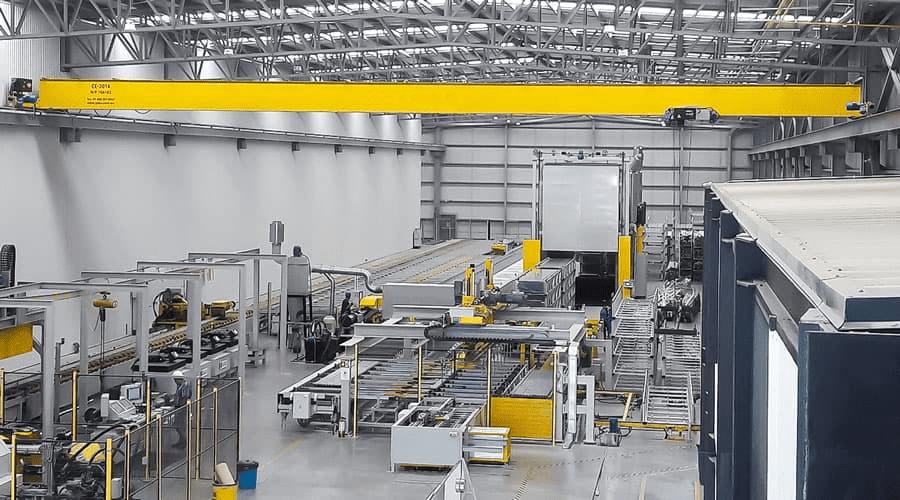
Through these sensor technologies, intelligent cranes can perceive in real time the weight, position, posture, and condition of lifted objects, enabling precise operation and safety assurance. These data can also be used for intelligent algorithm analysis and optimization, improving lifting efficiency and safety. Even in relatively simple single girder overhead cranes, reliable basic intelligent control functions can be achieved.
Application of Computer Vision Technology in Intelligent Cranes
The application of computer vision technology in intelligent cranes mainly includes the following aspects:
● Object Detection and Recognition: Through computer vision technology, intelligent cranes can detect and recognize lifted objects in real time, including goods and personnel. By detecting and recognizing targets, the crane can automatically adjust its position and posture to ensure accurate grasping and placement.
● Posture Estimation and Tracking: Computer vision technology helps intelligent cranes estimate the posture of lifted objects in real time, including position, orientation, and angles. By tracking changes in the object’s posture, precise grasping and placement can be achieved.
● Environmental Perception and Obstacle Detection: Intelligent cranes can perceive the surrounding environment and detect potential obstacles using computer vision technology. Through environmental perception and obstacle detection, collisions and safety accidents can be avoided.
● Motion Planning and Path Planning: Computer vision technology helps intelligent cranes perform motion and path planning. By analyzing the object and environment, the crane can determine the optimal actions and paths to achieve efficient lifting operations.
● Abnormality Detection and Warning: Computer vision technology helps detect abnormal situations during lifting and issue timely warnings. By monitoring the object and environment, the crane can identify anomalies, such as object instability or crane faults, and take corresponding measures to ensure safety.
In summary, the application of computer vision technology in intelligent cranes can improve the accuracy, efficiency, and safety of lifting operations, realizing automated and intelligent crane operation.
Application of Artificial Intelligence Technology in Intelligent Cranes
The application of artificial intelligence (AI) technology in intelligent cranes mainly includes the following aspects:
● Intelligent Control Systems: AI technology can be applied to intelligent crane control systems. Through machine learning and deep learning algorithms, cranes can learn and optimize control strategies, improving the efficiency and accuracy of lifting operations.
● Prediction and Optimization: AI technology can analyze and process large amounts of data. By analyzing historical and real-time data, intelligent cranes can predict object trajectories and weight, optimizing lifting paths and postures to improve efficiency.
● Autonomous Decision-Making and Planning: AI technology enables intelligent cranes to make autonomous decisions and plans. Based on the environment and task requirements, cranes can automatically select optimal lifting strategies and paths, achieving autonomous lifting operations.
● Abnormality Detection and Fault Diagnosis: AI technology can be used for abnormality detection and fault diagnosis. By monitoring sensor data and system status, cranes can detect abnormalities and faults in time and take corresponding measures, improving safety and reliability.
● Human-Machine Interaction and Intelligent Monitoring: AI technology can support human-machine interaction and intelligent monitoring in cranes. Through natural language processing and computer vision technology, cranes can interact with operators via intelligent dialogue and command instructions, while monitoring lifting operations and the environment in real time, providing feedback and warning information.
AI technology enables intelligent cranes to make autonomous decisions and plans. According to the environment and task requirements, cranes can automatically select optimal lifting strategies and paths, achieving autonomous lifting operations. This technology is especially critical in complex production environments, such as cranes in automotive production, ensuring precise and safe handling and assembly of components.
Conclusion
Intelligent cranes, through the deep integration of sensor technology, computer vision technology, and AI technology, achieve the transition from “mechanical execution” to “intelligent decision-making.” With the continuous maturation and application of these technologies, intelligent cranes will play an increasingly important role in industrial manufacturing, logistics warehousing, and metallurgy, providing solid support for enterprises to improve efficiency, reduce risks, and realize intelligent production.