Reject Contributor Images Before Editing the Wrong Problem
A contributor image can fail before anyone opens an editor. The photographer may be unknown, a product claim may appear only inside the graphic, or the subject may leave no safe room for the publication template. Polishing first turns an intake problem into a harder rights, accuracy, or layout problem.
A rights–claim–layout triage separates images that may be edited from images that need evidence, replacement, or rejection. The point is not to make every submission usable. It is to keep the editing queue limited to assets that can support an accountable article.
Open the Intake with Evidence Instead of Style
Collect the source file, contributor identity, capture or creation date, subject description, proposed caption, article section, and intended channels. Ask whether the contributor made the image, licensed it, received it from a brand, or downloa ded it from another page. “Provided by the author” is not a rights record.
Preserve the submitted file before resizing, recompressing, or stripping metadata. Assign an intake ID and checksum, then store the contributor’s message and any licence terms with it. A derivative should always point back to this package.
Ask for releases when identifiable people, private property, artworks, or protected designs require them. Record restrictions on territory, duration, attribution, modification, syndication, and commercial use. If the publication cannot meet a restriction, reject the asset rather than hiding the conflict with a crop.
Identify the factual job of the image. It may document an event, demonstrate a product, illustrate a general concept, or carry a quoted claim. The review standard changes with that job. A decorative image can be replaceable; a documentary image cannot be freely reconstructed.
Record whether any prior editing is disclosed. Screenshots, social downloa ds, brand composites, and generated artwork should not inherit the evidentiary status of a camera original. Label the best available source honestly and request missing provenance before enhancement.
Classify Failures Across Rights Claims and Layout
Run three independent lanes. Rights asks whether the publication may possess, modify, and distribute the image. Claims asks whether visible text, labels, numbers, identities, and depicted relationships are supported. Layout asks whether the protected subject can survive the required crop and overlay zones.
| Lane | Pass evidence | Reject signal |
| Rights | Traceable source and usable licence | Unknown ownership or prohibited modification |
| Claims | Caption and visible assertions are sourced | Unsupported result, identity, or statistic |
| Layout | Protected subject fits every required format | Crop removes necessary context |
Do not let one lane compensate for another. A beautifully composed licensed photo still fails when its caption identifies the wrong person. A factually sound chart still fails rights review when it was copied without permission. A cleared and accurate image may still need replacement if every mobile crop cuts through the subject.
Mark repairable issues narrowly. Dust in empty background, a bounded exposure problem, or extra neutral canvas may be editable. Missing permission, invented results, illegible evidence, and irrecoverable subject framing are not visual defects.
Check embedded text separately from the article. A testimonial, price, percentage, badge, or “before and after” label becomes a publication claim even if the contributor treats it as decoration. Require a source and effective date or remove the asset from consideration.
Use reason codes instead of vague comments such as “low quality.” Codes should distinguish RIGHTS-SOURCE, RIGHTS-TERMS, CLAIM-EVIDENCE, CLAIM-IDENTITY, LAYOUT-CROP, FILE-RESOLUTION, and EDIT-BOUNDS. That makes resubmission possible without inviting random cosmetic changes.
Route Only Eligible Images into PicEditor AI
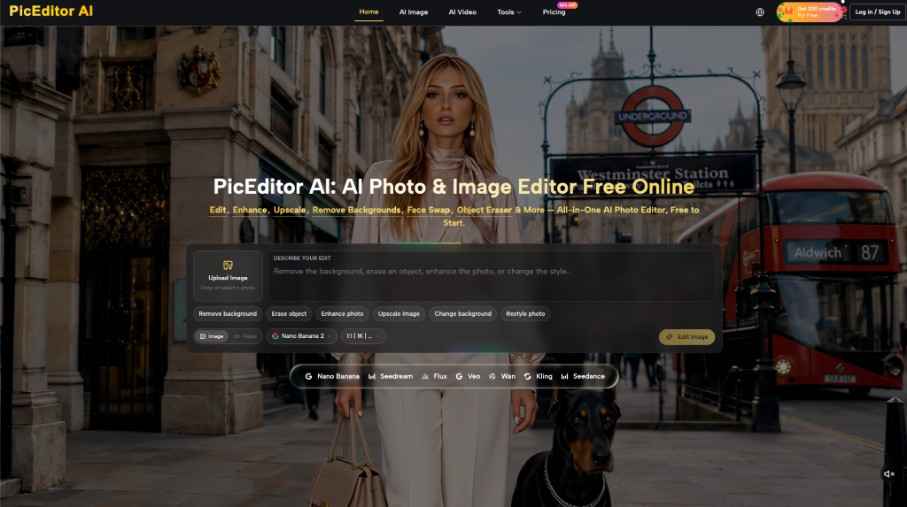
PicEditor AI’s official site accepts JPEG, PNG, and WebP files up to 30 MB and presents focused tools for enhancement, upscaling, background work, object cleanup, relighting, and other edits. Choose a route only after all three intake lanes pass or a documented editor approves a bounded exception.
For example: “Extend neutral background above and to the right for a headline crop. Keep the person, product, hands, packaging, logos, labels, colours, shadows, proportions, facial features, and every visible word unchanged. Add no badges, results, accessories, text, or people.”
An AI Photo Editor can produce a candidate, but it cannot supply a licence or verify the contributor’s claim. Save the intake ID, source, approved edit boundary, exact request, candidate, and reviewer with the derivative.
Inspect the active tool, upload visibility, output count, resolution, and other live controls before submitting unreleased material. Use an approved internal route when a contributor image contains embargoed products, private information, or contract-restricted subjects.
Keep claim-bearing text outside the generated region. If a layout requires a new headline, statistic, disclosure, or attribution, add verified copy later in a controlled design layer. Do not ask the model to re-render legal or factual wording.
Prefer extra canvas over subject reconstruction when the layout lane fails only for breathing room. The request should name which edges may expand and which pixels are protected. If the required template still demands cutting essential context, choose a different image.
Verify the Derivative Against Its Intake Lane
Compare source and candidate at equal dimensions before applying the publication crop. Overlay protected regions and inspect faces, hands, products, logos, labels, shadows, reflections, text, and boundaries. A visually plausible change is still a failure when it alters a supported claim.
Re-run the three lanes rather than checking only the requested edit. Rights terms may prohibit generative modification. A candidate may introduce a badge that creates a new claim. Extended canvas may contain shapes that become distracting or misleading after a responsive crop.
Render desktop, tablet, mobile, social-card, and newsletter variants with real overlays. Check that credits and disclosures remain readable, protected subjects are not covered, and the focal relationship still matches the caption. Approval belongs to the exported derivatives, not merely the large master.
Read every visible word at publication size. Reject invented characters, altered model names, malformed logos, false certification marks, or changed packaging quantities. Blurring suspicious text is not a reliable repair when the article depends on it.
Confirm that background extension did not imply a larger venue, different location, bigger crowd, or additional inventory. Empty space can carry meaning through scale and setting. Compare boundaries, perspective lines, light direction, and repeated texture.
Assign pass, repair, replace, or reject. Repair covers a specific export or bounded visual issue. Replace means the article can use another cleared asset. Reject means the submission lacks recoverable rights or evidence. Record the lane and reason code behind the decision.
Return a Reason-Coded Decision to the Contributor
A contributor should receive the intake ID, decision, failed lane, evidence needed, accepted file formats, and a resubmission deadline. State whether a new licence, original file, corrected caption, alternate crop, or replacement image would resolve the problem.
Do not send the generated candidate back as proof that the original was usable. If the asset is rejected for rights or claims, quarantine its derivatives from the publishing library. Keep them only where policy requires an audit record.
Editors who use an AI image editor should connect every accepted PicEditor AI derivative to its source and three-lane verdict. The edit is a controlled publication step, not a substitute for contributor evidence.
Track reason-code frequency over time. Repeated rights failures may require clearer submission terms; repeated layout failures may require downloa dable templates; repeated claim failures may require a caption and source checklist before upload.
When an accepted image is corrected or withdrawn later, find every published derivative by intake ID. Update article pages, newsletters, social cards, archives, and syndication copies, then preserve the earlier decision and correction reason.
A disciplined intake will reject some attractive images. That is a useful result. It prevents a publication from spending editing time on pixels that could never become a cleared, accurate, and layout-safe part of the article.