What Is OT Security and Why Does It Matter for Industrial Networks
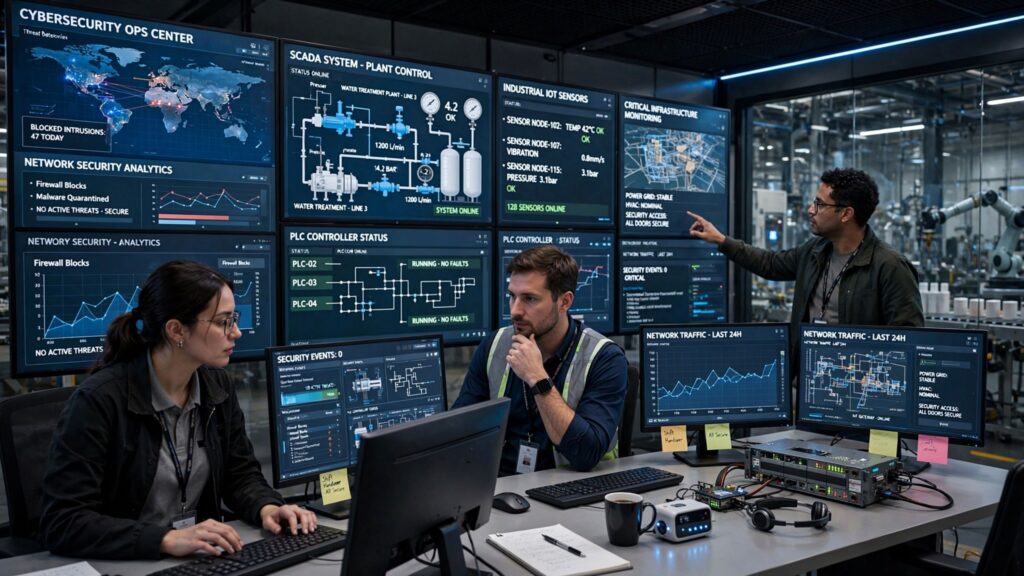
Let me point out that industrial networks might differ from corporate networks. The many systems that operate power grids, water treatment plants, manufacturing lines and pipeline infrastructure were built to a different set of priorities: continuous operation, physical safety and process reliability before cybersecurity was even a design consideration. Because of that origin, security must be approached differently in these environments, and this is precisely why OT security has developed into a separate and often urgent field.
OT Security Defined
Operational technology (OT) refers to hardware and software that detect or cause changes in physical processes through direct monitoring and control of physical devices. In industrial terms, it includes programmable logic controllers that control machinery, distributed control systems that manage continuous production processes, SCADA systems that provide supervisory oversight across distributed infrastructure, and the human-machine interfaces through which operators interact with these systems.
OT security involves safeguarding these environments from outside threats that could impair operations, threaten safety; or tamper with the physical processes they link to. The stakes are not the same as in IT security for viruses. A hacked database or email server leads to data loss and business disruption. An affected industrial system can halt a manufacturing line, taint a water supply, cripple an electrical grid or even endanger the humans that rely on those systems operating correctly.
The priorities of what is OT security and why it differs from IT security are anchored in this consequence gap. Where IT security treats confidentiality as the primary objective, OT security places availability and safe physical operation at the top of the hierarchy. Any security control that could cause an unplanned shutdown is itself a form of harm in an industrial environment, which is why OT security requires a fundamentally different approach to tools, processes, and decision-making.
The Unique Security Challenges Posed by Industrial Networks
The features that allow industrial networks to excel at their core functions also present major security challenges when those networks become targets.
Industrial control systems have a halflife. For example, a PLC on a manufacturing floor might stay in service for 15 or twenty years. In that time frame the OS could receive no updates – not through negligence, but because getting it updated requires a planned outage and could risk disrupting a finely tuned production process. A lot of controllers run on firmware that predates even basic security principles and don’t have any built in authentication or encrypted communications.
These devices, which cannot tolerate active network scanning without risking faults, are now connected, directly or indirectly, to enterprise IT networks that face the full spectrum of today’s cyber threats. There was little choice in the integration that followed: real-time data from industrial processes go into analytics platforms, remote maintenance access saves money on on-site support, and cloud connectivity delivers new operational capabilities. Every link that propels performance also opens a gateway for threats to enter systems that were never built to withstand them.
Industrial protocols compound the challenge. Protocols such as Modbus and DNP3, which dominate operational technology, were designed for reliable device-to-device communication rather than for authentication or integrity verification. If an attacker is able to access a network segment within the scope of these protocols, it can often talk to industrial devices using completely standard techniques without needing to exploit any software vulnerability at all.
Securing The Manufacturing Network Against Threats
Industrial networks have been operating in a much different threat environment than those found back in the past 10 years. Critical infrastructure has been a top target area, including energy, water and manufacturing infrastructure attacks that could accomplish strategic objectives inconceivable in traditional cyberattacks against the business IT system of an organization. Ransomware groups have learned that industrial organizations are more susceptible to operational disruption and have focused much of their attention with manufacturing, logistics, and energy targets.
The legacy OT cyber risk exposure that characterizes many industrial environments makes them structurally vulnerable in ways that persist regardless of how much investment is made in IT security perimeter defenses. Legacy operating systems without security updates, flat network architectures without meaningful segmentation, and industrial protocols without authentication all represent an attack surface that sophisticated adversaries know how to exploit.
A significant share of successful attacks against OT environments do not require attackers to directly penetrate industrial control systems at all. The pattern documented across OT physical disruption incidents shows that the majority of attacks with physical consequences begin with a compromise of IT networks, which are then used as a pathway toward OT systems or whose disruption causes industrial operators to shut down OT systems as a precautionary measure. Eight- and nine-figure financial losses have resulted from incidents that followed exactly this pathway, where the OT environment itself was never directly compromised but was taken offline because operating it with IT compromise just one or two network hops away was considered too risky.
IT / OT Boundary as a Priority for Security
The merging of IT and OT networks has resulted in an unaddressed security boundary for most organizations. These very mature Enterprise IT Security programs provide little protection to OT if the demarcation point of one domain vs. the other is poorly defined, monitored or allows traffic flow unrestrictively.
To successfully secure the IT/OT boundary, it is essential to first gain clarity on what actually crosses that line, which protocols and services and which systems communicate across the enterprise network and into the plant floor followed by appropriate controls. A core architectural pattern for managing this boundary is industrial demilitarized zones, which reside between IT and OT networks to allow for data flow in controlled ways and without building direct connectivity. Jump hosts with strict access controls manage remote maintenance connections. For the most sensitive environments, unidirectional data transfer mechanisms are used where even network communication in both directions is an unacceptable risk.
The convergence challenge is not really a technical one. OT engineering teams approach their work with a different set of professional priorities and a different risk framework than IT security teams. OT engineers are focused on uptime and process stability while IT security teams care about responding to threats and patch currency. Crossing this IT/OT boundary and creating effective security programs is going to require that these teams become intimately aware of each other’s constraints and objectives, supported by governance structures that provide for adequate visibility into industrial environments without applying inappropriate IT-centric assumptions upon them.
Important Controls in your OT Security Program
A sound OT security program does not import IT security disciplines unchanged, but instead modifies them for the unique constraints of industrial environments.
- Asset visibility is a prerequisite to any other security capability. In these scenarios, active scanning does not work, and passive network monitoring the process of passively observing traffic without sending any active queries is the de facto way to build an asset inventory in OT environments. Organizations cannot segment, monitor and respond to threats to assets they do not know about.
- Network segmentation not only restricts lateral movement within industrial environment zones, but also between IT and OT. One such framework for organizing these different zones is the Purdue Enterprise Reference Architecture, which organizes business systems, supervisory systems and process control systems into separate, but controlled communication across network layers.
- Behavioral monitoring allows you to view your industrial network traffic all the time. As OT networks have very predictable communication, deviations from them, such as anomalous connections, unused protocols and changes to controller configurations are both detectable and significant. Trained on industrial protocols, security monitoring can highlight early signs of compromise that signature-based detection algorithms could miss.
- Access control also defines who is allowed to access OT systems –including the vendor and integrator connections, a routine aspect of industrial operations. Remote access to industrial systems is one of the most commonly exploited attack vectors in OT security incidents and therefore warrants specific governance beyond standard enterprise remote access programs.
Frequently Asked Questions
Why does OT security not care about confidentiality?
Industrial control systems control physical processes where an unplanned shutdown leads to production, safety or equipment-related losses. In an industrial environment, security controls that risk unplanned downtime damage the organizations themselves. This hierarchy of priority availability first, integrity second, confidentiality last is what separates the OT security from IT security and determines every decision regarding what controls are acceptable in industrial environments.
How do attackers typically reach OT systems if they are not directly internet-exposed?
The most prevalent attack path starts with an enterprise IT network compromise and uses weakly protected business/OT DMZ connections to access the OT systems. These include poorly segmented networks, historian systems with redundant connection infrastructure, and remote maintenance pathways. OT systems are not compromised in ransomware attacks based on IT, but rather OT operations within industrial environments often face a precautionary shutdown, causing physical disruption stemming from an attack that did not touch the industrial environment at all.
What makes patching industrial control systems more difficult than patching IT systems?
Unlike servers, which may be taken down for maintenance, industrial controllers typically run continuously for years. They require a planned outage to patch, and must not be changed, as this can compromise the mandate of the process in that each modification requires retesting against process requirements, as they can modify device behavior. Legacy devices also often run firmware that is no longer supported by the vendor (meaning patches are never deployed). Compensating controls, such as segmentation, monitoring, and restriction of access, are still available for those systems that cannot be patched according to the normal schedule.






