Beyond the Usual European Getaway: Why Armenia Deserves a Place on Your Travel List
There is something refreshing about traveling somewhere that does not feel like it was designed for tourists.
You know the feeling. You arrive in a destination and expect to see the usual attractions, take a few predictable photographs, eat at restaurants recommended by every travel blog, and leave with a camera roll that looks remarkably similar to everyone else’s.
Armenia offers something different.
Tucked between Europe and Asia, Armenia is a country where ancient monasteries sit against dramatic mountain landscapes, where modern cafés share streets with centuries-old architecture, and where a simple family meal can become one of the most memorable parts of a trip.
It is not necessarily a destination that announces itself loudly. Instead, Armenia tends to reveal itself gradually. A winding mountain road leads to a monastery you did not expect to find. A conversation with a local turns into an invitation for coffee. A roadside restaurant serves food that makes you reconsider what you thought you knew about Caucasian cuisine.
For travelers looking for history, nature, culture, and authentic experiences in one relatively compact destination, Armenia is well worth considering.
Armenia Is a Destination for Curious Travelers
One of the most appealing things about Armenia is its variety.
A trip can begin in Yerevan with coffee and a walk through the city center, continue into the mountains the next morning, and end the day overlooking a lake surrounded by rugged peaks.
The country’s size makes it possible to experience very different landscapes without spending entire days moving between destinations.
That is particularly attractive for travelers who do not want to choose between a city break and an outdoor adventure.
Yerevan provides the urban side of the experience. The capital has restaurants, galleries, museums, wine bars, parks, markets, and an increasingly lively café culture. Yet it is also a city with a long history and a distinctive architectural identity.
Leave the capital behind, however, and the scenery changes quickly.
Mountain valleys, alpine lakes, volcanic landscapes, forests, gorges, and small villages become part of the journey. In many places, the road itself becomes an attraction.
This is one reason travelers interested in exploring the country often look at organized Armenia tours rather than limiting themselves to a single city. A well-planned itinerary can connect historical landmarks with natural attractions while leaving room for the slower experiences that make a trip memorable.
Yerevan: Where the Journey Often Begins
Yerevan is more than a convenient starting point.
The city has its own personality, and it deserves time to be explored rather than treated as a place to sleep between excursions.
One of the easiest ways to get acquainted with the capital is simply to walk.
The central streets are filled with cafés, shops, cultural venues, and public spaces. Republic Square is an obvious starting point, particularly in the evening when the architecture takes on a different atmosphere.
The Cascade is another landmark that should not be rushed.
The enormous stairway rises through the city and provides increasingly broad views of Yerevan. The area around it is also home to art installations, museums, restaurants, and cafés, making it a natural place to spend an afternoon.
But some of the best moments in Yerevan happen away from the major landmarks.
Sit at a small café. Browse a local market. Try Armenian coffee. Walk through a residential neighborhood. Stop somewhere because the smell coming from the kitchen is impossible to ignore.
Travel is often at its most rewarding when there is no checklist involved.
The Monasteries Tell the Story of the Country
You cannot travel far through Armenia without encountering its religious and architectural heritage.
The country’s monasteries are among its most recognizable landmarks, but their importance goes beyond their appearance.
Many are located in extraordinary natural settings.
A monastery may appear on a hillside overlooking a valley, sit between forested mountains, or stand dramatically against an open landscape. The combination of architecture and geography creates scenes that are difficult to forget.
Geghard Monastery is one of the best-known examples.
Partially carved into surrounding rock, the complex demonstrates how closely architecture and landscape can be connected in Armenia. Visiting it is not simply about seeing an old building. It is about experiencing the setting around it.
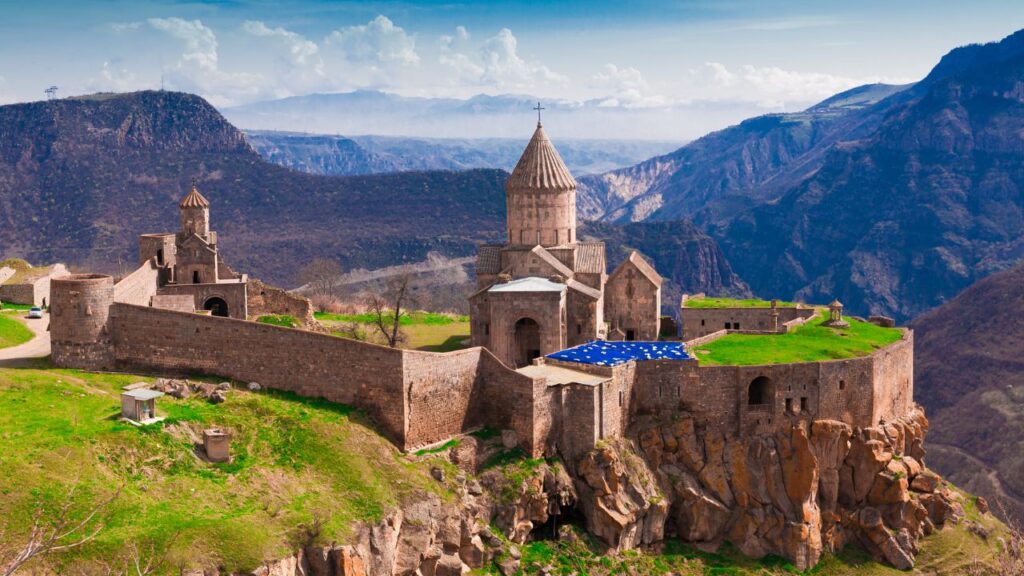
Another unforgettable destination is Tatev Monastery in southern Armenia.
Reaching Tatev is part of the adventure. The surrounding mountains create a sense of isolation that makes the monastery feel even more remarkable.
For travelers interested in history, these locations provide an opportunity to understand Armenia beyond museum displays and historical dates.
Stone walls, inscriptions, religious buildings, and ancient roads make the past feel tangible.
Lake Sevan: A Different Side of Armenia
Not every Armenian experience revolves around architecture.
Lake Sevan offers a completely different atmosphere.
Located high above sea level, the lake is surrounded by mountains and has long been an important part of Armenian life. Its enormous size gives the landscape a sense of openness that contrasts with the country’s narrow valleys and rugged mountain roads.
The lake is particularly appealing during warmer months.
Visitors can enjoy the scenery, explore nearby cultural sites, try local fish dishes, or simply spend time near the water.
Sevanavank, a historic monastery overlooking the lake, is one of the most recognizable sights in the region.
The combination is striking: dark stone architecture, blue water, and mountains stretching toward the horizon.
It is also a good reminder that Armenia does not fit neatly into one travel category.
It can be a cultural destination, an outdoor destination, a culinary destination, a historical destination, or all of them during the same trip.
The Food Might Become a Highlight of the Trip
Food deserves its own place in any discussion about Armenia.
Armenian cuisine is deeply connected to hospitality, family traditions, seasonal ingredients, and regional influences. Meals are rarely treated as something to get through quickly.
They are social occasions.
A traditional table can include grilled meats, fresh herbs, vegetables, cheese, lavash, salads, pickled vegetables, and a wide range of homemade dishes.
Lavash, the traditional Armenian flatbread, is particularly important. Watching it being prepared and baked can be an experience in itself.
Then there are dishes such as khorovats, Armenian-style barbecue, which is often associated with gatherings and celebrations.
Visitors should also make room for dolma, spas, gata, and other local specialties.
But perhaps the best advice is not to arrive with a rigid food itinerary.
Ask locals what they recommend.
Try something you cannot pronounce.
Eat at a family-run restaurant.
Visit a food market.
Sometimes the most memorable meal is the one you did not plan.
Armenian Hospitality Is Part of the Experience
One of the most frequently mentioned aspects of visiting Armenia is the country’s hospitality.
There is an important distinction between a destination being friendly to tourists and experiencing genuine hospitality as part of everyday life.
In Armenia, meals, conversations, and invitations can easily become part of the travel experience.
A short interaction can turn into a long conversation.
A question about where to eat can lead to a list of recommendations.
A visit to a rural area may involve being offered homemade food before you have even had time to explain where you are from.
Of course, every traveler’s experience is different. But for many visitors, these personal interactions become just as important as the famous landmarks.
They create the stories that people tell when they return home.
For Nature Lovers, the Mountains Are the Real Playground
Travelers who prefer hiking, photography, and outdoor exploration will find plenty to enjoy.
Armenia’s landscape is surprisingly diverse.
There are high-altitude trails, wooded areas, deep gorges, open volcanic landscapes, and mountain villages where life moves at a much slower pace.
Dilijan is one of the country’s most popular destinations for nature lovers.
Often associated with forests and hiking, the region provides a dramatic contrast to the drier landscapes found elsewhere in Armenia.
The surrounding area offers opportunities for walking, hiking, photography, and simply enjoying the scenery.
Further south, the landscape becomes more rugged.
The road toward Tatev is particularly impressive, with deep valleys and mountain panoramas appearing around almost every turn.
For photographers, Armenia presents an interesting challenge because the scenery constantly changes.
One morning might offer misty forests.
By afternoon, the landscape could be dry, rocky, and sunlit.
A few hours later, you might find yourself beside a lake surrounded by mountains.
Wine Has an Increasingly Important Place on the Travel Map
Wine lovers have another reason to consider Armenia.
The country has a long winemaking tradition, and modern Armenian producers have increasingly brought attention to local grape varieties and wine regions.
A wine-focused trip can introduce visitors to both traditional methods and contemporary producers.
The Areni region is particularly important in this story.
Areni grapes are closely associated with Armenian winemaking, and the region’s landscape makes a vineyard visit especially appealing.
Wine tourism also fits naturally into a broader Armenian itinerary.
A traveler can spend the morning exploring a monastery, visit a vineyard in the afternoon, and enjoy a long dinner in the evening.
There is no need to treat wine as a separate vacation theme.
It can simply become another layer of the journey.
The Best Trips Leave Room for the Unexpected
One mistake travelers sometimes make is planning every minute of a vacation.
There is a strange contradiction in modern travel. We have more information than ever, yet that information can make trips feel less spontaneous.
We know where everyone says we should eat.
We know which viewpoint is supposed to be the best.
We know exactly how long a particular attraction takes.
We know where to stand for the photograph.
Armenia rewards a slightly different approach.
Keep the important destinations on the itinerary, but leave some empty space.
Spend an extra hour in a village.
Take a slower road if the scenery looks interesting.
Stop for coffee.
Talk to someone.
Visit a place that was not in the original plan.
Some of the strongest travel memories rarely come from checking off a famous attraction.
They come from moments that could not have been planned.
When Is the Best Time to Visit Armenia?
The answer depends heavily on what you want to do.
Spring can be beautiful, particularly when landscapes become greener and temperatures are comfortable for sightseeing.
Summer is appealing for travelers interested in outdoor activities, mountain areas, and Lake Sevan. Higher elevations can also provide relief from the heat found in lower areas.
Autumn is especially attractive for travelers interested in scenery and food. The changing colors, harvest season, and generally pleasant conditions can make it an excellent time for exploring.
Winter presents a completely different Armenia.
Snow transforms mountain areas, and travelers interested in winter sports can consider destinations such as Tsaghkadzor.
This seasonal variety means there is no single “perfect” month for everyone.
Instead, the best time depends on whether your priorities are hiking, sightseeing, food, photography, skiing, or simply experiencing the country at a comfortable pace.
How to Plan a First Trip
For first-time visitors, trying to see everything is usually a mistake.
A more enjoyable approach is to create a route that combines several types of experiences.
For example, a trip could begin with several days in Yerevan before moving toward Lake Sevan and Dilijan. From there, travelers could continue toward southern Armenia, incorporating historic monasteries, rural landscapes, and wine-producing areas.
The exact route will depend on the length of the trip and personal interests.
Someone fascinated by history may want more monasteries and archaeological sites.
An outdoor enthusiast may prefer hiking and mountain destinations.
A food-focused traveler might prioritize markets, cooking experiences, wineries, and traditional restaurants.
Families may want a slower itinerary with fewer long driving days.
The important thing is to avoid treating the country like a collection of isolated attractions.
The experience becomes richer when destinations connect.
A monastery leads to a village.
A village leads to a meal.
A meal leads to a conversation.
A conversation becomes a story you remember years later.
Why Armenia Is Worth Discovering Now
Travel trends come and go, but destinations with a strong sense of identity tend to remain memorable.
Armenia has that identity.
It is a country where ancient traditions coexist with modern life. It offers dramatic scenery without requiring travelers to spend weeks moving between destinations. It combines history, food, wine, architecture, mountains, and hospitality in a way that feels remarkably natural.
Most importantly, it still provides plenty of opportunities for discovery.
You can visit famous landmarks, but you can also find places that are not crowded with international visitors.
You can follow a recommended itinerary, but you can still make unexpected discoveries along the way.
And you can experience the country’s history without feeling as though you are simply walking through an open-air museum.
That balance is increasingly valuable.
Travelers today are often looking for more than photographs. They want experiences that feel personal, stories they can bring home, and destinations that give them something they did not already know they were looking for.
Armenia can provide all three.
Final Thoughts
The most memorable destinations are rarely the ones that can be summarized in a single sentence.
Armenia certainly cannot.
It is ancient and modern, mountainous and urban, familiar and unfamiliar. It can be peaceful one moment and lively the next. It can be a place for serious historical exploration, a relaxing food-focused getaway, or an adventure through some spectacular landscapes.
That variety is precisely what makes it interesting.
Whether you spend your time wandering around Yerevan, looking across Lake Sevan, hiking through Dilijan, tasting wine in Areni, exploring ancient monasteries, or sharing a meal with locals, Armenia has a way of turning individual experiences into a larger story.
And perhaps that is the best reason to visit.
Not simply to see another country, but to slow down enough to experience one.