Before the First Big Snow: A Winter Prep Checklist for North Penn Homeowners
Winter in the North Penn Valley tends to arrive in stages: a dusting, a hard freeze and then the first storm that actually calls for a shovel. If you live in Lansdale, Hatfield or North Wales, or in Montgomery, Hatfield, Towamencin or Upper Gwynedd township, now is the time to get ready, before the forecast turns and the hardware store shelves empty out.
A good winter plan covers more than the driveway. It includes the sidewalk you are responsible for, the mailbox at the curb, the trash cans that still have to reach the street on pickup day and your own back. Here is a checklist to work through.
Know Your Sidewalk Deadline
Clearing the sidewalk is not optional in most of the area. In Lansdale, the borough code requires owners and occupants to clear a path at least 30 inches wide on the sidewalks bordering their properties, and anyone who has not done so within 24 hours after the snow or sleet stops falling can be cited. Neighboring boroughs and townships set their own deadlines and path widths, so look up your municipality’s ordinance before the first storm instead of after it.
Two habits apply almost everywhere. Do not shovel or blow snow back into the street, which PennDOT warns creates a hazard for every driver on the road. And where your sidewalk crosses the driveway, keep the cleared path continuous, so people on foot are not forced around a snowbank.
Choose the Right Shovel for the Job
Most homes need two tools, not one. A pusher, with a wide, curved blade, moves light and medium snow off driveways and sidewalks without lifting it. A scoop, with a deeper blade, handles heavy, wet snow and the packed ridge that plows leave at the end of the driveway, where there is no choice but to lift.
Plexon snow shovels, for example, cover both jobs: pushers with 17, 18 and 24-inch blades, one of them sold as a set with an ice scraper, plus aluminum scoops, including one on a fiberglass handle with a D-grip and one with a handle that folds for storage. Whatever you buy, look for a handle long enough that you can work without stooping, a grip you can hold in thick gloves and a blade that suits your surfaces. Store the shovels just inside the garage door or by the back steps, not in the shed behind three feet of snow.
Shovel Like Your Back Depends on It
It does. A national study by researchers at Nationwide Children’s Hospital found that an average of 11,500 snow shoveling injuries and medical emergencies were treated in U.S. emergency departments each year from 1990 to 2006. The lower back was the most frequently injured area, at 34 percent of cases. Acute strain from exertion caused 54 percent of the injuries, slips and falls 20 percent and being struck by a shovel 15 percent.
Heart problems were less common but far more serious. Cardiac events made up about 7 percent of the cases in that study, yet they accounted for more than half of the hospitalizations and all 1,647 deaths. The American Heart Association points out that shoveling is mostly arm work, which is more taxing on the heart than leg work, and cold air adds to the strain. Its advice is to warm up first, push snow instead of lifting it when you can, take frequent breaks and skip a heavy meal right before or after. If you have heart disease or risk factors for it, let someone else do the shoveling, and know the warning signs of a heart attack.
One more habit makes every storm easier: clear snow several times during a long storm instead of all at once at the end. Six inches is a much lighter job than twelve.
Beat the Plow Ridge at the End of the Driveway
The end of the driveway is where most homeowners lose the battle with the plow. PennDOT recommends moving snow to the right side of the driveway and clearing a short section just before the driveway, which lessens the amount of snow a passing plow pushes back into it. If you can, wait until the plows have made their last pass before you tackle the apron, so you only have to clear that heavy ridge once. Use the scoop for this part, lift small loads and turn your whole body instead of twisting at the waist.
Stay Ahead of the Ice
Snow you can shovel. Ice is the real hazard on steps and walks. Spreading ice melt before or early in a storm keeps snow from bonding to the pavement, so it comes up with the shovel instead of freezing in place. Read the label before you spread anything: products differ in how cold they still work, and some are not meant for newer concrete, pavers or use near plants. Use only as much as you need, sweep up leftover granules once the walk is dry and keep sand or kitty litter on hand for traction when it is too cold for melt to work. If you have a dog, wipe its paws after walks on treated sidewalks.
Get the Mailbox Ready for Plow Season
Every winter, plows knock down mailboxes along the curb, and the question of who pays comes up again. PennDOT’s answer is consistent: it allows mailboxes in the legal right-of-way along state roads, but they are the property owner’s responsibility to maintain and repair. The department adds that a box placed as far from the road as the carrier can reach, on a firm support, should be able to withstand the wall of snow a plow leaves behind. Many townships take a similar line on local roads and consider claims, if at all, only when a plow physically strikes the box.
PennDOT’s suggestions for avoiding the problem are simple. Check that the support is solid and the box is firmly attached. Put a 6 to 8-inch strip of reflective tape on the box so plow drivers can see it at night. Clear snow from the front and sides of the mailbox without throwing it back onto the road. If your box keeps getting hit anyway, consider a cantilever support that lets it swing out of harm’s way.
The Postal Service has its own request. Carriers need to approach a curbside box, deliver the mail and drive away without backing up or leaving the vehicle, so clear the ridge the plow leaves in front of the box. USPS also asks that the box sit 41 to 45 inches from the road surface to its bottom and 6 to 8 inches back from the curb.
Plan for Trash Day in the Snow
Pickup does not stop for winter, but getting the cans to the curb gets harder. Shovel a small, level pad at the end of the driveway for your cans, so they stand upright instead of sliding off a snowbank. Keep them out of the street, where plows will catch them, and out of the approach to the mailbox, which USPS asks residents to keep clear of obstacles such as trash cans. After pickup, bring the empty cans back promptly, before the next plow pass buries them.
If you burn wood, handle the ashes separately. The U.S. Fire Administration advises putting ashes in a metal container with a lid and keeping it outside, at least 10 feet from your home. Never empty ashes straight into a trash can, even when they seem cold.
Look Out for Neighbors and Hydrants
Storms are also when a little neighborliness goes a long way. If an older neighbor or someone with a heart condition lives nearby, offer to clear their walk or the end of their driveway. It is exactly the kind of help the Heart Association recommends for people at higher risk, and it often turns into a standing arrangement for the rest of the season.
If there is a fire hydrant in front of your house, dig it out after a big storm and leave clearance around it, so firefighters do not lose time searching for it under a snowbank. Many municipalities also prohibit piling snow on or against a hydrant, so keep it off your list of places to throw snow.
A Quick Pre-Storm Checklist
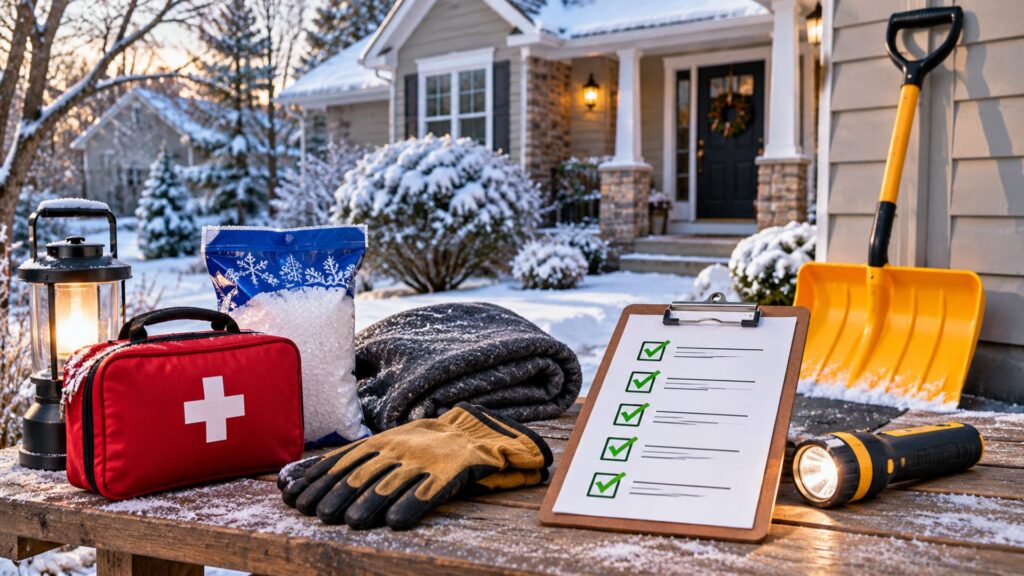
- A pusher and a scoop, stored where you can reach them during a storm
- Ice melt or sand, bought before the forecast turns
- Reflective tape on the mailbox and a quick check of the post
- A cleared spot for the trash cans, out of the plow’s path
- Your municipality’s sidewalk ordinance, so you know the deadline
- Gloves, boots with good traction and a phone in your pocket while you shovel
Ready When It Falls
Most winter headaches in the North Penn area come from being caught unprepared: the shovel that cracked last year, the mailbox post that was already leaning, the can buried under the plow ridge. An afternoon of prep now turns the first real storm into a few hours of work, done safely and on time.