7 Ways Voice AI for Healthcare Is Replacing Traditional Patient Intake in US Clinics
Patient intake has long been one of the most labor-intensive and error-prone processes in outpatient clinical settings. Front desk staff manage a constant flow of phone calls, paper forms, insurance verifications, and scheduling requests — often simultaneously. The result is a system that depends heavily on individual attention, creates delays during peak hours, and introduces inconsistency that compounds across dozens of patient interactions each day.
Across the United States, clinics of varying sizes are beginning to replace parts of this process with voice-based artificial intelligence systems. These systems handle inbound and outbound patient communication through automated, conversational voice interactions — not the rigid phone trees of earlier generations, but context-aware systems capable of asking follow-up questions, capturing structured data, and routing calls appropriately without human intervention.
The shift is not happening because voice AI is a novel technology. It is happening because the operational pressure on clinical front offices has reached a point where the cost of maintaining fully manual intake processes — in time, errors, and staffing — is difficult to justify when reliable alternatives exist.
1. How Voice AI for Healthcare Is Reshaping the Front Desk Workflow
The front desk in a medical clinic functions as the first point of contact for nearly every patient interaction — appointment requests, prescription refill calls, billing questions, and urgent triage routing all arrive through the same channel. When call volume increases or staff absences occur, the bottleneck is immediate and visible. Patients wait on hold. Staff rush through intake steps. Data entry becomes inconsistent.
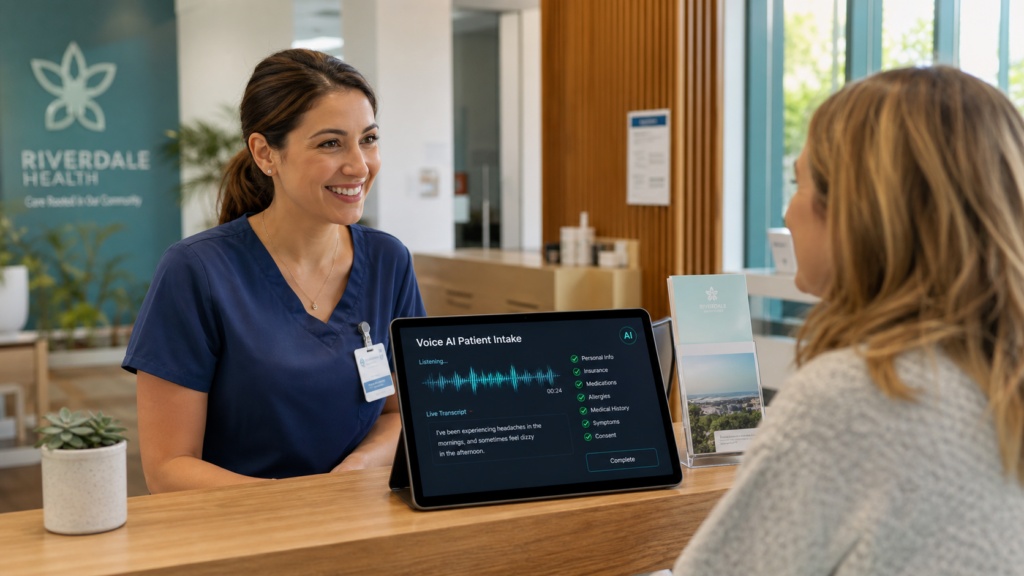
Voice AI addresses this directly by managing inbound calls without requiring a staff member to be available. A well-implemented voice ai for healthcare system can answer calls, collect patient-identifying information, confirm appointment availability, and route clinical questions to the appropriate care team — without putting callers on hold or transferring them multiple times. The workflow impact is measurable: front desk staff handle fewer repetitive calls and can dedicate more time to in-person patients and complex interactions that genuinely require human judgment.
What makes this different from earlier automated phone systems is the conversational capability. Rather than forcing callers through a numbered menu, voice AI engages in a structured dialogue that adapts based on responses — more closely resembling how a trained intake coordinator would handle a call than how a traditional IVR system operates.
2. Standardizing the Patient Information Collection Process
One of the consistent challenges in manual intake is variation. Different staff members ask different questions, capture information in different formats, and exercise different levels of diligence when documenting patient responses. Over time, these inconsistencies create problems in the patient record — missing fields, conflicting information, and gaps that require follow-up before care can proceed.
Why Consistency in Data Collection Matters Clinically
Inconsistent intake data is not just an administrative inconvenience. It can delay care decisions, create confusion during care transitions, and introduce errors that affect billing and insurance claims. When a patient’s reason for visit, symptom history, or insurance information is incomplete or incorrectly entered, resolving the gap requires additional staff time and sometimes direct patient re-contact.
Voice AI collects intake information using a standardized question set for every call. The system asks the same questions in the same sequence, captures responses in a consistent format, and transfers that structured data directly to the practice management system. The process does not vary based on call volume, time of day, or staff availability. Clinics that have implemented voice-based intake report fewer incomplete records and reduced time spent correcting data errors before appointments.
3. Managing After-Hours Call Volume Without Staffing Overhead
Most outpatient clinics operate within defined business hours, but patient need does not stop when the front desk closes. After-hours calls for appointment scheduling, prescription questions, and general inquiries have traditionally been managed through answering services or voicemail — both of which delay response and require manual follow-up the next business day.
The Operational Cost of Deferred Communication
Deferred after-hours communication creates a predictable problem each morning: a backlog of calls to return, appointments to schedule, and questions to address — all arriving at the same time as the regular daytime call volume. Staff begin each day behind, and the pressure continues through the morning until the backlog clears.
Voice AI systems can handle after-hours calls in real time. Patients who call to schedule an appointment after closing hours can complete the scheduling process through the voice system without waiting for a callback. Urgent calls can be routed according to defined protocols. Non-urgent requests are logged and processed automatically. The following morning, staff arrive with far fewer outstanding actions, and patients who called the previous evening have already received a resolution.
4. Reducing No-Shows Through Automated Appointment Confirmation
Appointment no-shows represent a consistent source of revenue loss and scheduling inefficiency for outpatient clinics. The standard approach — manual phone confirmation calls made by staff — is time-consuming and often incomplete. When confirmation calls are not made, no-show rates increase. When staff time is limited, confirmation calls are among the first tasks to be deprioritized.
How Automated Voice Confirmation Changes the Pattern
Voice AI systems can initiate outbound confirmation calls to patients ahead of scheduled appointments without requiring staff involvement. The system places the call, delivers the confirmation message, and captures patient responses — confirmed, cancelled, or rescheduled. Cancellations are logged immediately, and the appointment slot can be opened for rebooking.
The consistency of this process matters. Every patient with an upcoming appointment receives a confirmation call, regardless of how busy the front desk is on any given day. The confirmation script remains the same, and the data captured — whether the patient confirmed or requested a change — is recorded accurately each time. Over a scheduling period, this consistency reduces the unpredictability that makes no-shows difficult to manage.
5. Supporting Multilingual Patient Communication Without Specialized Staffing
US clinics serving diverse patient populations often encounter language barriers during intake. Patients who are not fluent in English may struggle to communicate effectively over the phone, leading to incomplete intake data, miscommunicated appointment details, and reduced engagement with the care process. Hiring multilingual staff for every front desk shift is not practical for most clinic sizes.
Language Capability as an Operational Consideration
Voice AI systems can conduct patient intake conversations in multiple languages, adapting to the caller’s language preference early in the interaction. This is not a translation workaround — it is a structured intake conversation conducted natively in the patient’s preferred language, with the same data structure and question flow used in English-language calls.
For clinics in regions with significant non-English-speaking populations, this capability reduces the number of calls that cannot be completed at first contact. Patients receive accurate appointment information, provide complete intake data, and are less likely to miss appointments due to confusion about logistics. The Centers for Disease Control and Prevention has consistently noted that communication barriers in healthcare settings contribute to health disparities — voice AI represents one practical way to reduce that gap at the point of first contact.
6. Integrating Voice-Captured Data With Existing Practice Management Systems
Introducing any new intake tool creates an integration question: how does information captured through the new system reach the existing patient record and scheduling infrastructure? Without clean integration, voice AI creates a parallel data silo — staff still have to manually transfer captured information into the practice management system, which eliminates much of the efficiency gain.
What Effective Integration Actually Requires
The value of voice-based intake depends almost entirely on whether the data captured moves into the clinical workflow automatically. When a patient calls to schedule an appointment, confirms their insurance details, or updates their reason for visit, that information should appear in the practice management system without requiring a staff member to transcribe it from a call log or message system.
Integration with common electronic health record and practice management platforms is now a standard expectation for voice AI systems deployed in clinical settings. The conversation data is structured during the call — fields are mapped to corresponding record fields — and transferred upon call completion. Staff can review the intake record, flag anything requiring clarification, and proceed with the patient file without re-entering information. This reduces transcription errors and removes one of the more time-consuming steps in the daily front desk workflow.
7. Maintaining Compliance and Documentation Standards During Automated Interactions
Healthcare organizations in the United States operate under strict documentation and privacy requirements. Any system that handles patient information — including voice-based intake — must align with those requirements. This is not a secondary consideration; it shapes how voice AI systems are designed, deployed, and maintained in clinical environments.
How Compliance Requirements Influence Voice AI Design
Voice AI systems used in healthcare must handle patient data in ways consistent with HIPAA requirements — governing how patient information is transmitted, stored, and accessed. Vendors designing systems for clinical use build these requirements into the architecture, including call encryption, access controls, and data retention policies aligned with regulatory expectations.
From an operational standpoint, automated voice interactions also create a documentation record by default. Each call is logged, the information captured is recorded, and the outcome — whether an appointment was scheduled, a message was left, or a call was transferred — is documented automatically. This level of logging is difficult to maintain consistently through manual intake, where call documentation depends on staff diligence and time availability. Automated documentation reduces the risk of gaps in the patient communication record and provides a cleaner audit trail when questions arise about intake accuracy or appointment communications.
Concluding Thoughts: Where Voice AI Fits in the Broader Intake Conversation
The adoption of voice AI in clinical intake is not a wholesale replacement of staff or a reimagining of how care is delivered. It is a targeted response to a specific set of operational problems that have existed in clinic front offices for years — high call volume, inconsistent data collection, after-hours gaps, and the staffing cost of managing it all manually.
What voice AI offers is consistency at scale. The same questions asked every time, the same data captured in the same format, the same confirmation delivered to every patient regardless of what else is happening at the front desk. For clinics that have struggled with intake reliability, that consistency has real operational value — not because the technology is impressive, but because the problem it addresses is concrete and recurring.
Clinic administrators evaluating these systems should focus on integration capability, compliance architecture, and the specific call types that create the most friction in their current workflow. Voice AI performs best when it is deployed against clearly defined, repeatable interactions — scheduling, confirmation, basic data collection — rather than positioned as a solution for every patient communication scenario.
The broader shift underway in US clinical operations is one of measured automation: identifying where human attention adds the most value and where reliable automated systems can handle the volume without introducing new risk. Patient intake, for many clinics, sits squarely in that territory.