Real-Time Analytics with DuckDB: Replacing Pandas for Speed
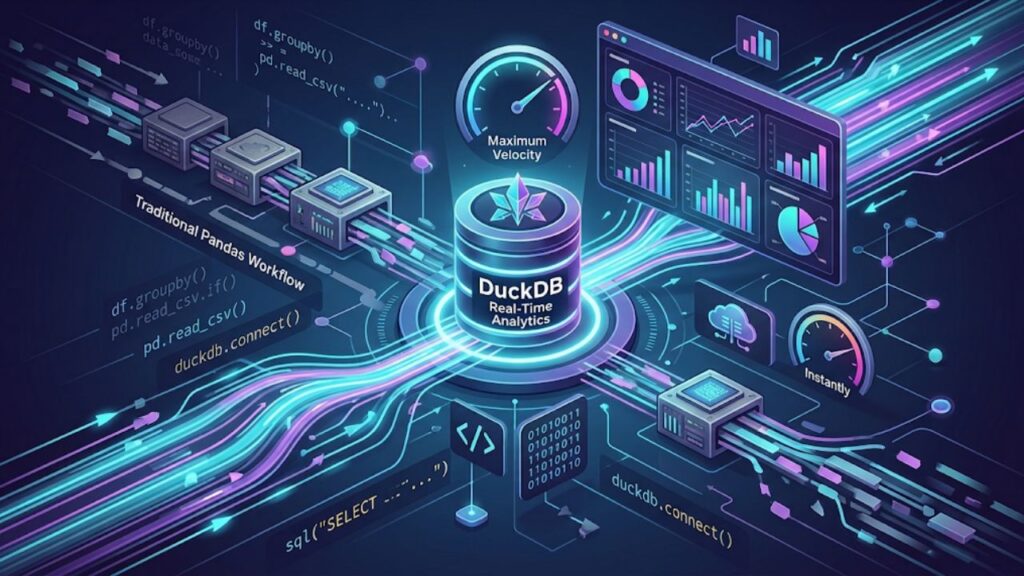
Picture yourself as a chef in a busy kitchen, responsible for preparing meals for hundreds of customers. In conventional kitchens, chefs have to use bulky and slow equipment and methods which can sometimes reduce efficiency. On the other hand, in a modern kitchen there are neat and efficient tools that enable you to cook more quickly and with greater accuracy. DuckDB is similar to one of these modern kitchen tools in the field of data analytics since it provides speed and efficiency whereas older tools such as Pandas tend to lag behind.
The article examines how DuckDB is bringing about a revolution in real-time analytics by taking the place of Pandas in order to speed up data processing. In the same way that a well-equipped kitchen provides the right tools for working with large amounts of data, DuckDB allows data scientists to carry out real-time queries and analytics with ease.
The Need for Speed: Why DuckDB Matters
Pandas has long been the library that people have turned to for data analysis in Python, and its popularity stems from its simplicity and versatility. However, when it comes to processing large datasets or providing real-time analytics, Pandas finds it difficult to keep up; while it handles smaller datasets that can be held in memory very well, it runs into performance issues when the size of the data increases or when real-time insights are needed.
It is in this case that DuckDB proves useful. DuckDB is like switching from a slow kitchen blender to a high-speed food processor; while Pandas might be seen as a multi-purpose tool that handles a wide range of tasks well, DuckDB is specialised for speed, scalability, and efficiency, especially in real-time analytics situations. Using DuckDB, data scientists can query their data more quickly, even when dealing with complex and large-scale datasets.
The Architecture Behind DuckDB’s Speed
DuckDB’s architecture is designed so that it can carry out real-time analytics with high performance since it carries out the querying directly in memory and thus avoids the necessity of loading the entire data set into a separate storage system; it’s similar to a chef who is working with ingredients that have already been prepared and are ready to use, removing the need for any additional steps.
DuckDB differs from Pandas in that, while Pandas processes the data one row at a time, DuckDB employs a columnar storage engine which speeds up queries by reading only the necessary columns rather than the whole dataset. As a result, it is able to quickly carry out filtering, aggregation, and complex analytics even when dealing with large amounts of data. On the other hand, Pandas usually involves transferring the data from one format to another, thereby introducing unnecessary overhead.
DuckDB’s architecture enables it to operate on one machine, which makes it an ideal choice for real-time analytics since it does not require the use of complex distributed systems. This is beneficial for data scientists as it allows them to run SQL queries on large datasets without encountering the performance problems that usually occur with Pandas.
DuckDB vs Pandas: A Race for Performance
To really understand how DuckDB surpasses Pandas in the area of real-time analytics, let’s look at the two by means of a practical example. Imagine that you are a data scientist who is working with a large dataset consisting of customer transactions and needs to compute the average spending per customer in real time.
Using Pandas, you would have to load the whole dataset into memory, carry out the necessary manipulations, and then apply the aggregation function. But in the case of millions of rows of data, this approach can become slow and require a lot of resources. In contrast, DuckDB enables you to run SQL queries on your dataset directly, leading to faster performance since it processes the data in a columnar format.
DuckDB is the better choice when it comes to carrying out fast analytics on large datasets or in situations that require real-time insights, whereas Pandas, although it can be a useful tool for exploratory data analysis (EDA) and smaller datasets, does not perform as well. The fact that DuckDB can run complex queries without experiencing much lag or high memory usage makes it a major advancement for real-time data processing.
Real-Time Analytics Use Cases with DuckDB
1. Business Intelligence (BI) Dashboards
In business settings companies usually depend on up-to-date insights if they are to make rapid decisions; whether the focus is on sales performance, customer engagement or inventory levels, speed is a necessity. By using DuckDB business analysts can incorporate real-time analytics into their BI dashboards and thus ensure that data is now processed and visualised faster than ever before.
For example, a company may use DuckDB to carry out real-time queries on sales data, refresh its dashboards with the most current insights, and give decision-makers access to the latest trends.
2. Financial Services
In finance, speed is an important element. For instance, trading algorithms have to quickly process huge volumes of data if they are to make informed decisions. Since DuckDB is capable of dealing with large financial data sets and carrying out complicated calculations in real time, it is an excellent option for the financial services industry in cases where decisions have to be made in a flash.
Data scientists and analysts are able to process both historical data and real-time market data using DuckDB, which allows them to make faster and more accurate trading decisions.
3. E-commerce Recommendations
E-commerce websites have to give users personalised recommendations in real time by taking their browsing history and purchase behaviour into account. Using DuckDB, these platforms are able to query huge datasets of user interactions and immediately update their recommendation algorithms with the most appropriate products. As a result, users always get recommendations that are based on their most recent behaviour, which in turn improves conversion rates and customer satisfaction.
DuckDB in Practice: How to Get Started
If data scientists want to make use of DuckDB’s speed and capabilities, their first move should be to take a Data Science Course or to attend classes that are concerned with high-performance analytics and database management. Such courses will show you how to incorporate DuckDB into your data pipeline, covering everything from installing the database engine to writing efficient SQL queries and optimising performance.
Learning how to use DuckDB will allow you to replace the conventional Pandas method with faster and more scalable solutions; no matter whether you are working with structured data, time-series data, or complex datasets, DuckDB provides the tools needed to deal with all of them in real time.
Conclusion: Embracing Real-Time Analytics with DuckDB
With regard to real-time analytics, speed, efficiency, and scalability are of the utmost importance. Although Pandas has long been a reliable tool for data analysis, DuckDB provides a more modern option that can take over from Pandas and enable faster and more efficient data processing. Because it uses a columnar storage approach and carries out SQL queries directly on the data sets, DuckDB is able to deal with large volumes of data without difficulty, thus providing the real-time insights that are necessary in today’s fast-moving, data-driven world.
Data scientists can greatly improve their performance and make their workflows more efficient by learning to use DuckDB, particularly when they are dealing with large datasets or are working on time-sensitive projects. By taking a Data Science Course or enrolling in data scientist classes, one can acquire the skills needed to use DuckDB in real-time applications and thus gain a competitive advantage in the field of data science. The future of analytics is now here, and with DuckDB it has never been faster.
Business name: ExcelR – Data Science, Data Analytics Course Training in Pune
Address: 101 A ,1st Floor, Siddh Icon, Baner Rd, opposite Lane To Royal Enfield Showroom, beside Asian Box Restaurant, Baner, Pune, Maharashtra 411069
Phone: 098809 13504