AI Automation vs. Traditional Automation: What’s Actually Different?

What if your workday could run on autopilot while you just supervise with your morning coffee?
Emails sent, reports ready, and tasks assigned—almost like magic, but real.
It may seem simple on the surface, but there’s a lot going on behind the scenes.
Some automation tools act like robots that follow rules: “Do this, then that, no questions asked. “Others are a bit smarter. They learn from data, adapt to changes, and even make decisions along the way.
That’s what makes AI automation different from traditional automation. And knowing this difference can change how you think about growth and efficiency in a big way.
In this blog, you’ll learn how AI automation and traditional automation differ and which one is best for your needs.
What is Traditional Automation?
Traditional automation operates on set rules. It follows a straightforward logic: “If this happens, do that.” Everything runs on pre-set instructions, from sending welcome emails to making weekly reports to giving out tasks.
It’s reliable and steady, especially when things don’t change much. It works just like a calculator, so you know exactly what it will do.
What is AI automation?
AI automation goes a step further by using data to learn instead of just following rules. It gets better over time, learns to recognize patterns, makes choices, and adjusts to new situations.
It goes beyond just giving instructions. It uses chatbots, product recommendations, and predictive systems to learn more about how people act and guess what they will want.
It’s like a smart assistant that not only does what you say but also learns, adapts, and fixes problems.
Key Differences Between AI Automation and Traditional Automation
Companies can make better decisions if they understand the differences between AI and traditional automation.
| Aspects | AI Automation | Traditional Automation |
| Rule-Based vs Learning-Based | Learns from data and improves continuously without frequent updates, resulting in smarter and more efficient systems over time. | Follows set rules, with each action determined manually. Must be updated whenever processes or conditions change. |
| Task Complexity | It can do complicated things like look at customer behavior, find fraud, and spot patterns that go beyond simple rules. | Best for simple, repetitive jobs that have a clear and predictable pattern. |
| Adaptability and Flexibility | Able to change and adapt to new information and changing business situations. | Rigid and only works under certain conditions, making it difficult to handle unexpected changes. |
| Data Processing Capabilities | Handles both structured and unstructured data, such as text, images, and voice, leading to more profound insights. | Processes structured data that is clean, organised, and simple to manage. |
| Scalability and Growth | Learns from more and more data to grow quickly, which helps the business grow over time. | You need to add more rules, scripts, and manual settings to scale, which can be hard to do. |
| Decision-Making Ability | Looks at data to make smart choices, often in real time, which leads to better results. | Follows set instructions without making its own choices. |
| Accuracy and Speed | Gains insight from data over time to improve accuracy, especially in complicated situations. | Gives quick and correct results for tasks with clear rules and steps to follow. |
| Maintenance and Updates | Requires initial training and monitoring but adapts over time, reducing manual effort and increasing long-term productivity. | Needs to be updated manually often when rules or procedures change, which makes maintenance harder. |
When to Use Traditional Automation vs AI Automation
Your work, data complexity, and goals determine whether you choose traditional automation or AI automation. Here’s how to select the best solution for your requirements.
Traditional Automation Works Best For
Automation that is based on rules works best in places where things are stable and processes are the same and can be predicted. It makes everyday tasks easier and more accurate.
- Repetitive Processes: If you have to repeat the same steps frequently, traditional automation is the best option. It improves consistency, reduces manual labor requirements, and saves time on daily tasks.
- Predictable Workflows: Traditional automation works well and reliably when workflows follow set patterns and always lead to the same results. It works best in places where things don’t change much.
AI Automation Works Best For
AI automation is suited for dynamic environments where data, decisions, and interactions require intelligence and flexible thinking. It helps companies get past rules and find better ways to do things.
- Data-Driven Decisions: AI automation is very useful when you need to make decisions based on a lot of data. It finds patterns, makes things more accurate, and helps companies make smarter, faster decisions.
- Customer Interactions: AI automation enhances the customer experience by understanding queries, responding naturally, increasing engagement, decreasing response time, and quickly scaling interactions.
- Complex Analysis: AI makes better business decisions by finding patterns, spotting anomalies, and finding hidden chances and risks in complex data.
The Future of Automation in Businesses
It’s not about picking one over the other anymore; it’s about putting them both together.
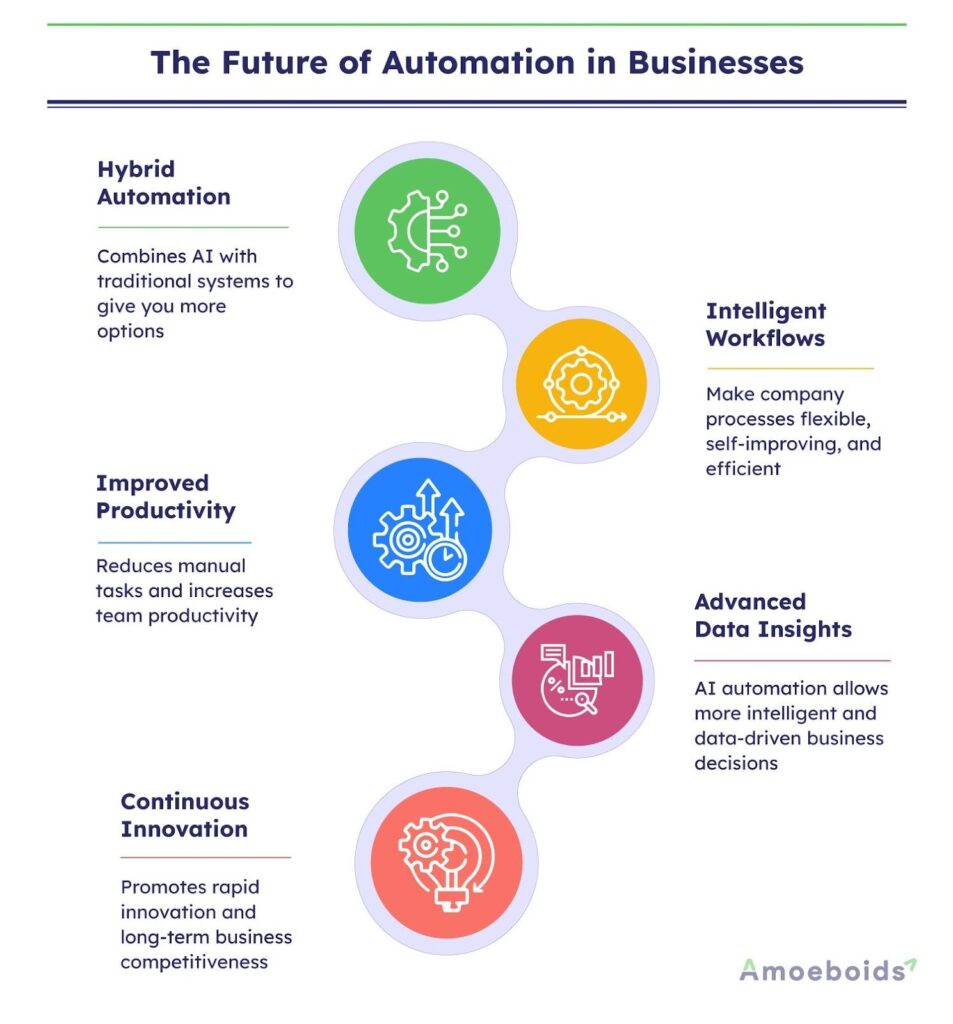
- Hybrid Automation: Hybrid automation is a mix of traditional and AI-based systems that helps companies become more flexible and successful overall.
- Intelligent Workflows: Workflows are becoming more intelligent. They don’t just do things, they also change and improve methods on their own.
- Improved Productivity: Automation cuts down on the need for manual work, so teams can focus on more important tasks instead of doing the same thing over and over.
- Advanced Data Insights: Automation powered by AI helps companies get more useful information from their data, which helps them make better choices.
- Continuous Innovation: As AI advances, automation will become more powerful, allowing companies to innovate more quickly and remain competitive.
Conclusion
Traditional automation and AI automation are not competitors—they are partners.
Traditional automation works well and is reliable when your tasks are simple and easy to predict. But AI automation really helps when you’re working with complicated data, talking to customers, or making decisions.
Ask yourself: Is your current automation helping you grow smarter or just faster?
Now is the time to rethink your automation strategy.
Start small, try things out carefully, and use both methods to get the most out of your efforts, grow faster, and stay ahead of the competition.