What Is Copper Stamping? Process, Advantages, and Applications
Copper is one of the most widely used metals in modern manufacturing—especially in electrical and thermal applications. It’s highly conductive, corrosion-resistant, and easy to form. That combination makes copper a perfect candidate for stamping, a fast and repeatable way to turn sheet metal into finished parts.
Today, manufacturers use copper stamping to produce everything from electrical connectors and busbars to heat exchanger components and medical device parts. When done with the right tooling and process control, stamping delivers high-volume production with consistent quality.
In this guide, you’ll learn what copper stamping is, how the process works, its advantages and limitations, and where stamped copper parts are commonly used.
What Is Copper Stamping?
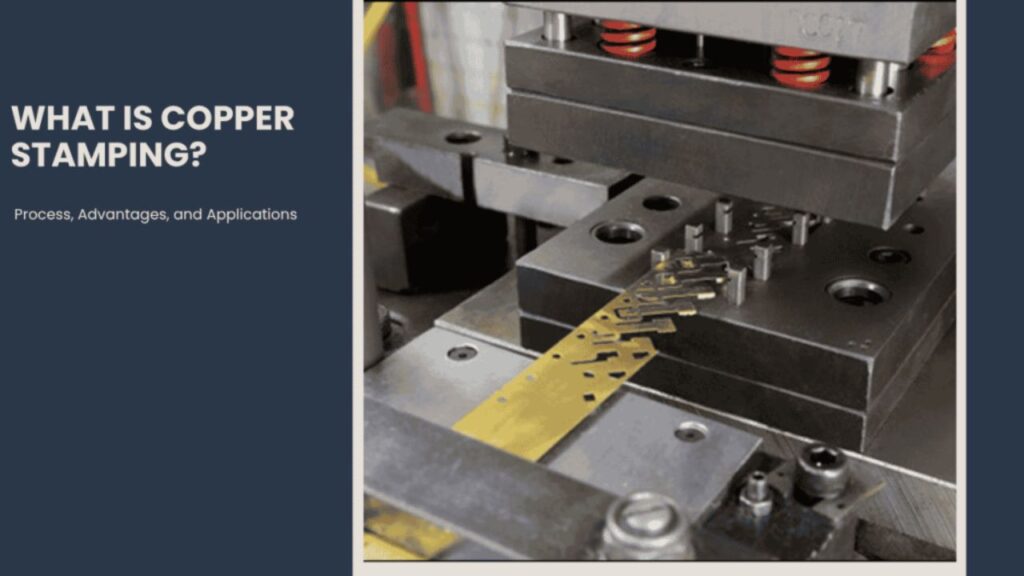
Copper stamping is a sheet metal forming process that shapes copper sheets or coils into parts using a press and custom tooling (dies and punches). Depending on the design, stamping can include operations such as:
- Punching (holes and cut-outs)
- Blanking (cutting the part outline)
- Bending (forming angles and flanges)
- Deep drawing (creating cup-like shapes)
- Embossing (raised or recessed features)
For high-volume production, manufacturers often use progressive die stamping, where a copper strip moves through multiple stations in a single press line. Each station performs a step until the final part is complete.
Key Properties of Copper for Stamping
Copper performs extremely well in stamping because it forms easily while still delivering strong functional performance. Common advantages of copper include:
- Excellent electrical conductivity for terminals, connectors, and power components
- High thermal conductivity for heat dissipation and thermal management
- Corrosion resistance for harsh environments and long service life
- High malleability that supports complex shapes without cracking
- Antibacterial behavior (useful in specific medical and hygienic applications)
Copper’s properties can also be tailored through alloying, depending on strength, fatigue resistance, or spring requirements.
Common Copper Grades for Stamping
Different applications require different copper grades. Some popular options include:
Pure / High-Copper Grades
Common examples include C11000 and C10200, often chosen for:
- busbars
- grounding straps
- terminals and connectors
- electrical contact components
These grades are valued for high conductivity and good formability.
Copper Alloys (e.g., Phosphor Bronze)
Grades like C51000 and C52100 (phosphor bronze) offer:
- better fatigue strength
- excellent corrosion resistance
- strong spring properties
They’re often used for:
- contact springs
- clips and retainers
- parts requiring repeated flexing
Typical sheet thickness ranges from 0.05 mm up to 6 mm+, depending on equipment capability and part design.
The Copper Stamping Process Step-by-Step
Here’s how copper stamping typically works in a production environment:
1) Part design
Engineers define dimensions, features, tolerances, and requirements such as conductivity, plating, or heat performance.
2) Tooling design (die development)
Manufacturers create the stamping die set—often a progressive die—based on the part geometry and forming sequence.
3) Press and line setup
This includes preparing:
- the press (tonnage, stroke, speed)
- feeder and straightener systems
- die alignment and safety checks
- lubrication plan (important for copper)
4) Stamping and forming operations
The copper strip moves through stations and gets progressively shaped, cut, punched, and formed until the part is produced.
5) Finishing (optional)
Depending on the application, parts may be:
- deburred
- plated (tin, nickel, silver, etc.)
- cleaned and anti-oxidation treated
- inspected for dimensional accuracy and surface quality
Advantages of Copper Stamping
Copper stamping is popular because it combines speed with precision—especially for repeat production.
High production speed
Once tooling is ready, stamping can produce parts rapidly with minimal cycle time.
Excellent repeatability
Using the same die set yields consistent parts over large production runs.
Complex shapes are possible
Copper’s ductility supports bends, holes, tabs, embossing, and intricate geometry.
Strong thermal performance
Stamped copper parts hold up well in applications involving heat transfer and electrical loading.
Suitable for large formats
Stamping can handle everything from small micro-components to large copper sheets, depending on press bed size and tooling.
Disadvantages and Challenges of Copper Stamping
Like any manufacturing method, stamping also has limitations:
High upfront tooling cost
Dies and punches can be expensive, which makes stamping less ideal for low-volume prototypes.
Surface oxidation
Copper can tarnish or oxidize over time, which may affect appearance and conductivity unless protected with coating/plating.
Risk of galling
Copper can stick to steel tooling at high speeds without proper lubrication, increasing wear and surface defects.
Applications of Copper Stamping Parts
Stamped copper parts are widely used wherever conductivity, thermal control, or corrosion resistance matters:
- Automotive: EV busbars, connectors, grounding straps, sensor terminals
- Electrical power: terminal blocks, switch contacts, fuse carriers, grounding bars
- Electronics: RF connectors, shielding components, contact springs, clips
- Medical: sensor terminals, electrode contacts, connector pins
- Aerospace: bonding strips, high-amp clips, avionics contacts, retainers
Conclusion
Copper stamping is a highly efficient way to manufacture copper parts at scale. With progressive tooling, multiple forming operations can be completed in a single continuous cycle—resulting in high precision, repeatability, and cost-effective large-volume output.
For the best results, choose a manufacturer with advanced tooling, process control, and proven experience in sheet metal stamping services. If you’re looking for a capable supplier, ProleanTech is an example of a company positioned to support high-quality copper stamping with modern CNC and stamping expertise.