From Data Silos to Smart Factory: A Step-by-Step Guide to Enterprise Integration in Manufacturing
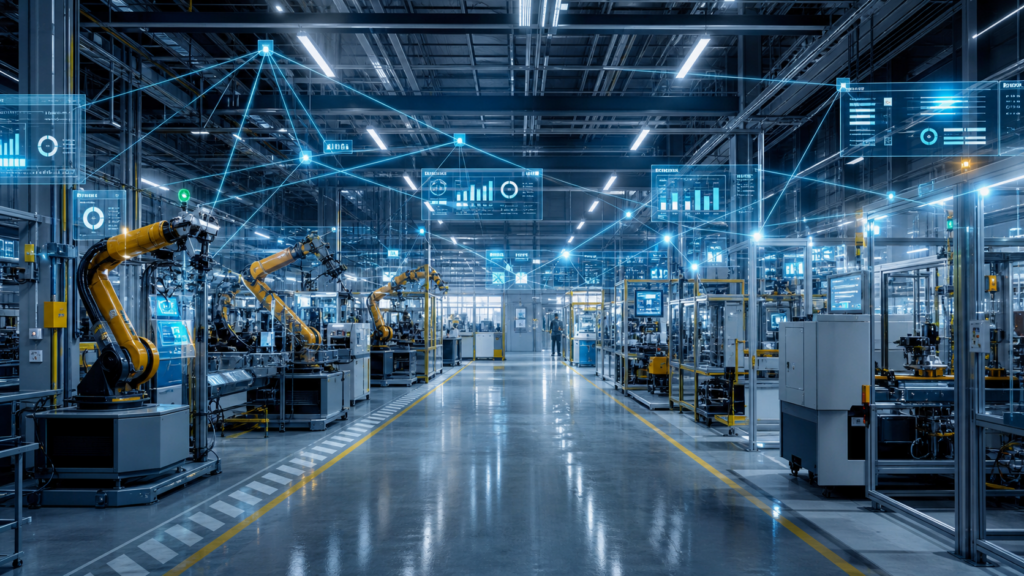
Most manufacturing facilities today run on a combination of systems that were never designed to work together. A plant might use one platform for production scheduling, another for quality tracking, a separate system for equipment maintenance, and yet another for supply chain visibility. Each of these systems captures useful data, but that data rarely travels between them in real time. Decisions get made on incomplete information. Problems surface later than they should. Coordination between departments becomes a manual effort rather than an automatic one.
This is not a technology failure. It is an architectural one. The systems exist, the data exists, but the connections between them do not. And as manufacturing operations grow more complex — handling more product lines, more suppliers, more regulatory requirements, and more demanding customer expectations — the gap between what these systems know and what decision-makers can act on becomes a genuine operational liability.
Enterprise integration is the process of closing that gap. It is not a single software purchase or a one-time project. It is a structured approach to connecting disparate systems, standardizing data flows, and building an operational environment where information is consistent, accessible, and usable across the entire enterprise.
What Enterprise Integration Actually Means in a Manufacturing Context
The term gets used broadly, but in manufacturing it has a specific meaning. Enterprise integration manufacturing refers to the deliberate connecting of operational technology systems — such as machine controllers, sensors, and production management software — with information technology systems like ERP platforms, quality management tools, and financial reporting. The goal is not simply to share data, but to make that data consistent, timely, and structured in a way that supports real decisions at every level of the operation.
For a practical understanding of what this looks like in practice, the principles behind enterprise integration manufacturing increasingly involve connecting AI-enabled analytics directly into production workflows — not as an add-on, but as a functional layer that interprets data as it moves between systems.
Integration at this level affects how a plant responds to variation. When a production line experiences an unplanned slowdown, an integrated system can surface that information across scheduling, maintenance, and procurement simultaneously. Without integration, that same event might only reach the relevant teams after manual escalation — hours or days later.
The Difference Between Data Access and Data Connectivity
Many manufacturers believe they have addressed integration because their teams can log into multiple systems and pull reports. This is data access, not data connectivity. Access requires a person to retrieve information manually and interpret it in context. Connectivity means the systems themselves exchange information automatically, in a structured format, without requiring human intervention at every step.
The distinction matters because manual retrieval introduces delay, inconsistency, and error. When a quality engineer pulls data from one system and a production manager pulls data from another, there is no guarantee that both are working from the same baseline. Integration eliminates that ambiguity by establishing a single, synchronized source of operational truth.
Where the Boundaries of Integration Sit
Integration does not mean that every system needs to connect to every other system. In practice, effective integration is defined by which data flows are critical to operations and which are incidental. A well-designed integration architecture identifies the systems that generate decisions — and ensures that those systems are connected in a way that reflects actual operational priorities, not theoretical completeness.
Identifying Integration Gaps Before Building Toward Them
Before any integration work begins, manufacturers need a clear picture of where information currently breaks down. This is not a technology audit. It is an operational one. The question is not which systems exist, but which decisions are being made without reliable, timely data — and why.
Common breakdown points include the space between production reporting and inventory management, between quality inspection results and supplier performance tracking, and between equipment maintenance records and production scheduling. Each of these gaps represents a place where information is generated in one part of the operation but does not reach the people who need it quickly enough to influence the next decision.
Mapping Information Flows Against Decision Cycles
One structured way to identify integration gaps is to trace the information requirements of recurring operational decisions. A shift supervisor deciding whether to run a machine past its scheduled maintenance window needs equipment health data, production targets, and maintenance history — ideally in one place, updated in real time. If that supervisor currently consults three separate systems and makes a judgment call based on partial information, that is a measurable integration gap with real risk attached to it.
Mapping these flows does not require sophisticated tooling. It requires honest conversations with the people who make decisions at each level of the operation and a systematic record of where information comes from, how current it is, and what gets missed.
Prioritizing Gaps by Operational Impact
Not all integration gaps carry equal weight. Some create minor inefficiencies. Others contribute to quality escapes, safety incidents, or supply chain disruptions. Prioritization should be based on the consequence of the information failure, not the complexity of the fix. A gap that leads to missed delivery commitments should rank above one that creates extra administrative steps, even if the latter is easier to solve technically.
Building an Integration Architecture That Reflects How the Plant Actually Operates
Integration architecture is the framework that defines how systems connect, how data is formatted and transmitted, and how conflicts or errors in data are handled. In manufacturing, this architecture needs to reflect the physical and operational reality of the plant — not an idealized model.
Many integration projects fail not because the technology is wrong, but because the architecture was designed by people who did not fully understand the production environment. A system designed for a high-volume, low-mix operation will behave differently under the conditions of a high-mix, low-volume environment. The integration layer needs to accommodate the variation that actually exists on the floor, not the variation that appears in a requirements document.
Choosing Between Point-to-Point and Middleware Approaches
Point-to-point integration connects individual systems directly to each other. It is straightforward to implement for a small number of systems but becomes increasingly difficult to manage as the number of connections grows. Each new system added to the environment requires new connections to every system it needs to communicate with, and each of those connections needs to be maintained independently.
Middleware — sometimes called an integration platform or message broker — sits between systems and manages the routing, transformation, and delivery of data. It introduces some complexity upfront but significantly reduces the cost and risk of maintaining integrations over time. As manufacturing environments adopt more systems and data sources, middleware-based architectures tend to be more sustainable. The ISO standard for industrial automation and integration outlines foundational principles that inform how these architectural decisions should be approached in production environments.
Handling Data Consistency Across Systems
One of the most persistent challenges in manufacturing integration is ensuring that data means the same thing across different systems. A part number in the ERP may be formatted differently than the same part number in the production execution system. A timestamp recorded by a machine controller may be in a different time zone than the one used by the quality management platform. These inconsistencies are not trivial. They cause records to fail to match, reports to show conflicting figures, and automated workflows to break.
Data consistency requires deliberate governance — agreed-upon definitions, formats, and identifiers that all systems use when exchanging information. This is a business decision as much as a technical one, and it requires input from the teams who rely on that data, not just the teams who manage the systems.
Phasing Integration Work to Reduce Risk and Sustain Progress
Large-scale integration is not a single project with a fixed end date. Attempting to connect all systems simultaneously introduces enormous risk — operational disruption, data corruption, and user resistance can derail even well-funded programs. A phased approach, built around measurable operational improvements, is more likely to produce durable results.
The first phase should address the integration gaps with the highest operational impact and the clearest data ownership. Early wins demonstrate that the integration program is producing tangible improvements, which builds organizational support for subsequent phases. Each phase should include a period of stabilization before the next one begins — time to validate that the connections are working correctly and that users are relying on the integrated data rather than reverting to manual workarounds.
Measuring Integration Effectiveness Over Time
Integration effectiveness is measured not by the number of systems connected, but by changes in operational outcomes. Decision speed, data accuracy, response time to production events, and reduction in manual data entry are all meaningful indicators. These should be tracked from before integration begins so that improvements can be attributed with confidence.
As manufacturing operations evolve — adding new product lines, onboarding new suppliers, or adopting new equipment — integration architecture needs to evolve alongside them. A system that works well today may create new gaps as conditions change. Sustaining integration means treating it as an ongoing operational discipline rather than a completed project.
Conclusion
The shift from isolated systems to a connected manufacturing enterprise does not happen through a single investment or a single decision. It happens through a sustained, structured effort to understand where information breaks down, build the connections that matter most, and maintain those connections as the operation changes over time.
Enterprise integration in manufacturing is ultimately about decision quality. When the people responsible for production, quality, maintenance, and supply chain have access to consistent, timely information, they make better decisions — not because they are more capable, but because they are working with a more accurate picture of what is actually happening. That is the practical value of integration, and it is the reason manufacturers across every segment are treating it as a foundational operational priority rather than a background IT initiative.
For organizations beginning this work, the most important first step is honest assessment — not of the systems available, but of the decisions being made without the information they need. From that starting point, everything else can be built in sequence, with purpose, and with results that compound over time.






