Revise an AI-Assisted Book Draft by Testing One Reader Question at a Time
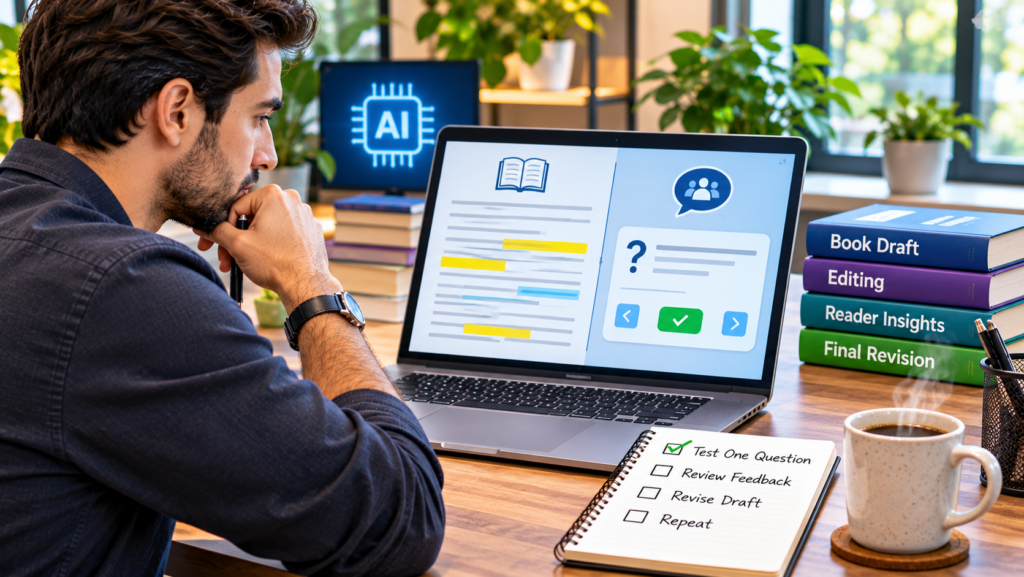
A long draft can look complete because it has an introduction, numbered chapters, and a closing summary. That structure is useful, but it does not establish that a reader can follow the explanation. Repeated points may hide between polished paragraphs, examples may arrive before the concepts they illustrate, and a chapter may answer a different question from the one its heading suggests. Revision becomes easier when the editor tests the draft against a reader’s specific questions.
Take a fictional beginner’s guide to keeping an observation notebook. A reader might want to know what to record, how often to write, and what to do with earlier notes. Those questions create a practical review path. They allow an editor to examine whether the pages support a coherent routine, instead of judging the manuscript only by its length or the confidence of its wording. A draft is working material until those relationships have been checked.
Begin with the question behind the chapter
Write a plain-language question beside each section. Avoid simply repeating its title. A heading such as “Building the Habit” might really need to answer “What should I do when I miss several days?” or “How do I keep the task small enough to continue?” If the editor cannot identify the question, the section may be combining several purposes. Separate them or choose the one that belongs at this point in the book.
Read the section looking only for its answer. Mark where the answer begins and whether it requires information introduced later. A useful explanation should not force the reader to reconstruct the author’s outline. Move necessary context earlier, and remove repeated scene-setting when it delays the practical point. This pass concerns the order of ideas. Sentence-level polishing can wait until the section has a clear role in the larger argument.
Distinguish an example from a restatement
An example should help the reader apply an idea in a recognizable situation. Saying that a notebook should be consistent, then explaining that consistency matters, adds little new information. Showing two short entries with different levels of useful detail gives the reader something to compare. Describe why one entry is more helpful for the task rather than assuming that the difference will be obvious from the samples alone.
Check whether the example introduces unsupported claims. A fictional illustration should be identifiable as an illustration. An invented person’s result should not quietly become evidence that a method works. Use straightforward situations whose value lies in explaining the decision. If a section depends on a factual statement, confirm the statement through an appropriate source and retain that source in the working notes for the manuscript.
Keep editing possible throughout the workflow
Creators exploring AI tools for editable book drafts can use OneKDP to develop pages and then revise the writing and layout. Editable output is useful because the first arrangement often reveals questions that were difficult to see in an outline. The editor can shorten an instruction, change a sequence, or replace an example instead of treating the initial generation as a finished book. The tool provides material to examine; the editorial purpose gives that material direction.
Keep a copy of the earlier version when making a substantial change. Compare the revision with the question it was meant to answer. Did the new text clarify the task, or did it introduce an attractive but unrelated explanation? A change should be assessed by its effect on the reader’s understanding. Without that comparison, revision can become an endless exchange of equally polished paragraphs that never settle the underlying problem.
Check instructions by carrying them out
Whenever the text asks a reader to do something, perform the action yourself using only the information on the page. Put aside the background knowledge that makes the instruction seem obvious. Check whether the materials, starting point, and expected result have been stated. If the action depends on a choice, explain what the reader should consider instead of moving directly to the next step as if the choice had already been made.
A fresh tester can reveal different problems. Ask them to follow one short section and describe where they become uncertain. Avoid immediately explaining what the author intended. Their uncertainty may show that the page needs another sentence, a clearer heading, or a different example. Record the point of confusion before revising it. A specific observation is easier to act on than a general impression that the writing needs to be smoother.
Read across chapter boundaries
After individual sections work, inspect the transitions between them. Does a term change meaning? Is the same introductory explanation repeated several times? Does a later exercise assume a decision the earlier chapter never asked the reader to make? These problems are often invisible when chapters are reviewed in isolation. A continuous reading pass checks whether the sequence carries knowledge forward without requiring the reader to fill in missing connections.
Finish with a separate language and layout review of the exported pages. Look for crowded examples, unexplained labels, and instructions separated awkwardly from the material they describe. Keep the final editorial notes with the chosen version. Good revision is not a contest to replace the greatest number of words. It is a process of making the reader’s next question easier to answer, one section at a time, until the whole book supports the experience its title promises.