Why an angled snow pusher blade clears a strip faster than pushing straight

Keeping the alpine roads open
When snow settles across the high country of New South Wales and Victoria, the first task of every winter morning is the same: open the roads. Access routes to Thredbo, Perisher and the smaller resort villages must be cleared before the day’s traffic begins, and the measure of success is simple, how much road is made passable in how little time.
A snow pusher blade is built for exactly this, and the way it is angled decides whether one pass clears a whole strip or merely builds a heap that grows heavier ahead of the machine.
The difference between a snow pusher set straight and one set at an angle looks small from the cab, yet it changes the physics of the whole pass. Understanding that change is the difference between a road cleared in one run and a machine grinding to a halt behind its own load.
What happens to the snow in front of the blade
Set a blade square across the direction of travel and every flake it meets piles up directly ahead of it. With nowhere to escape sideways, that pile grows taller and heavier the further the machine drives. Before long the blade is no longer clearing snow so much as bulldozing a swelling mound, and the resistance climbs until traction fails and the operator must back off and start again.
Now angle the blade. The snow it gathers no longer stalls in front; it slides along the face of the blade and rolls off the trailing end, casting steadily to one side into a long ridge called a windrow. Because the snow keeps leaving the blade as fast as it arrives, the load in front never accumulates. One continuous pass peels a clean strip and lays the snow neatly along the verge instead of carrying it onward.
• A straight blade piles snow ahead
• An angled blade casts snow aside
• Continuous discharge keeps the load light
Why casting beats carrying on a long run
Think of dragging a wide broom straight across a floor of sand. The sand bunches in front and soon you are pushing a heavy bank that resists every step. Sweep the broom at an angle instead and the sand peels off to the side as you go, so the broom stays light and the floor behind it stays clear. The angled snow pusher does the same with snow, converting a growing push load into a steady sideways cast.
On a road this matters enormously, because the goal is reach, not removal. A windrow laid along the edge can be widened or later carried away, but what counts in the moment is that the travelled lane is clear and the machine never bogs down.
Sorting blades by how they behave with the snow
A snow pusher and its relatives classify by their behaviour against the snow. A straight push blade simply shoves snow ahead, useful only for short distances or for relocating a heap a few metres. An angled cast blade deflects snow continuously to one side, the configuration that clears long strips of road without building a load.
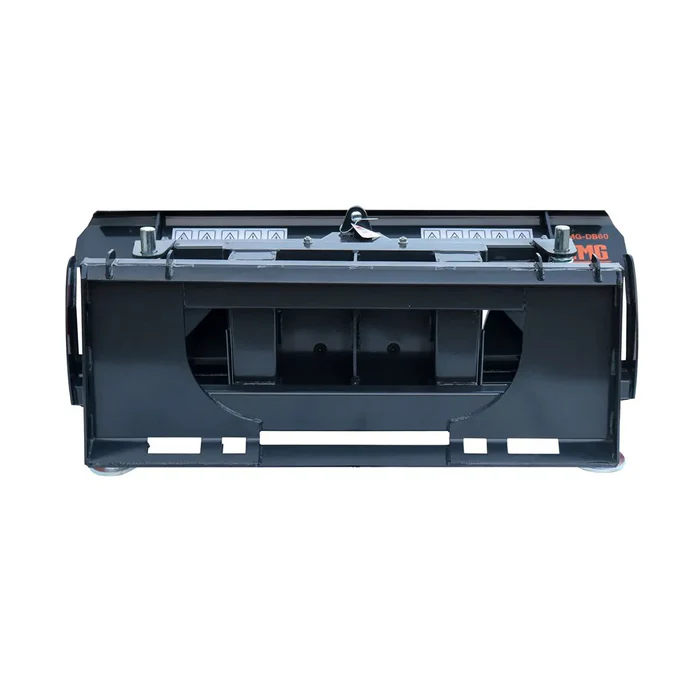
The sixty-inch dozer-style blade that angles left or right belongs to the casting family, and its swing is the feature that defines it. By changing the angle the operator changes the behaviour, from a near-straight push for nudging a pile to a sharp cast for stripping a lane, all without leaving the seat.
Choosing the behaviour the road needs
Each behaviour trades one virtue for another. A straight blade is simple and moves snow squarely but chokes on any distance. A containment pusher clears huge open areas fast yet must stop to dump, which suits a wide car park more than a narrow road. An angled cast blade keeps moving and clears length without ever stopping to unload, which is why it rules the long, linear job of opening a mountain road. The right call follows the shape of the ground, and a snow pusher that angles both ways covers more of those shapes than a fixed one ever can.
• Angle to strip a long lane
• Square up to nudge a pile
• Aim the windrow to a safe verge
Read as a tool that casts rather than carries, an angled snow pusher clears an alpine road one continuous strip at a time instead of stalling behind an ever-heavier load.
The principle for any operator working winter roads is that direction matters as much as power. Setting the blade to cast snow aside, rather than shove it ahead, is what keeps the machine moving and the road opening cleanly mile after mile through effective winter road maintenance solutions.