How Can Businesses Reduce Wiring Problems in Automated and Mobile Equipment?

An automated guided vehicle stops dead in the middle of a warehouse aisle. A six axis robotic arm drops a heavy part on an assembly line. When these failures happen, everyone immediately assumes there is a major software glitch or a blown servo drive. The reality is usually much less complicated. It is just a broken wire.
A simple physical connection fails because a cable bent back and forth a million times until the copper snapped inside the jacket. We spend huge amounts of capital on advanced robotics and fleet management software but often treat the physical wiring like an afterthought. That oversight causes expensive downtime. Managing cables properly and specifying the right materials up front is the most effective way to keep automated and mobile equipment running smoothly.
Stop Guessing on Bend Radii
When cables fail in moving equipment, it is almost always a mechanical failure rather than an electrical one. Wires work harden over time. Every time you bend a piece of copper, it gets a little more brittle. If you bend it tightly enough and often enough, the strands snap.
This is why the minimum bend radius is a hard rule in machine design. Every cable has a specific radius it can handle without stressing the internal conductors. You cannot just guess this by looking at it. Static applications have one bend radius rule, but dynamic applications where the cable moves constantly require a much larger radius. Forcing a thick cable into a tight turn on a moving machine guarantees a break. You have to design the mechanical routing to respect the limits of the cable, even if that means making a housing slightly larger.
Specifying for Continuous Motion
Flexing back and forth is one thing. Twisting is an entirely different problem. Torsion destroys standard cables rapidly. When a machine joint rotates, the internal conductors of a standard cable will migrate, bunch up, and eventually tear right through the outer jacket. The shielding typically shreds first, causing signal interference before the cable finally snaps.
If you build or integrate automated cells, do not just buy a spool of bulk continuous flex cable and assume it will survive the complex twisting of a robotic wrist joint. You need to talk to a dedicated robotics cable assembly manufacturer early in the design phase. They build assemblies specifically designed to handle torsional stress. They use specific slip layers inside the jacket that allow the internal conductors to slide past each other smoothly as the cable twists. Getting that internal friction right is exactly what keeps the cable alive after millions of cycles.
Surviving Constant Vibration
Mobile equipment presents a different set of physical challenges. Agricultural combines, mining vehicles, and heavy automated material handlers vibrate aggressively all day long. That vibration easily shakes poorly crimped terminations loose and causes cables to rub against metal chassis components until the insulation wears away.
Standard commercial grade industrial cables are perfectly fine for stationary electrical panels. They fail quickly on mobile equipment. When you deal with constant engine vibration and the heavy jolts of rough terrain, you need totally different crimping and routing standards. This is why heavy equipment builders often partner with an automotive wire harness manufacturer to supply their electrical systems. The automotive industry operates under strict standards for heavy duty locking connectors, aggressive strain relief, and precise routing rules that prevent the wiring from vibrating against sharp metal frames. Using those same standards on industrial mobile equipment saves you from hunting down intermittent electrical shorts later.
Controlling Environmental Hazards
Most automated and mobile equipment does not operate in a climate controlled cleanroom. These machines sit out in the rain, drive through puddles, or get blasted with high pressure hot water in food processing facilities. Machine tool automation gets constantly sprayed with aggressive cutting coolants and hydraulic oils.
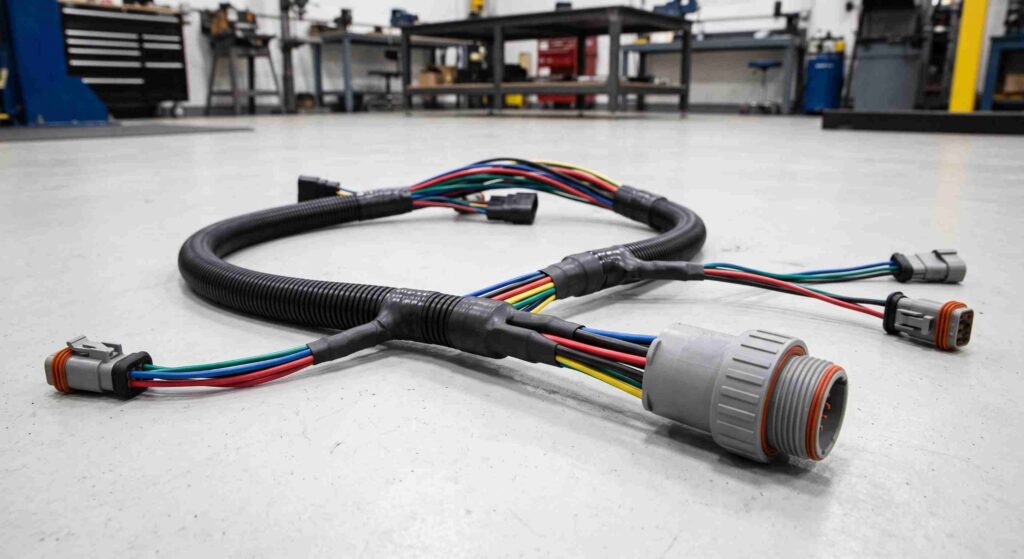
A standard plastic jacket and a basic threaded connector simply will not survive those environments for long. You have to specify a true Waterproof Wire Harness for these specific applications. Once moisture or chemical coolant wicks past a poorly sealed connector, it travels straight down the inside of the cable jacket. It corrodes the copper, ruins analog sensor signals, and eventually shorts out expensive remote I/O blocks. Using overmolded connectors and ensuring the entire assembly meets proper IP67 or IP69K sealing standards prevents this intrusion completely.
The Problem with Zip Ties
Let’s talk about basic installation on the plant floor. The absolute fastest way to ruin a good continuous flex cable is to zip tie it tightly to a moving machine arm. Zip ties create hard pinpoint pressure. When the equipment moves, the cable cannot distribute the flexing force evenly. Instead, it bends sharply right at the edge of the tight plastic tie, tearing the jacket and breaking the copper.
If you need to secure cables on a moving joint, use wide hook and loop straps or specialized cable clamps designed for motion. They hold the bundle securely without biting into the jacket. You want the cable to have enough room to shift slightly as the machine moves.
Managing Drag Chains Correctly
Drag chains or cable tracks are great for protecting wires on linear motion axes, but they are frequently misused. You cannot just stuff a bunch of cables into a track and expect them to last.
Weight distribution matters heavily. Heavy power cables need to be separated from lightweight sensor cables using internal dividers. If you stack them on top of each other, the heavier cables will literally grind the smaller cables to dust as the track moves back and forth. You also have to leave proper slack. Cables need room to lay flat in the neutral axis of the chain. If you pull them tight during installation, they will stretch and snap the first time the machine runs at full speed.
Standardize to Survive
Engineers sometimes want to pick the absolute perfect, highly specialized connector for every single sensor on a machine. This creates an absolute nightmare for the maintenance team. If a piece of equipment has twenty different connector types, the plant has to stock twenty different spare cables to prevent extended downtime.
Keep it simple. Standardize on M12 or M8 industrial circular connectors wherever you possibly can. Use standard lengths. When a cable does eventually get physically damaged by a forklift or a dropped part, a technician should be able to grab a standard spare and swap it in five minutes.
Building a Routine Inspection Protocol
Even the best engineered wiring systems degrade over time. The key is catching the wear before it causes a hard stop. Operators and maintenance staff should look closely at the cables during routine mechanical inspections.
Look for white stress marks on polyurethane jackets. Look for oil swelling or softening a PVC jacket. Check if the connectors are securely locked or if the strain reliefs are pulling away from the housings. Spotting a frayed cable on a Friday afternoon and swapping it during a scheduled weekend shift is cheap. Waiting for it to short out and blow a servo drive at two in the morning on a Tuesday is expensive. Treat your wiring with the same respect you give your mechanical drives, and your equipment reliability will drastically improve.